
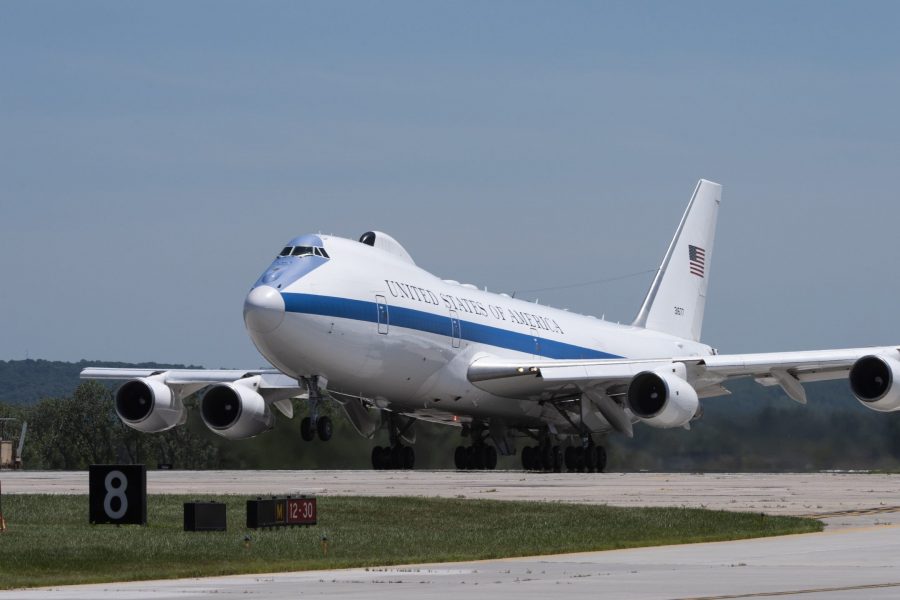
The E-4B is a highly survivable flying C3 center enabling national leaders to direct nuclear and conventional forces, execute emergency war orders, and coordinate civil response actions in support of the National Military Command System (NMCS).
The early E-4A first flew on June 13, 1973, reaching IOC in December 1974. The fleet was fully upgraded to E-4B standards in 1985. It is hardened against the effects of nuclear detonations,
including electromagnetic pulse (EMP). Comms and data processing capabilities include EHF Milstar SATCOM, six-channel International Maritime Satellite, and a tri-band radome that houses the SHF communications antenna.
All aircraft underwent Block 1 upgrades, enhancing electronic and communications infrastructure with commercial off-the-shelf (COTS) systems. Ongoing upgrades include replacing Milstar data links with AEHF-compatible FAB-T and modernized presidential voice-conferencing, replacing the VLF/LF transmitter and legacy SHF with Survivable Super High Frequency (SSHF) for uninterrupted, jam-resistant nuclear C2 fleetwide.
FY25 launched replacement of legacy UHF comms with Mobile User Objective System (MUOS) secure, jam-resistant BLOS. E-4B airframes are viable to approximately 2033, but phaseout of commercial 747-200s hampers continued sustainment.
USAF awarded Sierra Nevada Corp. the $13 billion Survivable Airborne Operations Center (SAOC) contract to replace the fleet on April 26, 2024. The company bought five new-generation 747-8 Intercontinental airframes from Korean Airlines and began reengineering the aircraft in 2024. An E-4C flew its maiden test flight from Dayton, Ohio, on Aug. 7, 2025, and flight and ground tests will continue through 2026 prior to mission equipment installation. The replacement fleet is scheduled for delivery through 2036.
USAF is also considering options to reabsorb the “Looking Glass” nuclear C2 mission primarily performed by the Navy’s E-6A Mercury, which is being replaced by a C-130J variant. Though the E-4B is capable of operating in this role, it is not the type’s dedicated, primary mission.
E-4 National Airborne Operations Center Technical Data
Contractors: Boeing; Raytheon (FAB-T); L3Harris (SSHF); Boeing/Collins Aerospace (Low-Frequency Transmit System); Sierra Nevada Corp. (E-4C SAOC).
First Flight: June 10, 1978 (E-4B); Aug. 7, 2025 (E-4C).
Delivered: December 1974-1985.
IOC: January 1980 (E-4B).
Production: Four.
Inventory: Four.
Operator: AFGSC.
Aircraft Location: Offutt AFB, Neb.; Dayton, Ohio (E-4C).
Active Variant: •E-4B. Modified Boeing 747-200 equipped as a NAOC. •E-4C. Modified Boeing 747-8i SAOC, planned to replace the E-4B.
Dimensions: Span 195.7 ft, length 231.3 ft, height 63.4 ft.; span 224.5 ft, length 250.2 ft, height 63.4 ft (C).
Weight: Max T-O 800,000 lb (B); max T-O 987,000 lb (C).
Power Plant: Four General Electric CF6-50E2 turbofans, each 52,500 lb thrust (B).; four GE Aviation GEnx-2B turbofans, each 66,500 lb thrust (C).
Performance: Speed 602 mph, range 7,130 miles, 12-hr normal endurance, 72-hr with air refueling (B); speed 660 mph, range 8,900 miles, (C) (unmodified 747-8i).
Ceiling: Above 30,000 ft.; 43,100 ft (C) (unmodified 747-8i).
Accommodation: Two pilots, navigator, flight engineer, up to 110 battle staff/mission crew (B); TBD (C).