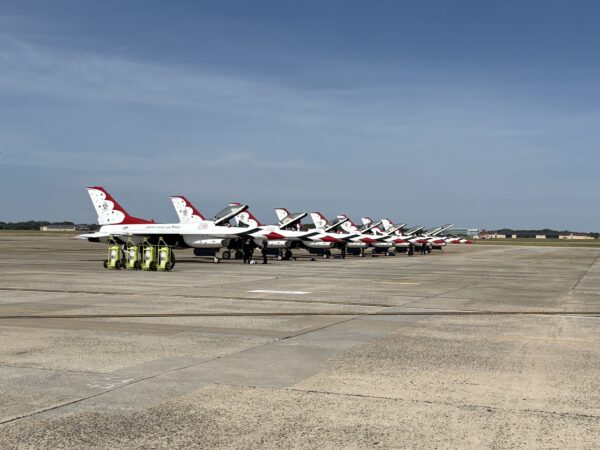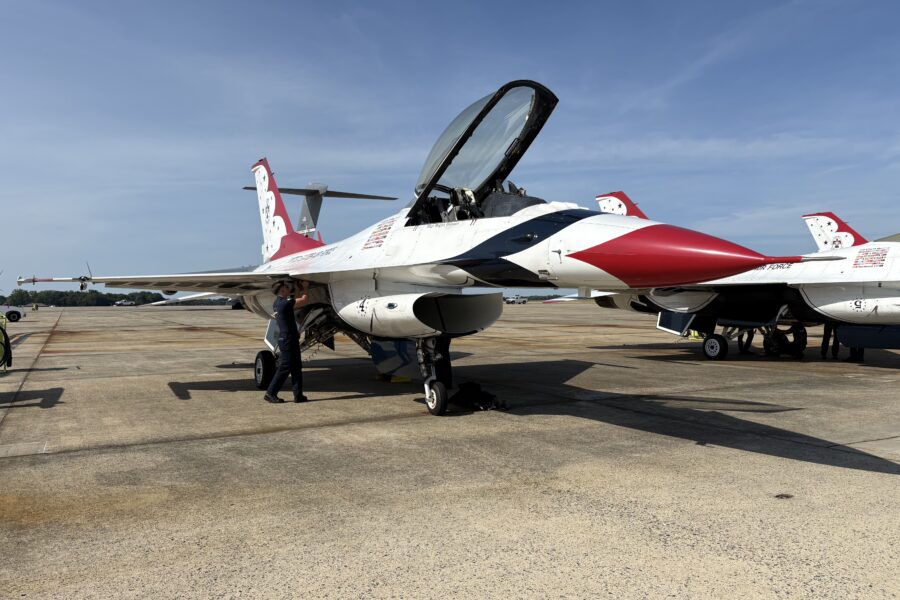
JOINT BASE ANDREWS, Md.—On July 4, thousands of people will brave 100-degree weather in downtown Washington, D.C., for America’s 250th anniversary. And high above them, the pilots of the U.S. Air Force Thunderbirds will be hot too—not that it will stop their red, white, and blue F-16s.
“The jets will perform well in the heat,” Lt. Col. Tyler Clark told Air & Space Forces Magazine. “The crowd will be sweating, and we’ll be sweating, but you know, we can overcome that. A little bit of pain for some long-term gain on what’s going to be a real cool aerial review.”
Eight Thunderbirds touched down here at Andrews on June 30, just a few weeks removed from their last appearance in the National Capitol region.
The Thunderbirds plan to perform elements of their aerial demonstration, rather than just a flyover, an extremely rare display over D.C.’s heavily restricted airspace.
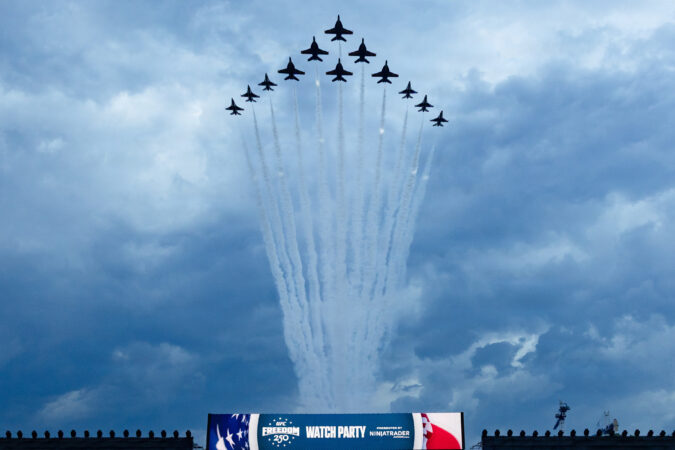
On June 14, the Thunderbirds and U.S. Navy Blue Angels teamed up for a rare 12-plane “Super Delta” flyover of the UFC Freedom 250 event at the White House. That event unofficially kicked off what has been a busy month for military flyovers over D.C. and the rest of the country, as celebrations for the 250th ramp up.
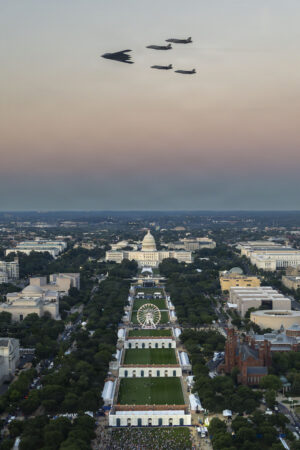
On June 24, F-16s, F-35s, and a B-2 bomber helped kick off the Great American State Fair by flying over the National Mall. On June 25, they were followed by a formation of B-52 bombers and F-15, F-35C, and F/A-18 fighters.
Elsewhere, the Blue Angels performed in Norfolk, Va., and Baltimore as part of the Sail 250 maritime festivals. And between their visits to D.C., the Thunderbirds flew over Las Vegas and the Hoover Dam for America 250 celebrations in Nevada.
Summer is always a busy time of year for the military’s demonstration teams. But there’s an extra level of excitement and demand around the major anniversary.
“I would say one of the biggest differences I’ve noticed, particularly in this season, is all the hype around celebrating the 250th,” Clark said. “And that’s been really, really special, not just for the United States, but also being a member of the Thunderbirds and getting to not only experience that, but also to help showcase the pride, precision, and professionalism by the United States Air Force during this momentous time.”
The Thunderbirds started their season in February at the Daytona 500 and will end in November at the Kennedy Space Center, both in Florida. Since April, the 150-person unit has been at a different show almost every week.
“You can just feel the energy, whether it’s the different show sites or interactions with the crowd or the general public, wherever our team goes, you can feel it. There’s something there that’s just been making this year really special,” Clark said.
July Fourth in D.C. promises to bring even more fervor. The Thunderbirds arrived at Andrews a few days earlier than they typically do for other shows to do more public engagements, Clark said. Practice time might be a little harder to come by, given the airspace restrictions in the region, but the unit has been prepping for this show for months.
Normally, the Thunderbirds are the star of any airshow they go to and have a tightly choreographed 36-minute routine. This time, however, they had to prepare for a shorter performance to share the spotlight with a massive array of U.S. airpower including performances from the Blue Angels and the F-22, F-35B, and MV-22 demo teams, plus flyovers featuring all three of the Air Force’s bombers and all of the U.S. military’s stealth aircraft types.
As plans for the larger program developed, Thunderbird leaders developed different options, Clark said. Eventually, they settled on a performance that’s pretty close to their full routine.
As the data was being provided to the team, it’s ‘OK, now, what are we able to go execute?’ So, what started off as, ‘Hey, we’re just going to do a couple of passes as part of the aerial review’ has now morphed itself into, we’re going to go fly the majority of our show, weather dependent, of course,” he said.
This past week, back home at Nellis Air Force Base, Nev., the team put the finishing touches on their performance, practicing in a range designed to mimic the restrictions of D.C. airspace, Clark said.
What will that performance entail?
“What I can tell you is, let’s all keep our fingers crossed from good weather, so we can send it uphill,” Clark said, before dropping a tease: “We had to take out a couple of maneuvers for fuel conservation based off of a little surprise afterwards, which I will keep close to the vest.”