
USAF Offers Another New Fighter Plan
A new Air Force report details revised plans for growing the F-35A fleet, both in total and as a share of the fighter force. And landmark new 10-year framework agreement between the Pentagon and prime contractor Lockheed Martin offers a foundation for fulfilling the plan.
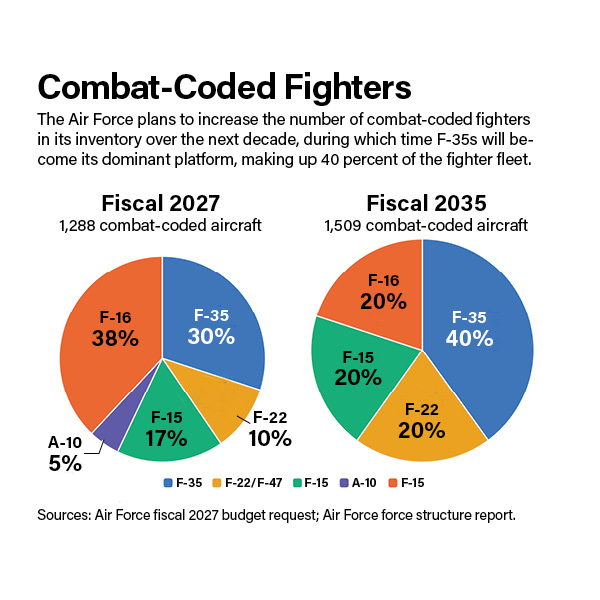
The new fighter force structure report, submitted to Congress on Oct. 16, estimates the Air Force will grow from 1,288 combat-coded fighters in 2027 to 1,509 by 2035 based on a “moderate risk” assessment. The F-35 would grow from 30 percent of combat-coded fighters to 40 percent during that time.
The new 2035 number shows an increase over last year’s report, which projected a need for 1,369 combat-coded fighters by 2030. In an Oct. 20 briefing with reporters, Lt. Gen. David Tabor, deputy chief of staff for plans and programs, said the data used for the previous report was “pretty old” and the revision includes newer information—but is not driven by lessons from the Iran war.
Combat-coded aircraft include those in the primary mission aircraft inventory, backup inventory, and attrition reserve; it does not include test and training aircraft. The total inventory of fighters is just above 1,900 in fiscal 2027 and projected to grow a net 120 aircraft by 2031—the F-35 fleet is projected to grow from 618 to 765 airframes, about 30 aircraft per year.
The report did not include the projected total aircraft inventory for 2035.
The Air Force’s analysis was based on reported requirements from geographic combatant commanders at a “moderate risk” level. A “low-risk” inventory would be 15 percent greater, the report shows.
Getting to the new 2035 goal depends on two key factors falling into place, Tabor said: Funding from congress and production from industry.
Top Air Force officials have for years said the service needs to buy 72 new fighters each year simply to replace jets aging out of service. The fiscal 2027 budget request did not reach that level, however, despite reaching a record scale. The Air Force proposed 38 new F-35s and 24 F-15EXs, for a total of 62.
Tabor said those purchases can “ramp over time” to hit the numbers the Air Force needs.
“The question is, can industry produce at those levels?” Tabor said Oct. 20. “They’ve assured us that they can, and we believe them, but we also actually need to see it manifest.”
On Oct. 22, the Pentagon and Lockheed Martin announced a framework agreement under which Lockheed would build 156 F-35 jets per year for both U.S. and international customers. The U.S. military would buy at least 850 of those 1,560 aircraft in the 10 years covered by the agreement, plus spare parts and modification kits.
Lockheed Martin has also agreed to invest at least $7 billion of its own money to support the F-35 program. But the deal, touted by both parties as a first of its kind, depends on Congress granting the Pentagon authority to negotiate a multiyear agreement.
Those authorities are written into drafts of the House and Senate versions of the 2027 National Defense Authorization bill, but the measures are currently stalled. Without those authorities, pricing and schedules cannot be set for the two programs lawmakers have in mind: F-35 and F-15EX.
Also unclear: the breakdown of F-35 variants under the agreement. The Air Force flies the F-35A, the Navy flies the C, and the Marine Corps as Bs. Production of the B-variant may be nearing an end.
Lockheed said if Congress does grant multiyear procurement authority and the necessary appropriations in the next few months, it would work with the F-35 Joint Program Office to finalize contract terms, pricing, and schedules through a formal award.
The potential benefits of these kinds of framework are financial stability, enabling Lockheed, Boeing and their suppliers to expand and stabilize production. Resulting efficiencies will save the government billions of dollars, thanks to “long-term pricing and industry volume discounts.”
Lockheed also predicted improved parts availability as a result, with the payoff being higher mission-capable rates. Annual deals, by contrast, strain the industrial base.
In an Oct. 22 earnings call, Lockheed CEO Jim Taiclet said at least 60 percent of an F-35’s content comes from suppliers, including major components from Northrop Grumman and BAE Systems, which make the center and aft sections of the jets’ bodies, respectively.
“We want them to have production stability, just as we would like to have it,” Taiclet said.