
DRONE-KILLER ROCKETS
W
hen the Air Force needed a new solution to shoot down the one-way attack drones that have dominated the new era of drone warfare, it turned to a decades-old weapon: small air-to-air rockets.
How the Air Force quickly found the solution is a story of learning on the fly and rediscovering ideas discarded in previous years.
The Advanced Precision Kill Weapons System (APKWS), as the system is known, relies on rockets that have been used for years, paired with a guidance system. APKWS was originally designed as an air-to-ground capability: A mid-mounted laser-guided kit was added to Hydra 70 rockets to turn the system into a precision-guided munition to strike targets on land.
The weapon provided the military with a relatively cheap and accurate munition during America’s wars in the Middle East, particularly in Afghanistan. First deployed in 2012, it was used over the years on Army and Marine Corps helicopter gunships, A-10 Thunderbolt II attack planes, and F-16 Falcons. In a short-lived experiment, a couple of OV-10 Broncos were deployed with APKWS to combat ISIS forces in Iraq and Syria.
A little over a decade later, the need would increase to defend against Iranian-built drones. In less than three years, it has become the primary way for U.S. and allied fighters to thwart one-way attack drones in a new age of semi-autonomous warfare.
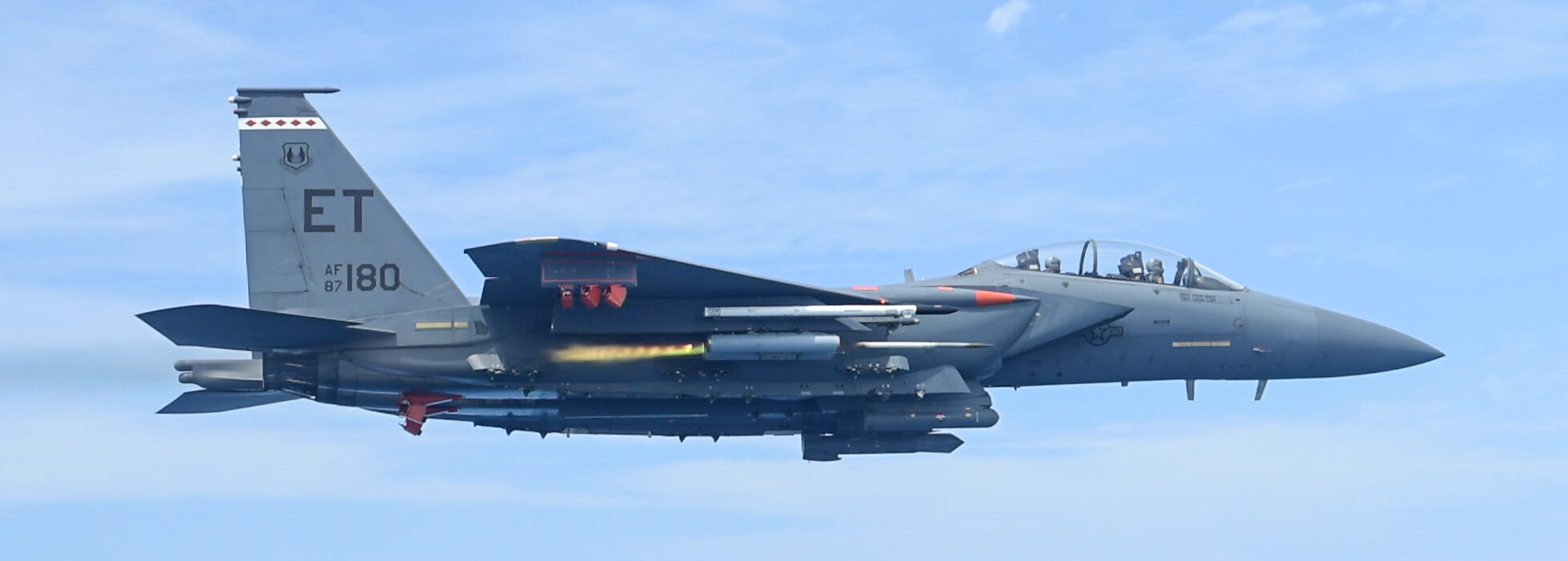
Dubbed the AGR-20F FALCO (Fixed-Wing, Air-Launched, Counter-Unmanned Aircraft Systems Ordnance), the air-to-air APKWS variant was first used in 2024 on F-16s. It is now the go-to drone killer for U.S. pilots in the Middle East. Countries around the world are lining up to buy them.
Air-to-air rockets date back to World War II, when German forces used unguided systems to try to knock out swarms of bombers. U.S. attempts to use the technology proved ineffective. During the Cold War, the Pentagon developed an air-to-air rocket for air defense that was never used: the AIM-2 Genie, which was armed with a 1.5-megaton nuclear warhead.
In 2019, the Air Force explored using the rockets in an air-to-air role in tests with the F-16 Fighting Falcon. For a few years, the experiment was considered only a proof of concept and not a real-world capability.
Without air-to-air rockets in its inventory, the Air Force relied instead on expensive, radar-guided AIM-120 AMRAAM missiles and infrared-guided AIM-9 Sidewinders. Iranian-origin drones were targeted by U.S. fighters using expensive air-to-air missiles when the Biden administration came to the defense of Israel. Those weapons were also a means of defense after the Houthis in Yemen began launching drones at commercial shipping and the U.S. and allied ships that came in to protect them.
The need for a new approach was made clear in April 2024 when U.S. and Western fighters patrolled the skies over Iraq, hunting for drones, tipped off that a massive Iranian ballistic missile and drone attack was headed for Israel. Iran sought to flood the zone and launched a barrage of drones, ballistic missiles, and cruise missiles to confuse and overwhelm Israel’s air defenses—nearly 300 projectiles in all.
The fighters included F-15Es from the 335th Fighter Squadron and 494th Fighter Squadron, which carried up to eight air-to-air missiles, and F-16s from the 121st Fighter Squadron, along with French and British jets. Fighters from Jordan, which sits between Iran and Israel, also sought to defend their territory.
Jets from the 335th Fighter Squadron had been rushed to the Middle East, arriving from North Carolina less than a day before. “After we got jets in-country, intel came down saying, ‘Hey, ‘There’s a potential for something coming up in the next 24 hours. You guys need to be ready to hunt,” then-Master Sgt. Christopher Oles, the production superintendent for the 335th Fighter Generation Squadron, told Air & Space Forces Magazine. “We’re loading eight missiles on one jet, like, ‘What are we going to do with all these?’”
Use them, it turned out.
Though the U.S. downed 80 drones, many fighters quickly exhausted their air-to-air missiles. Three F-15E crews even attempted—unsuccessfully—to drop laser-guided JDAM bombs on drones. That mission exposed a cost and capacity problem.
AMRAAMs cost roughly $1 million each, and AIM-9s cost hundreds of thousands of dollars depending on the variant. The most capable model is the AIM-9X, which costs around $500,000. Cost was not the only reason the weapons are no longer the optimal capability for the counter-drone mission. Another motive was to preserve the sizable inventories of AIM-9s, officials say.
Air Forces Central, led at the time by then-Lt. Gen. Alexus G. Grynkewich, and U.S. Central Command, pushed for a cost-effective alternative with support from the Air Force.
The service turned to a 70 mm Hydra rocket. And the APKWS kit turned it into a precision munition. To develop the new capability, the Air Force and BAE updated the software, but little else. Paired with a proximity fuse, it became a drone and cruise missile hunting munition.
“The great thing about it is that there wasn’t a formal requirement set out for this. This was sort of organic. People started figuring it out without it being a big program of record,” former Air Force Chief of Staff Gen. David Allvin said in an interview with Air & Space Forces Magazine. “We were on the wrong side of the cost curve in our munitions employment. We didn’t know this particular threat would manifest. They proceeded to test an idea, not really knowing exactly what the threat was going to be in the future, but could see that there were some potential applications. Good thing they did.”
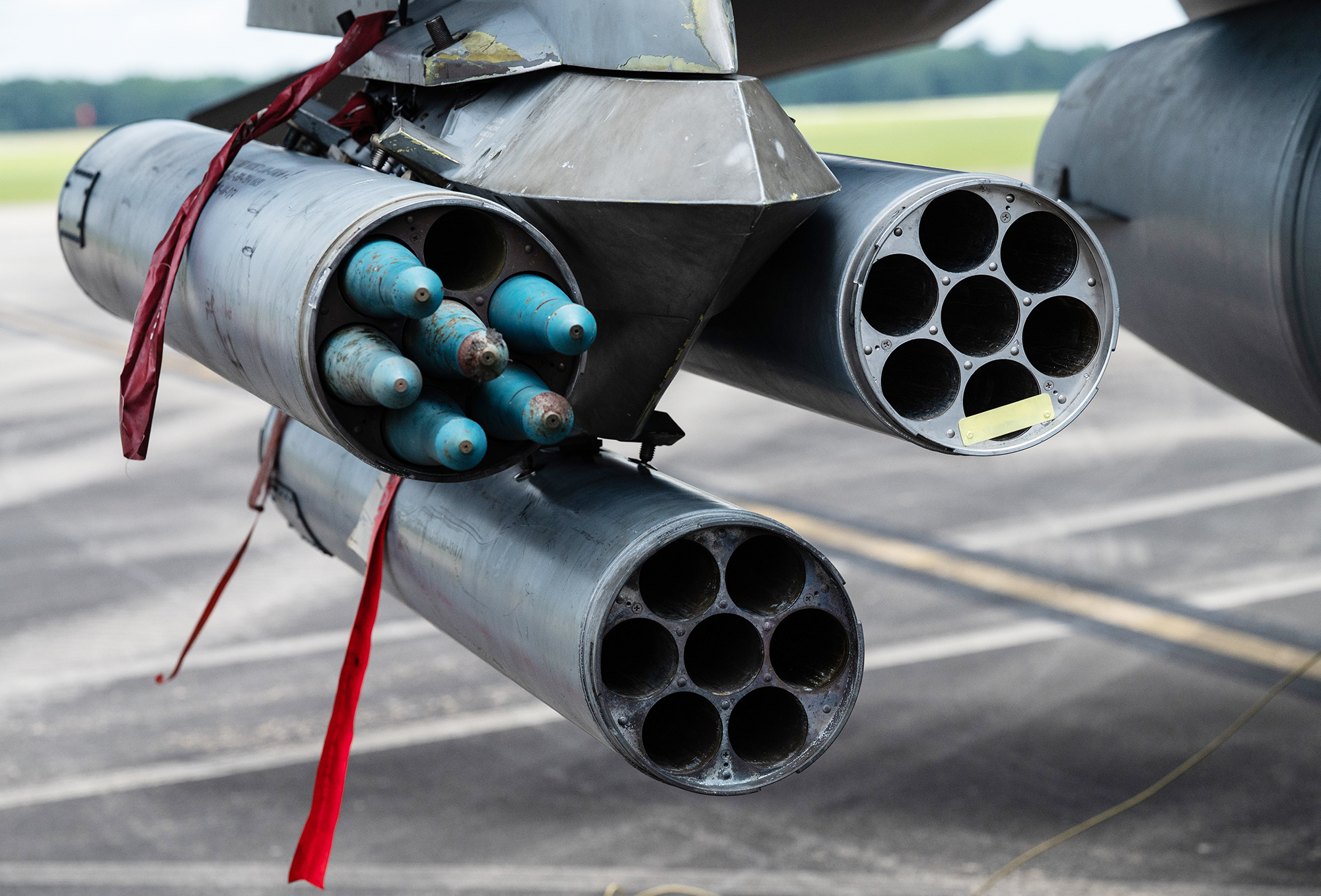
More than 8 million Hydra rockets have been produced and are currently made by General Dynamics, which makes the rocket and warheads for American use; the APKWS guidance kit itself can be fitted to similar rockets, making the system plentiful.
“From a technical aspect, it’s ‘Hey, I need more weapons on my jet,’ and that’s what the APKWS gives you: a pod of seven of those things versus a single AIM-9. You can shoot down a lot more drones when they’re coming in swarms,” retired Lt. Gen. Derek France, the commander of Air Forces Central from April 2024 to August 2026—when the weapon came into use—told Air & Space Forces Magazine.
“From an operational perspective, there’s not just the magazine depth of an individual airplane, which I care about, but I care about the magazine depth of the theater and making sure that, across the theater, I’ve got wings with the right weapons in the right place and get them in the air where they can defend their bases,” France added.
Even with the new capabilities, Iranian and Houthi drones were a hard target even for the most advanced missiles. They fly low and slow, have a small radar cross-section and a low infrared signature, making them harder to spot with optical sensors.
“We studied that very heavily before we came into theater as a great event, to understand how this could challenge us, and how we fly our formations and how we search for these,” Lt. Col. William “Skate” Parks, who was commander of the 480th Expeditionary Fighter Squadron in CENTCOM from October 2025 to July 2026, said in a December 2025 interview, on the events of April 2024. Parks was one of the first pilots to use the system in combat.
The rush to field the munition on Air Force fighters was a collaborative—and speedy—effort across the Air Force. Work began at Eglin Air Force Base, Fla., to equip the system on F-16s in the spring of 2024.
“Rockets have been around for a very long time, and it’s an iterative approach to developing and furthering what you already have in making it better for the use cases that you see at hand,” said the head of the Air Force Test Center, Brig. Gen. Mark A. Massaro.
In 2025, testing began using F-15E Strike Eagles overseas nine days after flight testing began in May of that year, said Massaro, who commanded the 96th Wing. “The F-15E had never had—any F-15 had never had—any kind of rockets on it before this time,” Massaro said. “So there was a lot of work that had been done to understand some of the integration capability differences and how to make that happen.”
But the team had a bureaucratic hurdle. Munitions are normally fitted onto an aircraft after going through a biannual process by the Non-Nuclear Munition Safety Board. “That is a safety process where, when you integrate weapons onto aircraft, you have to go through this,” Massaro said. “This was not on that normal timeline.” Then-Brig. Gen. Sean Choquette, the Air Force Director of Safety at the time, issued a risk analysis letter, and work on the F-15E moved forward.
The system got its first real-world test in the fall of 2024 when an Air Force F-16 from the 510th Expeditionary Fighter Squadron from Aviano Air Base, Italy, deployed to the Middle East. It scored the first combat air-to-air kill of a drone with an APKWS rocket system, current and former officials told Air & Space Forces Magazine. More kills soon followed.
In October of that year, the 480th Expeditionary Fighter Squadron from Spangdahlem Air Base, Germany, took the next step. The 480th scored dozens of kills using the rockets. It also used older AIM-9M Sidewinders, claiming the first air-to-air kill by an AIM-9M in over 30 years. In all, the squadron notched 108 total aerial kills of drones and cruise missiles during the deployment. News of the success quickly trickled across the Air Force.
“That’s a fantastic tagline,” Parks said, referring to the aerial kills. “We’re doing that in an innovative way.” Parks was later awarded a Bronze Star—along with a Silver Star for a mission over Yemen—in part for helping develop tactics to use APKWS against drones and cruise missiles and employing the AIM-9M missiles, which are much cheaper than newer models.
Parks had his squadron go to school—in combat.
“This was all new and innovative,” Parks said. “It’s very, very hard to build a training plan for your squadron when you’re not exactly sure how you’re going to do it. And so what we focused on was the basics for the squadron and just creating people and pilots who could dynamically think and every night sit down and reiterate, are we doing this right? Are we doing it wrong?”
“That’s what I’m most proud of: We have these rockets come online. It’s a brand-new thing, and we’re the ones doing it,” Parks added. “And it’s with guys who are now spending every minute of their day, when they’re not flying actual combat missions, preparing and improving on this. It showed because that success rate just started, started really becoming amazing with these rockets as we’re defending partners and our own forces.”
To guide an APKWS rocket, the target must be laser-designated or “lased,” unlike more expensive “fire-and-forget” missiles. Tactics quickly improved after the first kill, which used “buddy” lasing from another aircraft, and the F-16s were eventually able to self-lase targets, though the buddy lasing method is still used, according to current and former U.S. officials. A-10s, which, like F-16s, originally used the rocket as an air-to-ground weapon, have also been fitted with APKWS for air-to-air use, along with F-15Es.
APKWS uses a unique guidance kit. BAE’s Distributed Aperture Semi-Active Laser Seeker (DASALS) optics are located on all wings of the rocket, which deploy once it is fired, rather than a nose-mounted seeker that traditional laser-guided weapons use. The aircraft’s targeting pod—the Air Force calls it either the SNIPER or LITENING pod—points the laser at an aerial target to strike the target.
BAE has said it is working on an upgrade to the laser-guidance system—an additional seeker in the nose of the munition—that could make the weapon easier to guide onto its targets.
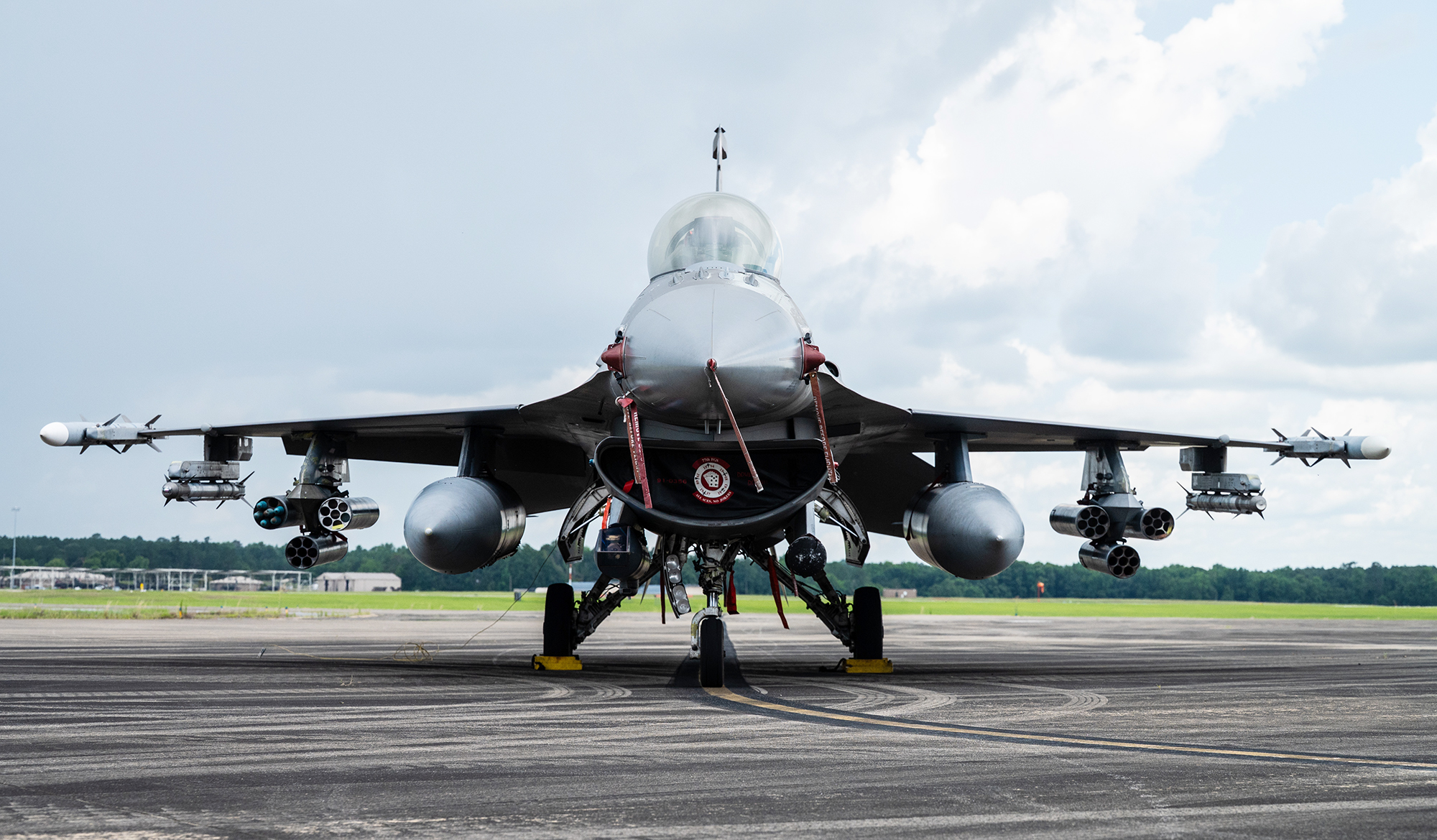
F-16s have mostly been observed fitted with one or two rocket pods, each of which can carry seven rockets. The F-16s can simultaneously carry multiple air-to-air missiles. Two-seat F-15Es have the most capacity and can carry up to six pods or 42 APKWS rockets.
“The first time I ever shot an APKWS was in combat at an enemy drone,” said Parks. “And,” he added for emphasis, “that is true.”
With some warning they would use the system, the squadron spent the weeks leading up to deployment training, rushing to learn how to use it, but by studying the academics and working in simulators, not firing rockets over the German countryside.
Building on its success, U.S. Air Forces in Europe incorporated the APKWS into its air-to-air training for F-16s in April 2025 out of a range in the U.K. U.S. fighters based on the continent not only routinely deploy to the Middle East, but also increasingly must be wary of Russian drone incursions into NATO airspace. The squadron that first trained to use APKWS ahead of combat that spring was the 555th Fighter Squadron, also based at Aviano.
“Employing these is challenging to do,” Lt. Col. Eric “Diesel” Kitaif, then-commander of the 555th, told Air & Space Forces Magazine last year. “I need to put it in the right regime, and I need to make sure that there is laser energy on the target. And so getting both of those things to happen can be challenging to be the person both employing the munition and the person lasing that munition.”
The U.S. found the munition critical enough that it diverted 30,000 proximity fuses intended for Ukraine for surface-to-air use to the Middle East for use on its fighters. Countries across the Middle East are ordering APKWS in the billions of dollars. Eurofighter Typhoons can carry the weapon, too, for anti-drone use, which the U.K. has done as the weapon is trickling its way across the globe. The Army, too, has fielded air-to-air APKWS on some of its Apache helicopters.
APKWS can also be used in a ground-to-air role, fitted to systems such as the Sierra Nevada Corp.’s BRAWLR, deployed overseas by the U.S. military, and L3Harris’ VAMPIRE, which is used by Ukraine, with plans to field the system for U.S. use.
Now, just three years after it entered service, the Department of Defense and BAE agreed to a seven-year framework agreement to produce 25,000 APKWS guidance kits a year, and 35,000 a year total to support international customers.
But APKWS has not proved optimal for some situations. It is still considered the preferred anti-drone weapon, but APKWS employment typically takes more time and space to set up the shot than using AIM-9s, especially when relying on buddy lasing. Aircrews found the airspace and timing were often too tight for APKWS employment in the Strait of Hormuz and Persian Gulf, so they have ended up relying on AIM-9s. But defensive counterair for base defense has featured APKWS.
The work to put APKWS on the F-16 and F-15E, as well as A-10s, has paid off in more than just cost savings for the Air Force. After the start of Operation Epic Fury on Feb. 28, Iran has fired more than 6,000 drones and 1,500 ballistic missiles, with numbers growing, U.S. officials said. What two years ago was an extreme outlier is now a routine threat.
“I would say that APKWS is a step in the right direction, but it can’t be the final step,” France said. “The two things that we need to focus on are air domain awareness at range: where are the drones coming from? How many are there? What’s their target? What do I know about them? And then magazine depth, both individual airplanes and theater-wise, to have enough to shoot them down in a layered defense kind of way. So both of those are important.”
“This drone problem is not going away,” France added. It’s accelerating in tactics, speed, advancements, and the numbers. That’s the direction that we’re going.”