


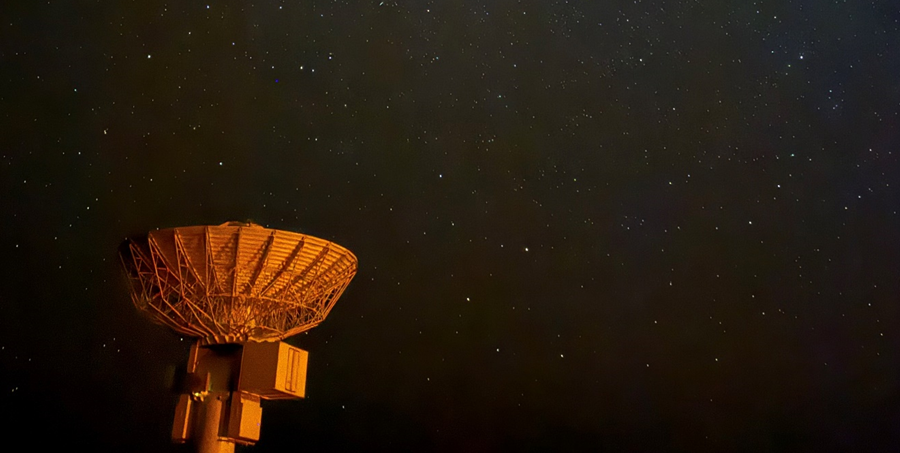
The Space Force has selected a site in north Texas as the preferred location for the final site of its new Deep Space Advanced Radar Capability, the service announced Sept. 9.
Pending final approvals, construction on the new radar and accompanying facilities will start at Lake Kickapoo, Texas, in 2027, according to a Space Force release.
The U.S., United Kingdom, and Australia are working together on the DARC program to boost their ability to monitor geosynchronous orbit, which extends out to 22,000 miles above Earth. Consisting of three radar sites, DARC will give the allies a 24/7, all-weather view of the entire GEO belt—greater coverage than is now possible with any other ground-based system.
“Selecting Texas as the preferred location for the final DARC site keeps us on track to deliver a truly global deep-space sensing network with our closest allies,” new Chief of Space Operations Gen. Douglas A. Schiess said in a statement. “This capability will improve visibility in our contested domain and reinforce our shared capacity to protect the space systems on which our nations rely.”
Under a trilateral agreement, the U.S. Space Force is leading development, but the agreement allows the U.K. and Australia to operate and host sites and participate in joint operations and exercises. Northrop Grumman is building the radars.
The first DARC site selected is in western Australia. Construction began in 2023 and wrapped up by late 2024, and the site was cleared for early operational use in 2025, even as testing continues. The second DARC site in Wales was selected in 2024, and construction is expected to start in April 2026, pending final approvals.
The Space Force hopes to move fast in Texas. The planned timeline is to award a contract and start construction next year, finish building by 2029, and wrap up test and evaluation before accepting the radar for operations in 2030. Those goals were moved up recently—the Government Accountability Office previously reported a 2032 timeline for having all three sites operational.
At one point, it wasn’t entirely clear a third DARC site would even happen. The Space Force indicated in 2025 that it was considering changing course on the DARC acquisition strategy, including potentially cancelling the third location. But the service’s fiscal 2027 budget request funded the full program. That includes $442 million in fiscal ’27 and another $1.6 billion through fiscal ’31.
Lake Kickapoo, about 120 miles northwest of Fort Worth, previously hosted the main transmitter site for the old AN/FPS-133 Space Fence system. That system was initially developed by the Navy, eventually transferred to the Air Force, and was decommissioned in 2013, with a new AN/FSY-3 Space Fence coming online in 2020. The Federation of American Scientists described the Lake Kickapoo site as “the largest continuous wave transmitter in the world” when it was built.
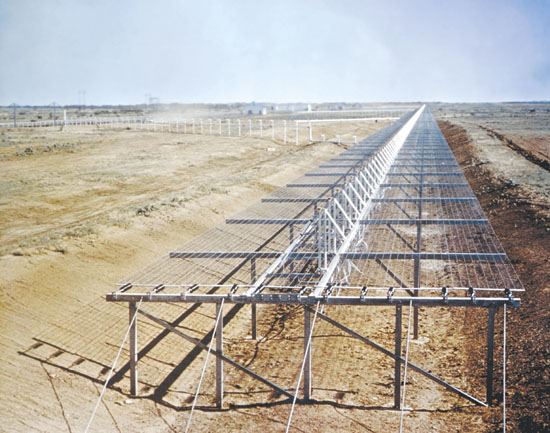
photo courtesy of ONR