


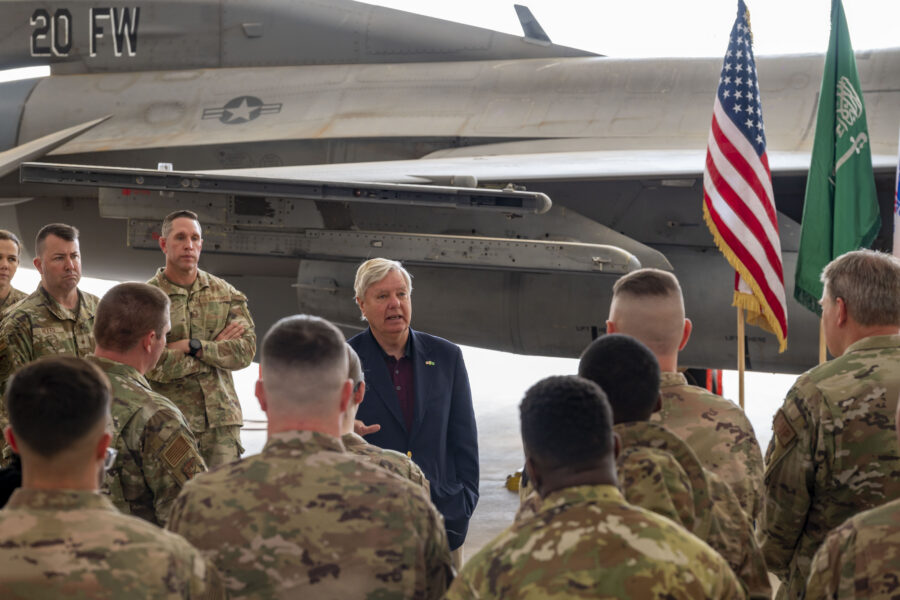
Sen. Lindsey Graham (R-S.C.), one of the most influential Airmen ever to serve in Congress, died July 12 after a sudden cardiac event. He was 71.
Starting in 1984, Graham served a total 33 years as a judge advocate general in the Air Force, South Carolina Air National Guard, and Air Force Reserve. He retired in 2015 as a colonel.
Graham was elected to the House of Representatives in 1994, where he served four terms before winning his Senate seat. He was approaching the end of his fourth six-year term when he died.
Graham held key leadership roles on the Senate Budget Committee, the Senate Armed Services Committee, the Senate Appropriations Committee, and the Senate Judiciary Committee. For much of the past two decades, he was among the most prominent national security voices in the Republican Party.
The senator briefly sought the presidency in 2016, but dropped out of the race before the primaries began. Starting out as a critic of President Donald Trump, he evolved to become one of his most prominent and trusted advisors on national security matters, including support for Ukraine, combatting terrorism, and opposing Iran’s nuclear ambitions.
Graham was among the most the most prominent Air Force veteran lawmakers since Sen. Barry Goldwater, who was a major general in the Arizona Air National Guard, chaired the Senate Armed Services Committee, and ran unsuccessfully for President in 1964.
Joining the JAG Corps
The son of small-town pool hall owners in South Carolina, Graham was the first member of his family to go to college, attending the University of South Carolina and joining the Air Force Reserve Officers Training Corps. His parents died while he was there, 15 months apart, leaving him and his sister Darline as orphans. Once in the Air Force, Graham adopted his sister, enabling her to receive Air Force benefits, according to a 2015 NPR report.
After graduating from South Carolina with a bachelor’s in psychology, Graham stayed at the university to study law. He graduated in 1982 and commissioned into the Air Force as a JAG, serving more than six years on Active Duty.

Graham gained national prominence during that time when he appeared on CBS News’ “60 Minutes,” defending service members charged with drug crimes. Graham’s work on the case helped expose problems with the service’s drug testing program, ultimately giving thousands of Airmen a chance to clear their records.
Graham spent four years at Rhein-Main Air Base in Germany, where he was the Air Force’s lead prosecutor for felony cases throughout Europe, retired Lt. Gen. Jack Rives wrote for Lawfire. In 1989, he transferred to the South Carolina Air National Guard, where he was Staff Judge Advocate at McEntire Air National Guard Base, S.C., during the first Gulf War.
In 1995, after being elected to the House, Graham transferred to the Air Force Reserve, and remained a reservist for the next two decades. During the Global War on Terror, he frequently joined congressional delegations visiting the Middle East, sometimes remaining behind for brief Active-duty stints, Rives recalled. His Air Force personnel record listed 19 deployments for a total of 142 days during his congressional career, according to the Washington Post.

“Col. Graham served with distinction on several weeklong deployments under my command in Afghanistan, and he was a true leader in every sense of the word,” retired Marine Corps Gen. John R. Allen said in 2015. “Col. Graham made particular contributions to issues of rule of law and detainee operations in Afghanistan.” During that tour, Graham became the first sitting member of Congress in decades to do military duty in a war zone, according to McClatchy Newspapers.
Rives also recalled that in 2008, Army Gen. David Petraeus “reluctantly” agreed to have Graham deploy to his headquarters staff in Iraq. “He later admitted he expected little to come of the arrangement,” Rives wrote for Lawfire. “Instead, Col. Graham worked 18-hour days throughout the deployment. Petraeus remarked that Graham accomplished more in those two weeks than many officers accomplished in two months.”
A Congressional Giant
On Capitol Hill, Graham forged a reputation as one of the foremost “hawks” of his era, advocating for a muscular foreign policy. A stalwart critic of the Iranian regime, Graham pressed for limits on Iran’s nuclear program and supported Operation Epic Fury, President Trump’s extensive air campaign launched against Iran this year.
In 2015, Graham proposed a new Authorization for Use of Military Force against the Islamic State group, seeking to expand the use of ground troops and eliminate any expiration date. He previously supported AUMFs in 2001 and 2002 and in 2011 urged President Barack Obama to remove Libyan dictator Moammar Gadhafi from power.
Graham’s staunch support for Israel drew an outpouring of commentary from Israeli politicians following his death. He was also an ardent supporter of Ukraine in its war against Russia. He advocated giving weapons to Ukraine starting in 2015, and strongly supported expanded aid after Russia’s 2022 invasion. Just days before his death, Graham had visited Ukraine, meeting with President Volodymyr Zelenskyy and touring a drone factory.
Graham’s 2016 presidential campaign gained little traction in a crowded field. But after dropping out, he became a close ally of Trump, the eventual winner, and was sometimes called the “Trump whisperer” in the Senate. Last year, he played a leading role as chairman of the Senate Budget Committee, crafting the reconciliation package known as the “One Big Beautiful Bill Act,” which included $150 billion for defense. He was leading the charge for a second reconciliation package, including $350 billion in defense spending, at the time of his death.
Tributes
In a social media post, Trump called Graham “one of the greatest people and Senators I have ever known” and “a true American Patriot.”
Members of Congress offered their own tributes. Sen. Roger Wicker (R-Miss.), chairman of the Senate Armed Services Committee and also a former Air Force JAG, said in a statement that he and Graham had been friends for more than 30 years.
“There are no words to describe his impact on the foreign and domestic policy of the United States,” Wicker said. “Lindsey served his beloved country in uniform and in the House and Senate. He stood solidly for freedom and strength and he fought for liberty across the globe. Lindsey Graham can be succeeded in office but he cannot be replaced.”
Rep. Don Bacon (R-Neb.), a retired Air Force brigadier general, posted on social media that he recalled “periodically seeing Air Force Colonel Lindsey Graham in 2007-2008 when I was in Iraq. … He lived a life of service to our country.”
Sen. Jack Reed (D-R.I.), the top Democrat on the Senate Armed Services Committee, said: “Theodore Roosevelt’s famous ‘Man in the Arena’ concept certainly applies to Senator Graham, who relished the dust, sweat, and challenges of public life. Lindsey could be polarizing, but he was willing to work across the aisle, sometimes at political risk, to advance policies he believed in, like the defense of Ukraine, or supporting highly qualified judicial nominees from the other party.”
Rep. August Pfluger (R-Texas), a former Air Force F-22 pilot and chair of the Republican Study Committee, wrote on social media that Graham “was an advocate for peace through strength and always fought for our military personnel and military families.”
At the Air & Space Forces Association, retired Lt. Gen. Burt Field, president and CEO, paid tribute to Graham’s life of service. “AFA mourns the death of Sen. Lindsey Graham, who served his nation as an Airman, a member of the House of Representatives, and as a U.S. Senator. His unflinching focus and commitment to national security matters were the hallmark of a distinguished career.”