
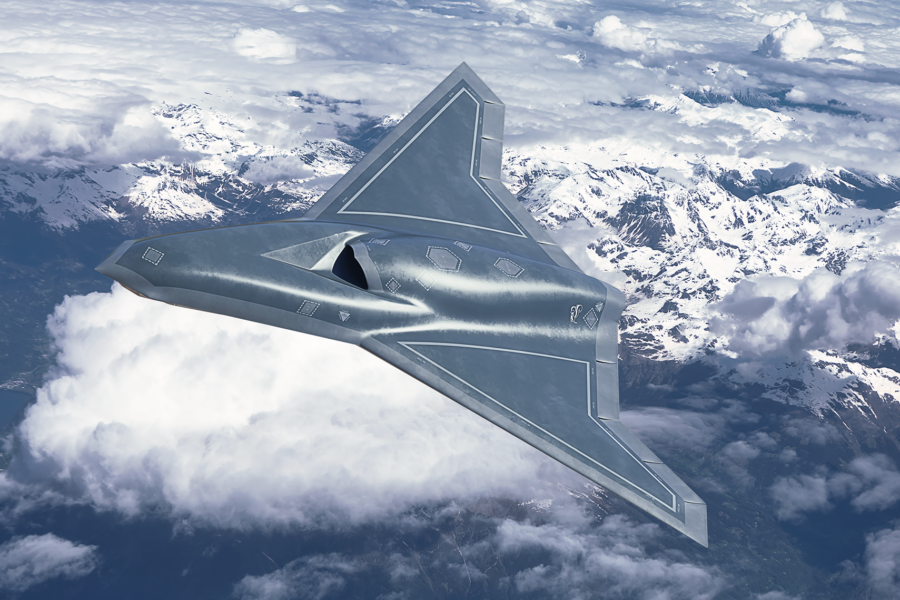
Lockheed Martin’s proposed autonomous drone, called Vectis, is still on track to fly a prototype by the end of 2027, an official from the company’s Skunk Works division said Sept. 10, and the firm already started work on four more Vectis aircraft.
“The team is extremely excited as these parts start to come together [for Vectis], to actually get the wheels off the ramp by the end of 2027,” Ron Fehlen, vice president and general manager of Skunk Works, said in a conference call with reporters.
Lockheed first unveiled Vectis last September, ahead of AFA’s Air, Space & Cyber Conference, and officials said at the time they hoped to fly within two years.
This year, Fehlen told reporters Lockheed chose to begin work on the additional four Vectis aircraft “to lean into it,” and to have more aircraft to expand testing and further advance production efforts.
Vectis is a Group 5 drone, meaning it weighs more than 1,320 pounds and usually flies above 18,000 feet, the same category as the MQ-9A Reaper and the Air Force’s Collaborative Combat Aircraft, the FQ-42 and FQ-44. It will be roughly 34 feet long with a wingspan of 38 feet, Fehlen said, and images released by Lockheed show it has a lambda wing design, with no tail.
Vectis will have autonomous capabilities, using Lockheed’s MDCX autonomy command and control platform that has also controlled the Navy’s MQ-25 Stingray drone, and will be able to carry out multiple missions. Fehlen did not directly address questions about Vectis’ stealth capabilities, aside from saying it will be survivable. Fehlen also did not detail the drone’s loadout or weapons capabilities, but a video released by Lockheed showed Vectis would carry weapons in an internal bay.
As a potential CCA for the Air Force or another customer, Vectis could be controlled both from a ground station as well as teamed up with crewed fighters as a drone wingman, Fehlen said. The pilots flying alongside Vectis would direct it using a touchscreen interface like a tablet.
The Air Force is developing a fleet of at least 1,000 semi-autonomous CCA drones to expand its combat “mass” at a lower cost than fielding more manned fighters. The first iteration of CCAs, made by General Atomics Aeronautical Systems and Anduril Industries, will specialize in air-to-air capabilities, but more “increments” will follow. Air Force officials said Sept. 3 the service has a cost target of $20 million for CCA’s air vehicles, not counting additional systems such as sensors.
Fehlen said Lockheed envisions Vectis as appealing to multiple customers, including the U.S. Air Force and Navy and international customers. Lockheed declined to comment on the potential price tag for Vectis, aside from saying it will be offered at a competitive price point for CCAs.
Fehlen said Skunk Works is leveraging multiple advancements and technologies it developed for other programs—including work on complex air vehicles, advanced design and manufacturing processes, autonomy, and artificial intelligence—into Vectis.
Vectis was designed using fully digital processes, Fehlen said, which is “creating that unbroken digital thread, from the design all the way through sustainment.”
Development work on those additional four Vectis CCAs is now under way, Fehlen said, and is moving faster in part due to the digital design process.
“It is a survivable, autonomous multimission platform, which we believe is the solution needed within today’s operational environment and into the future,” Fehlen said. “So we’re making that strategic investment to accelerate the production progress and the maturity of Vectis. It’s an imperative that we do this to deliver the capability our nation and our allies desperately need.”
The Air Force and Lockheed’s experiments earlier this year with AI-controlled intercepts using the X-62 VISTA plane—a heavily modified test F-16D loaded with autonomous capabilities—have also helped shape Skunk Works’ approach to Vectis, Fehlen said. In those tests, the VISTA conducted 27 AI-controlled intercepts of a live T-38 Talon jet during eight sorties.
Fehlen highlighted the submerged inlet on Vectis’ dorsal side as a key design attribute, one which he said would reduce drag on the aircraft and help increase its flight range. And in situations where Vectis might have to take off from rough runways, like under the Air Force’s Agile Combat Employment concept, having the vent on top of the drone could help reduce chances of debris getting sucked into the inlet.
Vectis’ tail-less design will also help reduce drag and maximize range, Fehlen said.
Lockheed is also concentrating on keeping the building process for Vectis simple, to lower costs and speed up production. Part of that is by reducing the number of parts required to build it. The firm will build these CCAs using a process called minimal tooling determinate assembly, which Fehlen compared to the way ready-to-assemble furniture is sold with holes already drilled and aligned for consumers to put together easily. Using minimal tooling determinate assembly would dramatically reduce the amount of labor needed to build Vectis, Fehlen said, as well as cutting down on the number of times workers have to go back and redo steps in the process by getting it right the first time.