
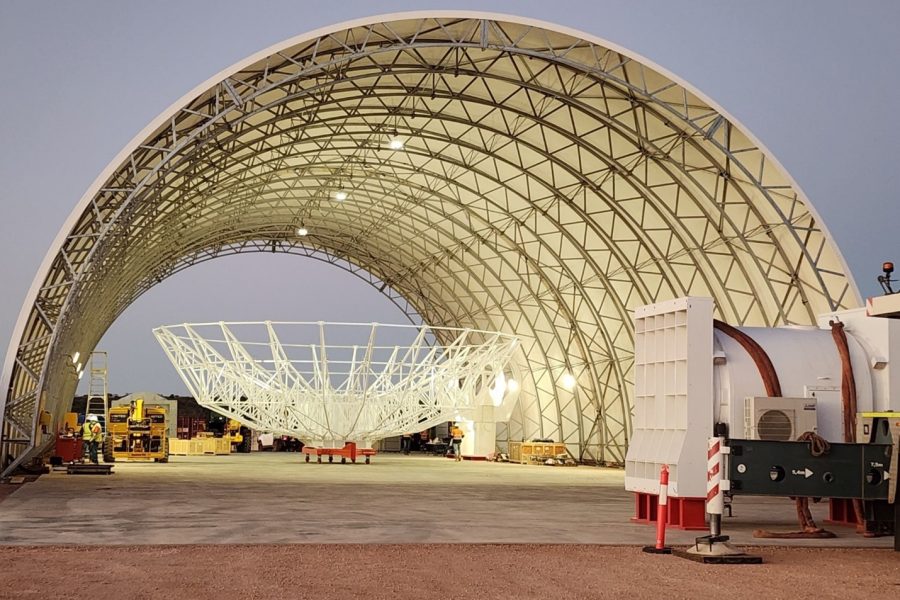
Editor’s Note: This story has been updated to include additional information from the Deep-Space Advanced Radar Capability program office.
The Space Force is on track to start construction at its third deep-space radar site later this year, despite early program delays and cost growth.
A Government Accountability Office report released July 2 detailed the state of the Deep-Space Advanced Radar Capability program—known as DARC—as the program’s first radar undergoes testing. The Space Force approved the radar for early use last September, clearing the way for operations before testing is complete.
The report stated that “unanticipated cost growth” and delays at the first radar site could have ripple effects, and delay construction at a third site by at least 10 months to July 2030. But a Space Systems Command spokesperson told Air & Space Forces Magazine on July 17 the report was inaccurate and that Site 3 construction is, in fact, slated to begin this year.
“Program delays and cost growth in the Deep Space Advanced Radar Capability program prior to Site 1 construction are attributed to impacts from finalizing the DARC Memorandum of Understanding with the host country and the delivery of the Systems Integration Lab and has not resulted in a delay to Site 3 construction as the report indicated,” the spokesperson said. “The Space Force intends to accelerate the Site 3 schedule with a planned start this Fiscal Year and completion in FY31.”
The Space Force uses a mix of satellites and ground-based systems to monitor orbital activity in space and to detect and warn of potential missile threats—both key missions for the service and U.S. Space Command. Space domain awareness, or the ability to know what is going on and where in space, is foundational to the military’s ability to operate freely in space and to perform core missions like space control.
DARC is a joint effort between the U.S., Australia, and the United Kingdom to use ground-based radars to track objects in geosynchronous orbit, up to 22,000 miles above Earth. The radars will provide 24/7, all-weather tracking, and once all three sites are online, will give the U.S. and its allies a continuous view of the entire GEO belt—greater coverage than is now possible with any other ground-based system. Under the pact, the Space Force is leading development, but the agreement allows the U.K. and Australia to operate and host the sites and participate in joint operations and exercises.
Northrop Grumman is on contract to build the first two facilities—one in Western Australia and a second in Wales. The Space Force hasn’t announced the location of the third site, which is expected to be in the U.S. and also built by Northrop, with a contract expected later this year or in early 2027.
The first DARC site is on a path toward operational acceptance early next year, and construction of the second is slated for next April. All three sites should be online by December 2032, according to GAO.
The Space Force indicated in 2025 that it was considering changing course on the DARC acquisition strategy, including potentially cancelling the third site. But its fiscal 2027 budget request funded the full program. That includes $442 million in fiscal ’27 and another $1.6 billion through fiscal ’31. That’s enough to fund the remaining operational testing slate for the first DARC site and pre-construction work at the Wales location. If approved, it will also allow the program office to start engineering and design for the U.S.-based radar and coordinate the necessary Federal Aviation Administration approvals.