
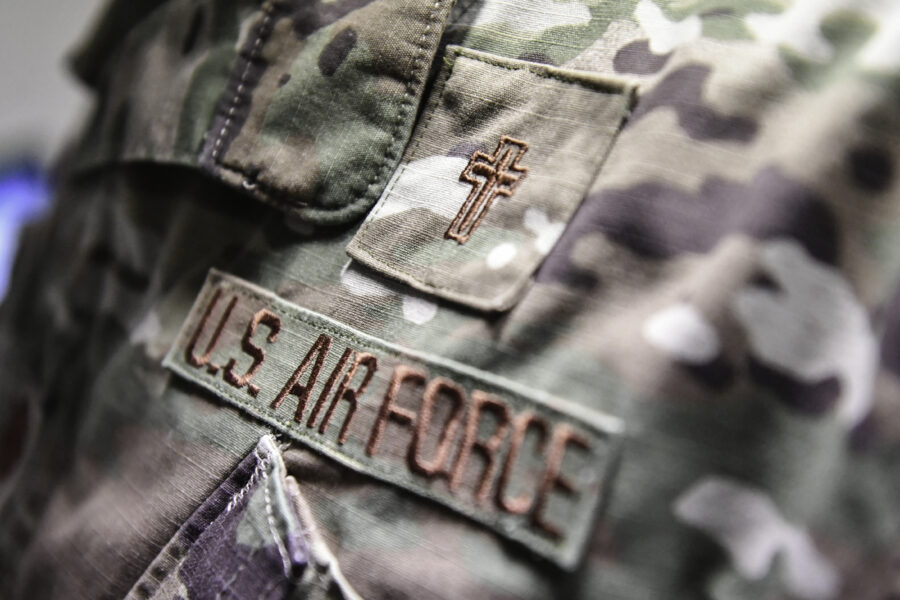
The Department of the Air Force has released new guidance for the policy that directs chaplains to remove rank insignia from their uniforms, an update that directs Airmen and Guardians to treat chaplains as they always have—as commissioned officers.
The June 17 announcement—which applies to all Air Force and Space Force personnel—comes about three months after Defense Secretary Pete Hegseth directed the Chaplains Corps to replace uniform rank insignia with the appropriate religious affiliation insignia to make them more approachable to the lower-ranking service members.
Hegseth emphasized in a March 25 post on social media that a chaplain is “first and foremost, a chaplain, and an officer, second.”
The move sparked some concern among retired Air Force leaders. Former Air Force Chief of Chaplains and retired Maj. Gen. Steven Schaick said in March he always considered himself an officer and the chaplain at the same time. Former Chief Master Sergeant of the Air Force Gerald Murray also said that the identity of rank gives chaplains the credibility they have earned within the military organization.
The new Air Force guidance attempts to address these concerns in a May 15 memo that directs chaplains to wear their religious affiliation insignia on the operational camouflage pattern, or OCP, uniform. Chaplains will continue to wear rank insignia on their service dress uniform.
“Removal of rank insignia from OCP uniform does not alter established customs and courtesies,” Brian Scarlett, principal deputy assistant secretary of the Air Force for manpower and reserve affairs, wrote in the June 15 memo.
All military chaplains are commissioned officers, so junior enlisted personnel and noncommissioned officers “will use the chaplain insignia itself as the visual cue to initiate a salute,” regardless of the chaplain’s specific grade, according to the June 17 announcement.
In most day-to-day operations at the wing or delta level, Airmen and Guardians are expected to know their chain of command and the leadership within their units. Commissioned officers should generally know the rank of their unit’s assigned chaplains, so the junior officer initiates the salute.
Some situations aren’t as clear. The department’s advice is: “when in doubt, salute.” For example, when a chaplain and an officer of another branch “approach each other and the rank of one cannot be visually determined (as will now be the case with chaplains in OCPs), standard military courtesy dictates that they should mutually exchange a salute and a verbal greeting,” the announcement states.
According to standard customs, chaplains may be addressed by their rank or by the title “chaplain.” When exact rank must be established for protocol or administrative reasons and is not visually present, it will be established through a verbal introduction such as “Good morning, Major [Name],” according to the announcement.
The U.S. military’s chaplaincy dates back to July 29, 1775, when the Continental Congress authorized one chaplain for each regiment in the Continental Army, and pay equal to that that of a captain, according to the U.S. Army Historical Foundation. Since then, chaplains have served on the front lines of every war and are often a key resource for troops coping with loss and personal problems, including deaths caused by accidents, suicide, and combat losses.