


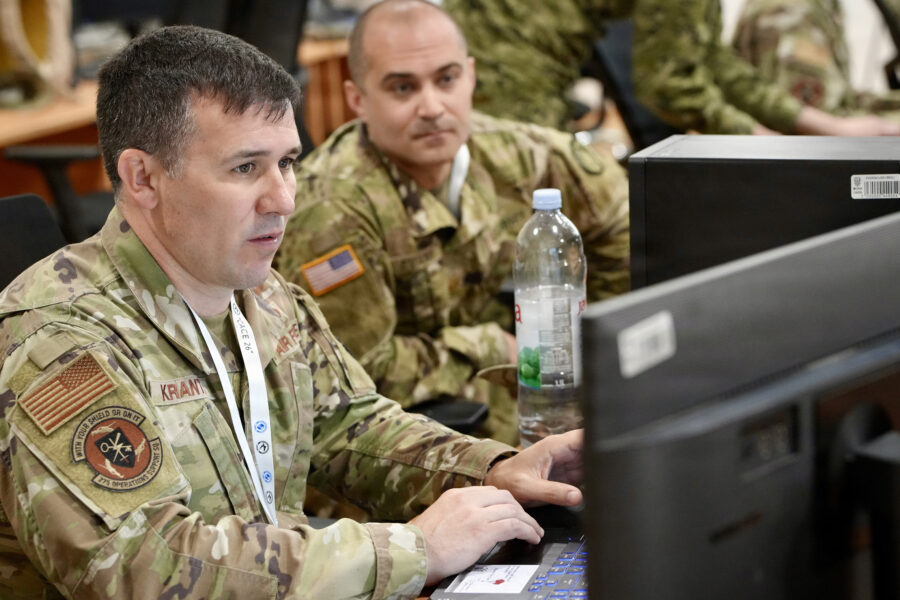
Calls for the creation of a dedicated cyber-focused military service are gaining traction among some cyber advocates and lawmakers. But a recent think tank report adds a twist to that push—calling for a so-called Cyber Force to have no enlisted personnel. It’s an idea some experts say misses the mark at a critical time when debate on how to shape a potential service is still being shaped.
At the moment, that debate remains theoretical. Last week, the Senate Armed Services voted 14-13 against a proposal from Sen. Kirsten Gillibrand (D-N.Y.) creating a Cyber Force under the Department of the Army as part of its work on the 2027 defense policy bill.
But Congress’ work on that bill is far from over, and the narrow committee vote will likely galvanize proponents to keep trying—a similar proposal to create a space-focused military service was scrapped in 2017 but came back in 2019, leading to the creation of the Space Force.
If and when the Cyber Force proposal comes up again, a commission led by two D.C. think tanks is offering a blueprint for how to organize the new service. The Commission on Cyber Force Generation report, led by the Center for Strategic and International Studies and the Foundation for Defense of Democracies, recommends a Cyber Force with 20,000 Active-Duty personnel, another 3,000 to 5,000 National Guard cyber personnel, and a civilian component of 6,000.
“The commission recommended the Cyber Force consist of commissioned officers and warrant officers, but without an enlisted cadre,” according to the report. The commission compared their proposed force to the U.S. Public Health Service, which contains only commissioned and warrant officers.
Such a setup is needed, the commission says, to provide sufficient pay for the cyber skills necessary for the new force. The move also gives personnel the respect of a warrant officer.
“It’s a stark recommendation, but I think it’s also been misunderstood,” Joshua Stiefel, commission cochair, told Air & Space Forces Magazine. “Anyone who is a cyber operator on the enlisted side today has more than merited the ability to wear a warrant officer’s collar device.”
Report authors also noted that currently the traditional services don’t prioritize cyber or cyber personnel with their legacy construct models of commissioned officers leading larger numbers of enlisted with a small number of warrant officers.
The Air Force, for example, currently has less than 1,000 enlisted personnel in offensive cyber warfare career fields, compared to 700-plus officers. The Space Force has faced a similar dynamic, with its own enlisted force just barely outnumbering its officer corps 1.19-to-1.
“Considering a legacy pay scale, the commissioners could not articulate valuable reasons to preserve enlisted rank structure when the same individuals could continue their service as warrant officers,” according to the report.
Cyber Force wouldn’t take on all cyber duties for the joint force, Stiefel said. The individual branches would still continue to have cyber personnel and missions that support their responsibilities, much like aviation is handled among the branches now.
But some don’t agree with the commission’s central argument: that enlisted cyber personnel can’t be enticed into service without officer-level pay or that the military model doesn’t work.
“Our enlisted force is the greatest military advantage in history and it’s offensive and ill-informed to call them a ‘legacy construct,’” a retired senior enlisted leader from the Space Force told Air & Space Forces Magazine. “It’s worse yet to say they do not or cannot possess ‘uniquely specialized skill sets’ and aren’t valuable enough to merit the respect of officers.”
Retired Air Force Col. Frank DiGiovanni, who formerly served as the Pentagon’s director of training, readiness, and strategy, said enlisted personnel in military cyber roles are worried less about pay and more about the service, challenge, and the military mission set.
“Of these the more powerful factor is the unique military, cyber mission set,” DiGiovanni said. “For example, no one in the private civilian sector is authorized to conduct offensive cyber operations independently.”
DiGiovanni has studied hacker culture closely, authoring a 2018 doctoral dissertation at the University of Pennsylvania on the topic
Among his findings were that the hackers valued symbolic capital, or recognition among their peers, over financial incentives.
Training the Cyber Force
Stiefel noted that in the current training pipeline, cyber operators take a long time to go through technical training, sometimes as much as a year. Commissioned officers also require a four-year degree, while warrant officers have no college degree requirement.
The retired Space Force enlisted leader said any potential Cyber Force would need to have the ability to “flex” its personnel in times of crisis, training cyber operators quickly for specific jobs.
As far as the four-year degree requirement for commissioned officers, DiGiovanni said his research showed the right cyber candidates are mostly self-taught and learn key skills within six months.
“If the adversary’s training cycle is as little as six months and ours is five years … we lose the cyber war before it starts because we can’t scale our force as fast as the adversary,” DiGiovanni said.
After getting rid of warrant officers in 1959, the Air Force brought them back in 2024, focused on cyber warfare and IT. The new Warrant Officer Training School lasts eight weeks.
But the Space Force, with its own highly technical workload, has yet to establish a warrant officer corps.
Chief of Space Operations Gen. B. Chance Saltzman noted at the 2024 AFA Warfare Symposium that the service was conducting technical work just fine with its enlisted.
“We don’t see a need to have warrant officers at this point. Because of the way we were designed, all of our enlisted personnel have very technical paths,” Saltzman said. “And so, we feel like there’s other avenues to provide them the compensation they need.”
Technical Talent
The military’s current setup tends to push enlisted personnel to take on more leadership or managerial roles as they move up the ranks to become senior noncommissioned officers, while warrant officers can focus on becoming technical masters.
Air Force leaders, when the service reintroduced warrant officers, cited that dynamic as particularly important for cyber and IT—for the most part, operators in those fields like doing their highly technical work and are less interested in traditional NCO roles. On top of that, the rapid pace of change in technology means their technical skills can fall behind if not trained and tested frequently.
“Those high performing operators want to stay on the keyboard because of several … intrinsic factors that make them the great operators that they are. And oh, by the way, the minute you get off keyboard, you’re stale,” DiGiovanni said.
The commission report recommends a Cyber Force that embraces that dynamic by giving the management roles to commissioned officers and letting warrant officers focus on the technical side of cyber work. That could help, the commission argues, in recruiting a force that wants to do cyber, but not much else in the military.
Stiefel pointed to the potential for a Cyber Force National Guard to help recruiting and retention too.
He gave the example of direct commissioning an individual at the rank of major or lieutenant colonel.
“And you’re serving on the weekend, the service is getting the benefit of your experience and your expertise, and then you’re serving your country in a way you may not have otherwise considered. That’s really, really exciting stuff,” Stiefel said.