


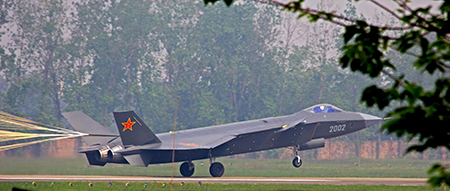
 Besides fifth-generation J-20 and J-31 fighters in development, the PLAAF is improving its 4th-gen fighters with AESA radars and helmet-cued missiles as well as increasing their numbers, said Lee Fuell, technical director for force modernization and employment at the National Air and Space Intelligence Center. Speaking to the US-China Economic and Security Review, Fuell said the PLAAF and Navy have a combined 2,300 operational aircraft and 1,450 “older fighters, bombers, and trainers” for training and research. The PLAAF also operates an increasing number of remotely piloted aircraft, some of which are stealthy and some of which are armed. China recognizes its need to improve its joint-force employment and is conducting large-scale Red Sword exercises to practice “opposing force scenarios” with a heavy dose of electronic and information warfare. Its cruise missiles have the range to reach the “first island chain” of its defense perimeter and, with bomber launch, it can reach the second as well. PLA strategy authors express increasing confidence that they can “more readily withstand US involvement” in a conflict with Taiwan “than in years past,” Fuell said. (Fuell testimony)
The Space Force has selected six commercial space domain awareness companies to support military operations with both steady-state and surge capacity, as part of the service’s new Commercial Augmentation Space Reserve.