


The Pentagon and Lockheed Martin on Oct. 22 announced a framework agreement to buy F-35 Joint Strike Fighters for the next 10 years.
But the deal, touted by the Pentagon as “landmark” and a first of its kind, depends on Congress granting the military authority to enter into such a multiyear agreement. Details such as pricing and schedules also have yet to be hammered out.
Under the deal, Lockheed will build 156 of the fifth-generation jets per year for both the U.S. and international customers, across lots 21 through 30. The U.S. military will buy at least 850 of those 1,560 aircraft over the decade covering the agreement, as well as procurement of initial spare parts and modification kits, the Pentagon and Lockheed said in statements. The deal also covers sustainment of the global F-35 fleet.
“We have fundamentally changed how we stabilize the American defense industrial base to produce at speed and scale,” Michael Duffey, undersecretary of defense for acquisition and sustainment, said in the Pentagon’s statement. “This agreement with Lockheed Martin proves it. By aligning financial incentives with actual performance, we are ensuring our warfighters are equipped with the lethal capabilities they need to fight and win.”
Lockheed Martin has also agreed to invest at least $7 billion of its own money into projects to support the F-35 program.
“This multiyear framework strengthens the way we can plan and invest in the F-35 enterprise,” Lockheed President and CEO Jim Taiclet said in the company’s statement. “With the greater certainty that comes from the U.S. government’s transformative approach to F-35 production and sustainment, we can make the upfront investments needed to expand capacity, improve efficiency, and build a more resilient supply chain.”
While the Defense Department touted the agreement’s ability to create “a stable, long-term procurement signal to modernize and expand” the F-35, it also noted in its statement that actually executing the agreement “remains subject to congressional authorization and appropriations.”
Congress is currently considering granting the Pentagon the authority to enter into multiyear procurement contracts for the F-35 and F-15EX fighters as part of its work on the 2027 defense policy bill. Lawmakers have also yet to pass a budget for fiscal 2027, leaving the
But that legislation is still pending—meaning the Oct. 22 announcement is only a framework and not finalized.
Lockheed said if Congress does grant the multiyear procurement authority and the necessary appropriations in the next few months, it will work with the F-35 Joint Program Office to finalize the contract terms, pricing, and schedules through a formal award.
Lockheed said having predictable, multiyear procurement plans for the F-35 would save billions of dollars “through long-term pricing and industry volume discounts.” And the agreement will allow the program to combine data from a variety of sources into integrated analytics, that will provide more visibility into parts inventory and readiness metrics and allow “transparent, data-driven decision making.”
The deal will also allow Lockheed to enter into long-term contracts with suppliers to buy raw materials and critical parts in bulk, which the company predicted would improve F-35 mission-capable rates. Currently, those deals are made on an annual basis, which Lockheed said “has historically strained the industrial base.”
In an earnings call with investors Oct. 22, Taiclet said at least 60 percent of an F-35’s content comes from its suppliers, including major suppliers such as Northrop Grumman and BAE Systems, which make the center and aft sections of the jets’ bodies, respectively.
“We want them to have production stability, just as we would like to have it,” Taiclet said.
Taiclet said one of Lockheed’s biggest costs comes from suppliers providing components late, or at poor quality, and he predicted this agreement will help correct those problems.
Taiclet told investors that Lockheed and its suppliers will be under a fixed-price escalation contract, in which set prices increase under certain economic conditions.
“We’ll all collectively—if we do well and perform well, and those investments pay off that we make—we will get to retain those profits under the fixed-price-with-escalator concept,” Taiclet said. “Before, we would have to give back, with price and operating profit, any improvements we invested in internally. So that is going to apply to the production system. Even if it stays at 156, it’ll be a much healthier production system for industry, and a more predictable production system for government.”
And combining aircraft production with the purchase of spare parts and modification kits in the same contract will also yield volume savings and cost predictability, Lockheed said.
“Our new multiyear framework gives suppliers stability to plan for the future and invest with confidence, improving readiness across the F-35 fleet,” Lockheed Martin Aeronautics President OJ Sanchez said in the company’s statement. “This, in addition to the investments Lockheed Martin is making to the global spares pool, will directly translate into higher mission-capable rates and a more resilient supply chain—critical capabilities the warfighter needs to meet today’s mission and prepare for tomorrow’s threats.”
During the earnings call, Taiclet reiterated Lockheed’s desire—first voiced in April 2025, after the company lost the Air Force’s F-47 contract to Boeing—to add sixth-generation technologies into the F-35, which he previously referred to as making a “Ferrari” F-35. Taiclet said this could achieve 80 percent of a bespoke sixth-generation aircraft’s capabilities, at half the cost.
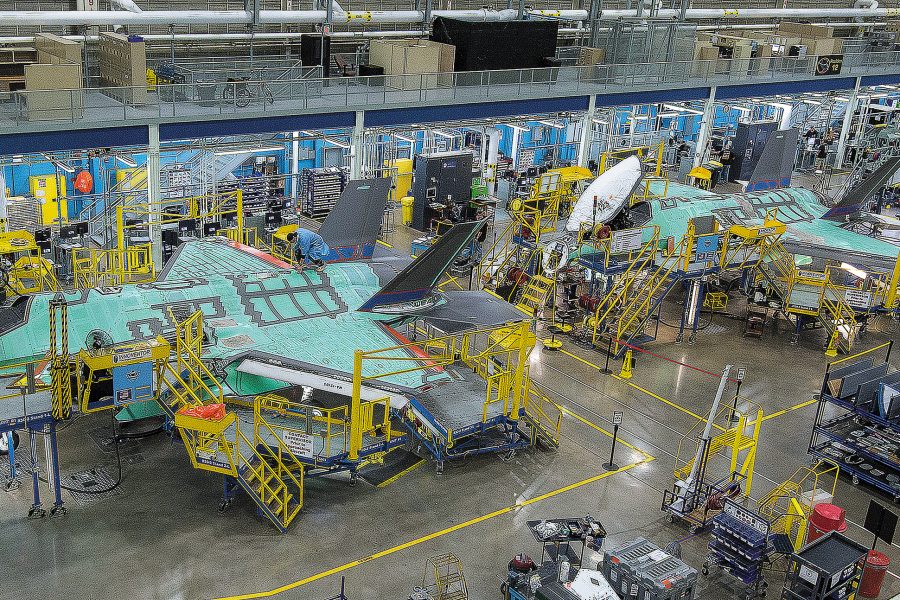
Lockheed’s primary F-35 factory is in Fort Worth, Texas.