


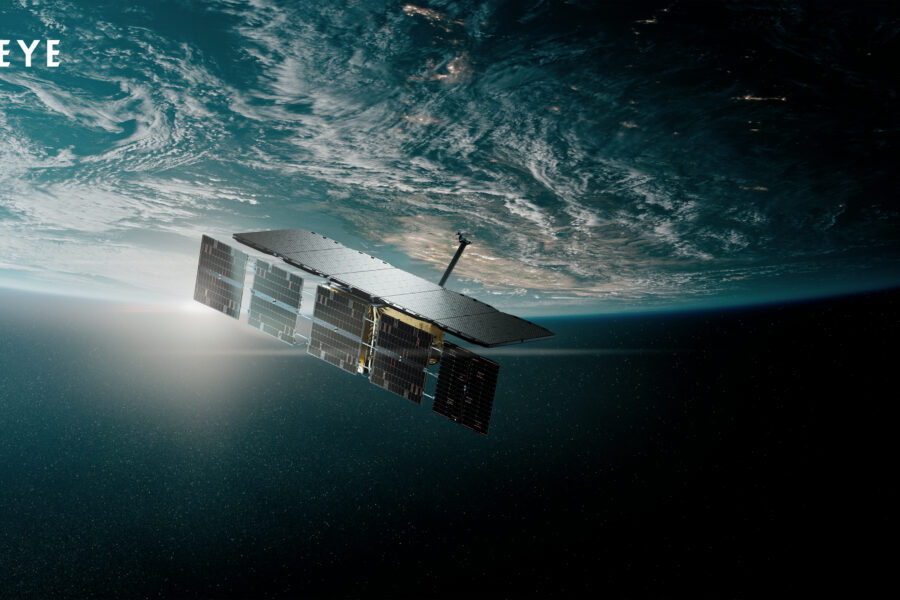
Over a two-week period beginning in late September and culminating in mid-October, a Russian satellite maneuvered dangerously close to a commercial Finnish satellite currently providing intelligence to the Ukrainian military.
The apparent provocation has experts wondering why Russia made the move—testing new capabilities, collecting intelligence, or trying to intimidate the Finnish company—and what, if anything, the U.S. Space Force could or should do about these types of events in the future.
While the incident did not involve a U.S. asset, the Russian action highlights the growing importance of commercial space assets to military operations and how those relatively defenseless assets could be vulnerable in or before a conflict.
Between Oct. 15-19, a Russian satellite dubbed COSMOS 2612 performed deliberate, fuel-intensive maneuvers to close in on the Finnish ICEYE-X36 satellite, according to a report by LeoLabs, which the company shared with Air & Space Forces Magazine.
Instead of a somewhat standard flyby, COSMOS matched, shadowed, and orbited around the ICEYE satellite, coming as close as 500 meters to it, according to the report.
The Russian satellite spent months adjusting its orbit, then rapidly closed the distance with the ICEYE satellite, continuously maneuvering around it before COSMOS abruptly ended its movements and distanced itself Oct. 18-19.
The LeoLabs report characterizes the event as a “red” on “blue” engagement in orbit and calls it a planned, highly coordinated rendezvous and proximity operation, which required precise navigation and onboard sensing.
An ICEYE spokesperson declined to provide a detailed response to a query from Air & Space Forces Magazine about the incident.
“We are aware of the situation and tracking it closely. Our constellation architecture is designed for continuity and resilience,” the spokesperson said in an email.
The Center for Strategic and International Studies held an online event Oct. 21 to discuss the incident and its implications for the U.S..
Neither of the two experts at the CSIS event claimed to understand Russia’s goals with the stunt, but Greg Gillinger, senior vice president of strategy and development at Integrity ISR, called it unusual and said it indicated Russia’s intent to send a message to the Finnish company.
“I still scratch my head about what the Russian endgame is with this,” Gillinger said.
Clayton Swope, deputy director of the CSIS Aerospace Security Project, said the event certainly was not “benign.”
“I don’t think we have enough information right now to know whether or not Russia achieved the objectives it wanted to achieve here,” Swope said.
The COSMOS/ICEYE incident comes about a month after Space Force leadership publicly announced that the force has on-orbit offensive space weapons at its disposal and under Guardians’ control.
“Today, we continue to ensure we remain ready to meet the challenge of evolving threats wherever they exist,” Air Force Secretary Troy E. Meink said during the opening keynote at AFA’s Air, Space & Cyber Conference on Sept. 14. “This is why the Space Force now has on-orbit space control weapons capable of defending the joint force against hostile adversary action.”
The timing of the satellite maneuvers, following Meink’s comments, could be a Russian signal, threat, or influence campaign meant to deter outside, commercial support for Ukraine—or even a bluff, retired Air Force Col. Jennifer Reeves, the senior resident fellow for Space Studies at the Mitchell Institute, told Air & Space Forces Magazine.
What USSF Can Do
In 2025, USSF’s Rapid Capabilities Office kicked off a project to field threat-awareness sensors that communicate close hazards to space asset operators. Such sensors would presumably alert operators if a Russian satellite came as close as it did to the ICEYE bird.
Beyond sensing and communicating, though, an April report from the Secure World Foundation noted that more nations are starting to fund “bodyguard” capabilities for their space assets, Air & Space Forces Magazine reported at the time. Germany, India, France, and Japan are all either building or planning to acquire such space-based bodyguards, which could protect and counterattack any space-based incursions.
Swope, speaking on the COSMOS/ICEYE incident, said spacefaring nations need clearer expectations for behavior in space, and predicted events like the recent incident would likely happen again.
“I just feel like it’s not a question of if; it is a question of when we see these satellites do something that we’re going to say is hostile again,” Swope said.
He also said any use of bodyguard satellites needed to include a clearer explanation of what they will accomplish in orbit.
Reeves likewise said the Space Force needs to be prepared to both understand and respond to future incidents like this one. While the service has been building its space domain awareness capabilities in recent years, that’s only one piece of the larger puzzle, she said.
“There’s a big difference between knowing where something is and understanding what it’s doing,” she said.
The force has made “tremendous progress” in tracking orbits and objects with a sophisticated sensor network and other tools, she said. But the Pentagon must put more “rigor” into protecting both military and commercial assets in space, Reeves said.
“The Space Force needs to be running through these scenarios on the regular, and hopefully they are,” Reeves said. “I’m going to trust that they are in their wargames and exercises.”
Those exercises need to include both allies and commercial partners, Reeves added.
“We’ve got to determine how quickly we can determine what happened,” she said. “Can we distinguish an accident from something deliberate? How confident are we in attribution?”
Both Reeves and Swope separately noted that any counterattacks or deterrence to space-based provocations don’t have to involve space-based retaliation or actions.
Reeves pointed to the U.S. ability to strike ground-based facilities to sever links to satellites. Swope noted increased pressure on Russia’s oil “shadow fleet,” a network of an estimated hundreds of old tankers used to export oil while evading sanctions, could be a lever to nudge Russia away from space tomfoolery.
Necessary Guidance
Ultimately, while the Space Force will be the entity dealing with satellite harassment or attacks, the force’s role needs clearer definitions on what constitutes aggression and merits a response, especially given the long-term consequences of space debris and other factors involved in kinetic actions in orbit, Reeves said.
“I don’t think it’s necessarily the Space Force itself that should be determining that,” Reeves said. “I think it should be our national leadership that’s coming up with that. … Because at this point in time, we don’t have that coming from the national-level leadership.”
That lack of guidance has placed the burden on military leadership to decide what the U.S. believes hostile actions in space look like and how the military should respond.
“We don’t want to be doing this thought work when we’re living it in real time,” Reeves said. “There are dire consequences in space if the wrong action is taken or a hostile action is taken.”