
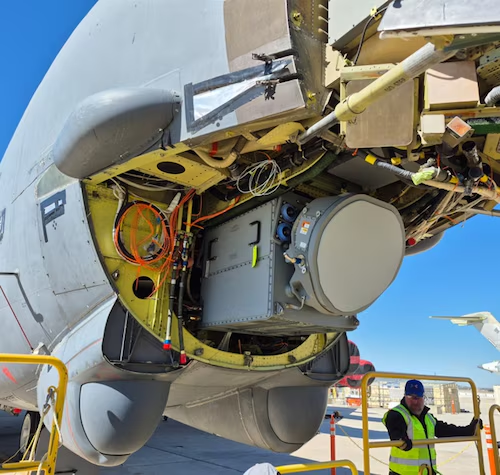
The B-52H Stratofortress that crashed at Edwards Air Force Base, Calif., on June 15 was helping test a new advanced radar that is key to a sweeping modernization of the six-decade old bomber.
The Air Force has flown the B-52H since the early 1960s, at the height of the Cold War, and the service wants to keep it in service into the 2050s as a complement to the new B-21 Raider stealth bomber still in testing.
To keep the venerable bomber relevant for a modern fight, the Air Force launched a Radar Modernization Program to replace the legacy mechanical AN/APQ-166 radar with the active electronically scanned array AN/APQ-188 radar. Along with the modern radar, the service is also working on outfitting the B-52 with new Rolls-Royce engines, improved avionics, new digital cockpit displays, new weapons, better communication systems, and other changes. When the fleet is fully modified in the 2030s, the Stratofortress will be redesignated the B-52J.
Late in the morning of June 15 local time, a B-52 with eight crew members aboard—including service members, government civilians, and contractors supporting the test mission—crashed immediately after takeoff. The plane erupted into flames so severe they consumed practically the entire aircraft. Col. James Hayes, deputy commander of the 412th Test Wing at Edwards, called the event a “tragedy” in a June 15 news conference and said it was clear no one could have survived.
Top Pentagon officials, including Defense Secretary Pete Hegseth, Air Force Secretary Troy Meink, and Air Force Chief of Staff Gen. Kenneth Wilsbach, posted to social media mourning the loss of the eight aboard the plane.
Boeing, which originally built the B-52 and is the lead contractor on integrating the new modernized systems, confirmed later that evening that two of its employees died in the crash.
Hayes said the B-52 had just taken off to conduct a test sortie and was supporting the Radar Modernization Program.
A B-52 loaded with the new APQ-188 radar—a system developed by Raytheon Technologies that can better navigate and target in all weather conditions—flew from Boeing’s San Antonio, Texas, facility to Edwards in December 2025.
A spokesperson at Edwards was not immediately able to confirm if the B-52 that arrived in December was the one that crashed. It is unclear what effect, if any, the B-52 crash might have on the radar program or the broader modernization effort.
But the radar program has had difficulties in recent years, including technical integration challenges and cost growth that triggered a law in spring 2025 requiring congressional notification, and delays that contributed to the B-52J’s projected initial operational capability slipping three years. The radar program’s troubles led the Air Force to scale back its scope, a Pentagon report said in March.
After the crash at Edwards, the Air Force now has 75 B-52s in its fleet.
The B-52 was originally only expected to fly for 20 years, but its status as a “bomb truck” capable of carrying massive amounts of ordnance—as much as 70,000 pounds—has kept the heavy bomber in regular use in recent decades. B-52s played critical roles in the Gulf War, the wars in Iraq, Afghanistan, and against the Islamic State, and most recently as part of the Operation Epic Fury campaign against Iran.
It can also carry a vast array of different munitions, including precision-guided weapons, gravity bombs, cluster bombs, mines, cruise missiles, and nuclear weapons.
Keeping the B-52 airworthy has become more and more difficult as spare parts become harder to source and its aging systems break with increasing frequency. Many companies that originally built parts for the B-52 more than half a century ago are no longer in business, forcing the Air Force to track down alternative supply sources.
Those hunts aren’t always successful. With increasing frequency, B-52 maintainers must resort to “cannibalizing” spare parts from one bomber to fix up another.
The growing difficulty in keeping B-52 engines and other key systems functional was a major factor behind the Air Force’s decision to modernize it into the B-52J.
The Commercial Engine Replacement Program, or CERP, is the biggest component of the modernization effort, and will replace the bombers’ original Pratt & Whitney TF33 engines with Rolls-Royce’s new F130s.
So far, no new F130s have been mounted on B-52s, and the biggest work on the engine replacements is still to come.
The Air Force announced in May that the CERP program had passed its critical design review, which finalized the program’s design. Next, Boeing will modify the first two B-52s with new engines and other upgrades at its San Antonio facility, with the first arriving there later in 2026. Once upgrades on those two B-52s are done, the plan is to fly them to Edwards for extensive testing.
But while B-52s are old, they have a strong track record and a fair bit of life left in them, said Doug Birkey, executive director of AFA’s Mitchell Institute for Aerospace Studies. The B-52H spent most of its early years on nuclear alert while older B-52 variants were flown heavily during the Vietnam War, he said, meaning the Hs didn’t collect a large amount of flight hours during the Cold War.
Officials will likely rely on witness testimony and any possible video evidence as they investigate the Edwards crash, since it occurred near the base’s air traffic control tower, Birkey said. But the intensity of the fire means there will likely be not much physical evidence to analyze, he addedd.
The crash at Edwards was the first loss of a B-52 in a decade. In May 2016, a B-52 skidded off the runway during an aborted takeoff at Andersen Air Force Base in Guam after the crew suspected a bird strike when several engines lost thrust. That B-52’s crew safely evacuated, but the bomber caught fire and was a total loss.
Another B-52 crashed into the ocean northwest of Guam in 2008 after takeoff, killing all six crew members. The subsequent investigation concluded that the B-52’s rear stabilizers malfunctioned and led to the crash.
Those were the only two prior losses of a B-52 in the 21st century. In 1994, a B-52 crashed at Fairchild Air Force Base, Wash., causing a fiery explosion that killed all four aboard. During the flight, which was a practice run for an air show, the pilot passed low and slow above a runway, and then banked so sharply to the left one wing was vertical above the other. The plane stalled and plunged into the ground, creating a massive fireball.