
Production surge slows as Air Force nears weapons goal.
After an intense period of restocking, Air Force precision weapon inventories are almost back to acceptable levels, Air Force leaders say. Now they are throttling back planned purchases for fiscal 2021.
“We have been able to make a dent” in the munitions shortage, said Gen. Arnold Bunch Jr., head of Air Force Materiel Command during the Air Force Association’s Air Warfare Symposium in February. The sharp reduction of U.S. air attacks against the Islamic State group “has allowed us to get in a better place and on a better trajectory” in terms of war reserves.
Bunch has previously referred to ups and downs in purchasing as a “sine wave” that plays havoc with budgets and frustrates weapon producers, who have had to add tooling and shifts to meet USAF’s urgent demands for replacement weapons in recent times.
“What I would hope we would do, is level off … at this year’s level, maybe plus or minus a little bit,” Bunch said.
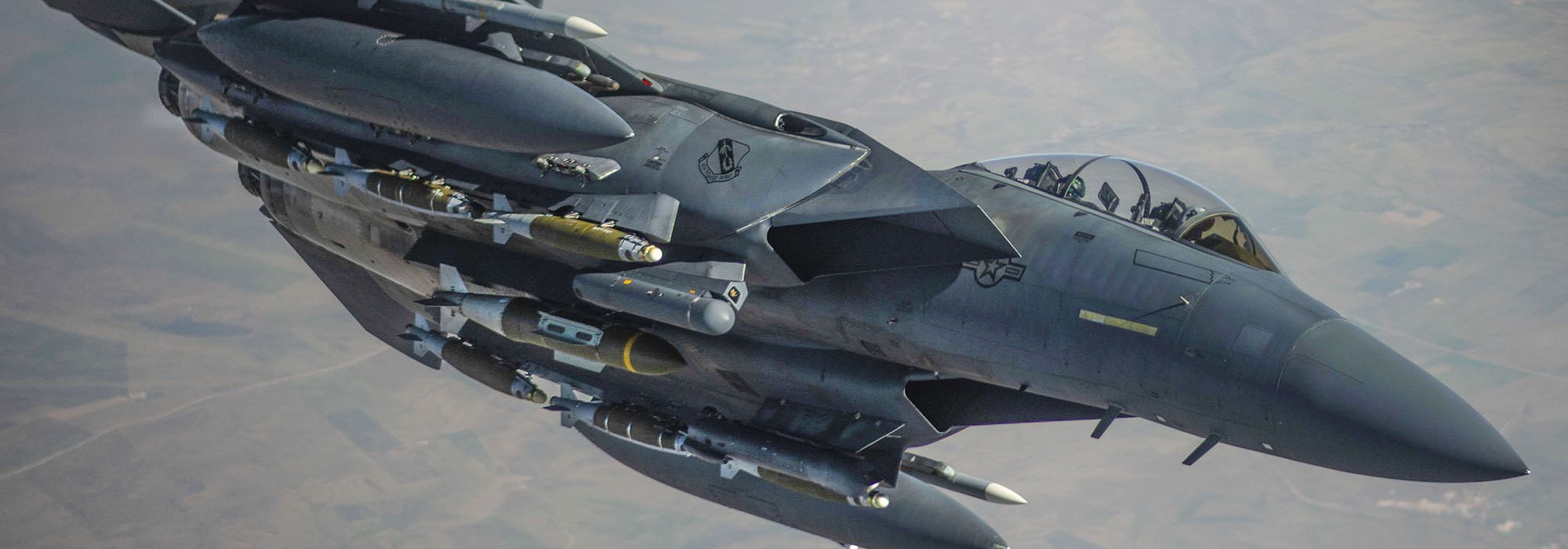
During Operation Inherent Resolve, the Air Force was using up Joint Direct Attack Munitions (JDAMs) so quickly that they were being loaded onto combat aircraft in the Middle East a scant 24 hours after being crated up and shipped from Boeing’s St. Louis factory. This rapid usage was exacerbated by allied air forces “borrowing” munitions from the U.S. because their own limited stocks were depleted from action in Afghanistan and Libya.
Precision munitions were the weapon of choice in the fight against ISIS due to the rules of engagement. Because civilians were mixed in with ISIS combatants, extremely accurate targeting and strikes were required to avoid civilian casualties.
The shortages prompted the Air Force to surge production of weapons like the JDAM, Small Diameter Bomb 1, and the AGM-114 Hellfire.

In planning the fiscal 2021 budget, Bunch said, the Air Force had to “focus on the high-end fight,” reducing its appetite for JDAMs. The Air Force bought 30,872 JDAMs in fiscal 2019, which was its high water- mark. It requested 37,000 in fiscal 2020, but Congress only approved 25,000. The request for fiscal 2021 is only for 10,000 JDAMs, including both “base budget” and Overseas Contingency Operations accounts.
Production of the SDB 1 increased from 5,743 units in fiscal 2019 to 7,078 in fiscal 2020; USAF is seeking only 2,462 in fiscal 2021.
Was the munitions downshift a bill payer for other programs? Or was it a signal that the Air Force intends to start buying longer-range weapons that can be released farther away from enemy air defenses?
“It might be a little bit of all of those,” said Gen. James “Mike” Holmes, head of Air Combat Command. “After several years of the Air Force working hard to replenish the JDAM stocks, we’re approaching the objectives that we set, and those objectives are set by looking at the war plans and the different contingencies.”
Holmes said “the right balance of risk was to continue to acquire those weapons, but as we approach the objective, to start slowing down a little bit on the JDAM,” which is a gravity-fall weapon.
The Air Force is investing in “the things we’ll need for long-range fires, across the joint force, to challenge a peer adversary,” Holmes said. “When you look at everything that had to fit in the budget, some pretty good work was done over the last several years to replenish the JDAM stocks and work toward the objective, and in the Department they made the decision that they’re getting close enough that they can slow down that buy rate a bit.”
While contractors have purchased tooling and hired staff to meet larger production goals, the Air Force footed the bill, Holmes said. “When they go to tool, we actually pay for it,” he explained. “The industry comes to us and says ‘to go to whatever rate, this is what it will cost you.’” Now that the tooling is in place, it provides the potential to surge production in the event of a large-scale conflict, Holmes said.
Bunch said the Air Force budget plan does not throw contractors back to low production, but rather creates an “opportunity” for allies to replenish their stocks, as well, through increased foreign military sales. U.S. military demand had made such sales difficult in recent years. Now the Air Force wants allies to know those weapons are available again.
“We want them to buy ahead,” so the U.S. is not seen as the store in a contingency. “We want them … to replenish, buy ahead, so they’re prepared,” Bunch said.
The longest-range conventional weapon the Air Force is buying is the Joint Air-to-Surface Standoff Munition (JASSM), which is on its fourth variant. The JASSM-ER (for Extended Range) has maintained a steady production rate, with buys of 360 in 2019, 390 in ’20, and a request for 400 in ’21. Beginning in 2021, the Air Force would also acquire five Long-Range Anti-Ship Missiles, or LRASMs, the counter-maritime version of the weapon.
With help from Congress, “we stood up an additional JASSM production facility,” which is now under construction, Bunch said. Lockheed Martin Missiles and Fire Control builds the JASSM and LRASM in Troy, Ala.
Bunch said the National Defense Strategy tells the Air Force “we need to take more risk in the near, and look for the far. Those standoff and those more advanced weapons are the far, and we’re trying to make the move to that area.”

Multiple studies have argued for increased purchases of longer-range weapons in recent years. Some have suggested adding motors to conventional gravity weapons. Indeed, Holmes has told Air Force Magazine that USAF needs new munitions that combine longer range and a degree of stealth in an package that’s inexpensive enough to buy in mass quantities.
The Air Force developed the precision-guided GBU-39 Small Diameter Bomb I because it found that JDAM-sized weapons were too large for the small, precise attacks necessary in wars like the counterinsurgencies in Afghanistan and Iraq. Its 250-pound warhead was a better size for many targets, and its lighter weight meant USAF aircraft could carry more weapons. The SDB I uses GPS/INS, laser, and even radar-homing guidance for some variants, and has a range of about 45 miles, for use against stationary targets.
The GBU-53 SDB II, built by Raytheon and named “StormBreaker,” increases that range to some 70 miles. It adds Link 16 connectivity and can attack moving targets in brownout or adverse weather. An F-15E can carry up to 28 SDB IIs.

Boeing, the maker of JDAMs, showed off a new variant of that bomb at the AFA 2020 Air Warfare Symposium. Called “Powered JDAM,” it adds a wingset and power module to increase JDAMs’ range by 20 times. The company is pitching the munition as a lower-cost alternative to a cruise missile.
The munitions would have the range to “stand outside the engagement zone,” said Wade Kirkbride, a business development representative for Boeing, calling the weapon the “centerpiece” of the company’s plan to “evolve JDAM for the future.” The munitions, which could use any of a number of sensors for targeting, could also be used as a decoy for more expensive missiles such as JASSM, which cost more than $1 million per round.
