


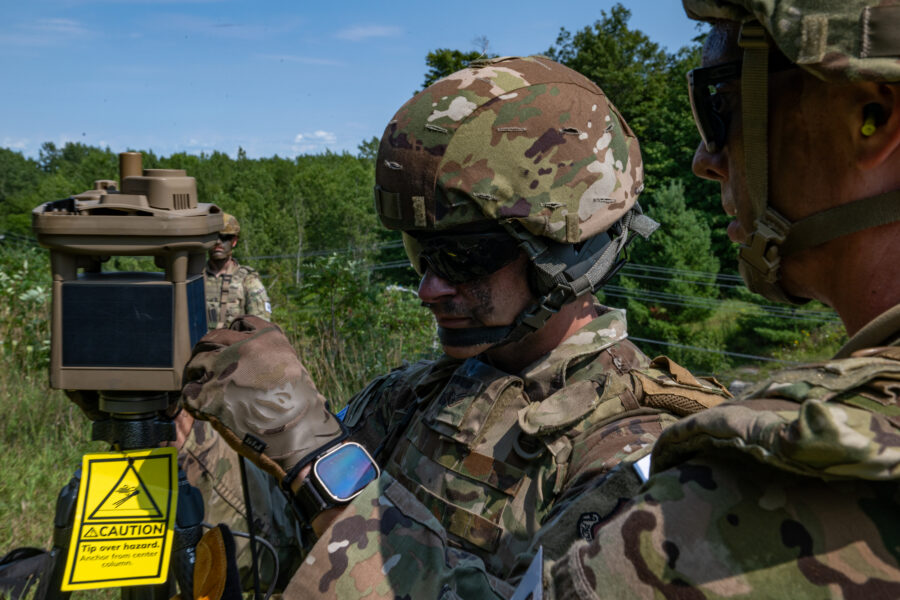
In the small world of Air Force weather specialists, combat weather specialists are a niche unto themselves, deploying with Army ground units to provide forecasts and, if need be, fight alongside those Soldiers. For Staff Sgt. Francisco Estrada, the hardest part of the job isn’t the possibility of ground combat, though—it’s briefing Army helicopter pilots on short notice how wind, fog, rain, and other conditions will affect a mission.
Being right about hazardous conditions often means an upcoming flight is scrubbed. Being wrong about them, though, could cause helicopter engines to fail or send an aircrew flying into the side of a mountain.
“Anybody can sit behind a desk and put everything together when they have all the time in the world, but when you are on the fly like you are oftentimes out in the field … it’s really hard to gather everything that you need do it well and do it confidently, when somebody’s asking you, ‘Hey, well, can we can we launch? Can we go?’” Estrada told Air & Space Forces Magazine.
Airmen in this unique career field were tested Aug. 12-13 when combat weather squadrons from across the Air Force participated in Thunder Challenge 2026, a physically and mentally challenging competition that this year put six three-Airmen teams from around the world through two days of high-pressure skill tests at Fort Drum, N.Y.
Competitors marched 10 miles, carrying weapons and 35-pound rucksacks. The competition also included a night land navigation course and a simulated mountain rescue on foot through the thick forested terrain.
Skill stations tested everything from small-arms knowledge to combat casualty care—combat-related tasks these Airmen could need at any time since they are attached to Army combat units. In between these tactical tasks, the combat weather Airmen, known as staff weather officers, or SWOs, also had to prove their technical job expertise by completing tasks ranging from setting up portable weather sensors to a timed weather knowledge test.
Thunder Challenge “is the only competition that measures the lethal combination” of tactical skills as well the “environmental science” knowledge needed operate within Army combat units and advise aviators and combat leaders on how changing weather conditions could impact future missions, Chief Master Sergeant Ronald Buchanan of the Air Force’s 5th Combat Weather Group, told Air & Space Forces Magazine.
“It’s unique because you they go straight from grueling, physical challenges such weighted ruck marches or live-fire stress shooting directly to setting up tactical meteorological equipment, and then from that, using that same equipment or their weather knowledge to deliver an Indo-Pacific-focused forecast brief, not only just under the physical but also under that mental fatigue as well,” Buchanan said.
“These competitions help further prove that we can operate and deliver critical environmental intelligence at the absolute forward edge of any battlefield.”
Estrada, whose team from the 7th Combat Weather Squadron in Germany beat out five other teams to win first place this year, was also part of last year’s winning team at Thunder Challenge. He has been a combat weather specialist for the last three of his seven years in the Air Force. While assigned to the Army’s 12th Combat Aviation Brigade at Katterbach Army Airfield, Estrada has seen a lot of Airmen “get scared” when it comes to preparing an air mission brief on a short deadline with limited data.
During Thunder Challenge, teams had to prepare a brief in about 45 minutes with “very little data, and more importantly, with data from a location that we didn’t know,” Estrada said.
“It’s such a compact timeframe to do that confidently … you have to consider so much. Whether it’s where they’re flying to, their route of flight, are they going over an ocean because at that point, we have to consider what the sea temperatures are like,” Estrada said, adding that headwinds, crosswinds and other conditions that can “make or break their decision to fly, especially when it comes to fuel consumption.”
Normally, SWOs will have at least several hours’ notice, if not a day or two, to prepare a brief and “we’ve had time to kind of do everything and kind of get used to the localized weather pattern,” Estrada said.
Satellite imagery helps with dissecting approaching weather fronts that can bring stormy, wet weather. Topography plays a large role in preparing a brief, Estrada said, especially in the mountains, where low ceilings can be dangerous.
Helicopter pilots have low cloud ceiling minimums they can fly in, “but in those mountains, because they hold so much moisture to trap it all in, it’ll be socked in so you’ll have ceilings go from like 3,000 feet to all of a sudden, your ceilings are on the surface,” Estrada said. “You can’t get through it.”
Army aviators spend a lot of time studying available weather forecasting applications but depend on combat weather Airmen for an unbiased analysis of flying conditions, said UH-60 Black Hawk pilot Capt. Tom Pelkey, who was one of the judges on the air brief portion of the competition.
“You will not launch until the Air Force weather officer gives you a brief,” he said, explaining that Army regulations require it to “ensure that the pilots themselves don’t shop for favorable weather” to suit their mission.
Many factors are needed for a good air brief such as “what’s the moonset going to be if we’re launching at night—like how much illumination? What’s the sea state going to be since we’re flying over water?” said Pelkey, who is assigned to 3rd Battalion, 10th Combat Aviation Brigade at Drum.
Air density is also a critical piece of data helicopter pilots need when planning a mission, Pelkey said. Helicopters need dense air to generate lift through the main rotor blades. Air density decreases with altitude and has an adverse impact on aircraft performance.
“The engine’s going to work based on the density altitude or how much moisture is in the air affected by the temperature, so if it’s going to be hot and moist, my engine doesn’t have much air to beat into combustion,” Pelkey said. “And that’s something helicopter pilots, and even pilots in general, have to be aware of … because that limits us on what the aircraft can carry, how many people we can carry, and what maneuvers we can do.”
When critiquing each team’s air brief, Pelkey said pilots stress that they need combat weather Airmen to provide analysis along with weather data.
“The big thing that we want … the SWOs to understand is, ‘you bring me the weather. All right, so what? What does that mean for my mission exactly?’” Pelkey said. “If we had two routes that we’re going to fly, you need to recommend the route that I’m going to fly based on the weather.”
Sending combat weather Airmen to Thunder Challenge gives leaders an opportunity to gauge the effectiveness of the training that SWOs receive throughout the year, said Col. Staci Coleman, commander of the 5th Combat Weather Group, which commands the 18th Combat Weather Squadron headquartered at of Fort Bragg, N.C., and the 3rd Combat Weather Squadron out of Fort Hood, Texas.
The competition “enables leaders to put the Airmen to the test, so we can see where they’re at with the development of their skills,” Coleman said. “Can they apply their weather expertise and operate as warfighters and make good decisions under pressure? So, we use that as an opportunity to put them under stress just to see how they can respond and to show them where the gaps are in their own training and things that they need to improve on.”
Coleman added that “it shows us where we’re strong and where we need to improve and ensures that we’re building combat-ready Airmen who are ready for the fight.”
To 1st Lt. Isabel Weiss, participating in the competition was a great experience for her “very junior team,” since it was “totally different from what most people think of when they think of the Air Force and when they think of weather support.”
“I think a lot of people think of computer people just looking at models, but it was a really intense competition, and we got to go into the Army combat skills that we’ve learned, and also we got to show our other proficiency,” said Weiss, who is part of an 18th CWS detachment that’s attached to the Army’s 3rd Combat Aviation Brigade at Fort Stewart, Ga. “We were into it; I thought it was amazing.”
Her team came in fourth place, which she is “very proud of” since “we were brand new to this type of competition environment,” said Weiss, who was named Fittest SWO from her combined score on the fitness test, 10-mile ruck march, and mountaineering portion of the competition.
Her team trained at Fort Stewart for the night land navigation, but the course at Drum was “very hard, and it was pitch black,” Weiss said. “We only had red light headlamps, and two of our headlamps died.”
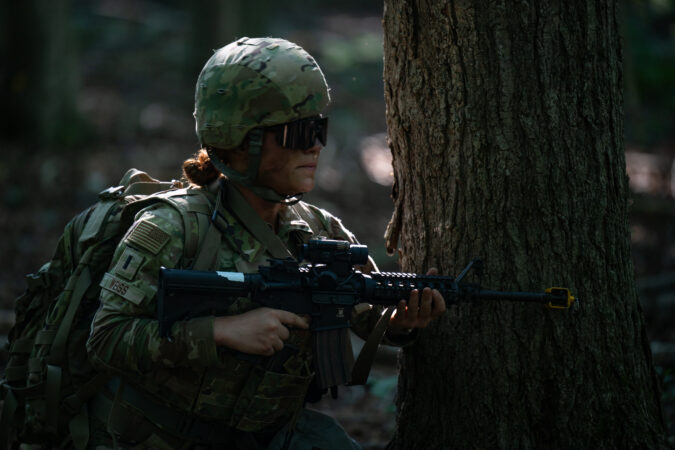
“We were in the trenches for sure, but that was great,” she said. “I really do like this tactical stuff. … We had our face paints on, we had our bulletproof vests and helmets, sleeping outside, shooting weapons; it was just a really cool thing that you don’t get to do very often with the Air Force.”
The competition was also great on-the-job training for her junior Airmen teammates, Weiss said.
“I think the first time that they go to an exercise, or when they get ready for deployment, they’re going to be so familiar with the equipment, when it’s used, how it’s used, and then just working in a high-pressure situation—I think it’s a really unique thing that I’ve never heard of an Airman experiencing so early in their career.”
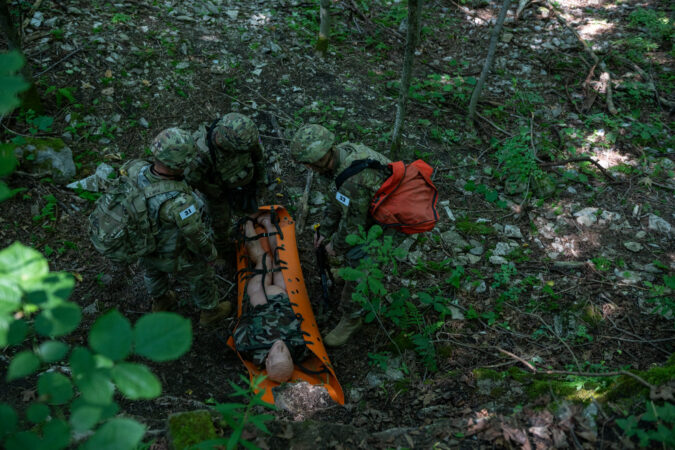
For Estrada, the hardest field skill was the mountain rescue portion of the competition that required teams to locate a dummy casualty and move “him” through steep, wooded terrain on a “Skedco,” which is a special stretcher equipped with straps for securing a casualty that can be lowered down steep inclines by ropes.
“We had to assess him for any injuries or any wounds, and … then we had to move him in Skedco from point A to point B,” Estrada said. “I think it might have been a good 100 meters, long enough to just be exhausting.” Teams then had to lower the casualty down one cliff and up to the top of another steep rise, he said.
Estrada said he will likely compete in next year’s competition as well. “It gives you an opportunity to kind of gauge where you’re at versus like your peers,” he said. “And I think there’s something rewarding about that—seeing all your effort, all the dedication that you put into your skillset to kind of become a better forecaster, a better combat weather team. There’s something so gratifying about that, that it’s hard to kind of walk away from.”