
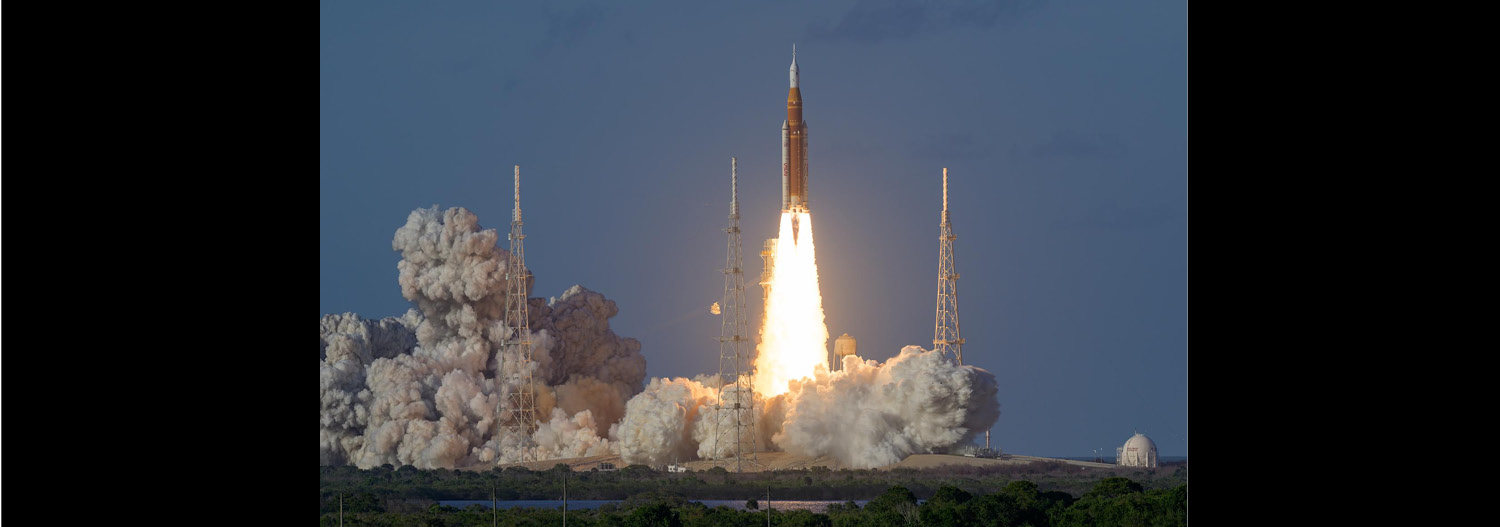
The United States and China are competing in a modern-day space race with generational strategic consequences at play, both in space and on Earth. And at this moment in time, China—not the United States—is positioned to dominate. To change that future trajectory, the United States must commit the time, actions, and resources needed to prevail.
Unlike the space race of the 1960s, when President John F. Kennedy committed the nation to “landing a man on the Moon and returning him safely to the earth” before the decade was over, this contest has no defined finish line. Instead, it will be defined by enduring competition for long-term strategic positional advantage in space. The winner will be the nation that can execute and defend its objectives across the full span of space operations—to include sustaining unimpeded human transportation and logistics lines from low-Earth orbit to cislunar space; controlling critical resources at the lunar poles; and establishing secure habitats and reliable power systems to support long-duration missions on the lunar surface.
The first player to secure these conditions will define the rules and norms of humankind’s space economy, space exploration, and space security interests. Collectively, securing these interests will play a major role in positioning the leader of the space race as a dominant figure on Earth and beyond.
Col. Kyle Pumroy, USSF (Ret.) is a Senior Resident Fellow for Space Studies at AFA’s Mitchell Institute for Aerospace Studies.
Download the entire report athttp://MitchellAerospacePower.org
China’s record on Earth is informative. Its belligerent use of hard power to assert territorial dominance over its neighbors projects a future that puts at risk U.S. interests in space. While the 1967 Outer Space Treaty (OST) prohibits claims of lunar sovereignty and militarizing the Moon, China’s military-led space program and plans for Moon bases are inconsistent with the treaty’s provisions. Moreover, China’s record of ignoring treaty agreements suggests the United States cannot count on self-constraint. While upholding the OST should be the United States’ desire and priority, pragmatically, it must prepare otherwise. That points to wielding the ability to deploy Guardians into space, with Title 10 military authorities, to credibly enforce norms and standards.

Developing a military human spaceflight program is therefore necessary to establish and secure U.S. strategic positional advantage in space, especially on the Moon. History demonstrates that whenever territorial conquest, the potential for economic gain, and national interests overlap, hard power matters.
China’s Military Programs
China has displayed remarkable discipline in meeting its space exploration and habitation objectives. Over the 30 years between 1992 and 2022, China achieved all its stated human spaceflight goals within or close to objective timelines, including operating a crewed spacecraft, mastering rendezvous and docking, and building a space station.
China’s success traces to a consistent national vision and objectives. As described by China’s former General Director of lunar exploration missions, Ye Peijian, “The cosmos is an ocean, the Moon is the Diaoyu Islands. …If we can go, but don’t go, future generations would condemn us. Once others … have occupied, no matter how much you wanted to go you couldn’t.” Expressed more plainly, China views success in the space race as a means to control territory and corresponding logistics routes—a modern day Silk Road through space.
China’s progress is evident: China has continuously retained at least four Taikonauts—its word for astronauts—on its Tiangong space station since June 2022; leadership plans to double the space station’s physical size by 2035, enabling it to double its crew to eight Taikonauts. China is also pushing forward with a credible plan to put Taikonauts on the Moon by 2030.
Importantly, China’s Taikonauts are not civilians operating under a civilian-led program, as are NASA astronauts from the United States; they are members of the Chinese military operating under military authorities.
U.S. National Security Interests
America’s current manned spaceflight program, in contrast to China’s, has been defined by inconsistency for decades; objectives for lunar and Mars missions have come and gone. Under the direction of current NASA Administrator Jared Isaacman, however, a renewed focus appears to be taking hold. During NASA’s Ignition event in March 2026, Isaacman portrayed space exploration within the context of great power competition; he also unveiled a multiphased Moon base strategy. He affirmed his commitment to maintaining human presence in low-Earth orbit.
Isaacman’s focus is helpful, but without a national security element at the core, funding human spaceflight becomes a matter of national prestige alone, making it easy to dismiss as a luxury rather than a necessity. This argues for a new national strategy in which competition in space is seen as it is: a competition whose strategic implications stretch far into the future.
China’s ambitions for LEO and lunar space stations exclusively inhabited and executed by military Taikonauts demonstrates their vision and gives them a comparative edge. By contrast, U.S. interest in space ranges from high-end science projects and tourism to business opportunities—not security.
As an example of the floundering vision and American ambivalence toward space exploration, the U.S.-led International Space Station is slated to be decommissioned in 2030. America’s only operational option for supporting moderate-to-long-duration human spaceflight will close before any alternative is fielded.
U.S. objectives to return humans to the Moon likewise lack focus. President George W. Bush announced in 2004 that the United States would return to the Moon by 2020, but in the 22 years since that declaration, the lunar landing date has shifted time and again. Indeed, from 2010 to 2016, it wasn’t even a firm policy objective. The first Trump administration attempted to reinvigorate Moon exploration with an objective for a lunar landing in 2024, but President Joe Biden let that slip to “mid-2027” and it has since been delayed further to “by 2028.”
While the recent successes of the Artemis II mission demonstrated progress, significant mission complexity must yet be resolved in the next two years to enable the planned Moon landing with Artemis IV. The program continues to rely on complicated space shuttle-era technologies that are difficult to control and susceptible to unplanned errors. The complexity and fragility of the Artemis lunar missions make uncertain both the timeline and ability to achieve current goals.
Yet, President Kennedy’s goal setting in 1962 led to the successful landing of Apollo 11 in 1969—an incredible achievement in an era of slide rules. America can succeed in space given sufficient focus, funding, and commitment.
Space today is an ungoverned expanse without laws or norms. That means the most present and powerful players will wield the greatest power, ultimately dictating norms and legal-political frameworks to everyone else. Human presence is therefore an essential element of national strength.
Without a change in strategy, the predictable future is Chinese dominance of lunar resources and access, protected and defended by military Taikonauts. Consequently, the U.S. will be left conceding to China’s desired norms and standards for lunar habitation and resource access.
In the context of history, the contest to institute norms and standards in newly inhabited regions is well established. However, because such experiences are so distant from current memory, they seem abstract and part of a bygone era. While the United States hopes for peaceful habitation of space and an alignment of values, history shows that when global powers expand economic and territorial interests, hard military power emerges as a necessity to dissuade malfeasance and protect national priorities. U.S. Space Force senior leaders must, therefore, be ready to provide options to national leadership for the application of military power in space. And, just as on Earth, where some military objectives can be fulfilled remotely, others require the unique skills and engagement of human operators. There is a difference between destroying a machine and holding a human life at risk. As the saying goes, “satellites do not have mothers.”
For the United States to contest China’s positional advantage, it will need to advance human spaceflight as a national security imperative; the presence of Title 10 military forces can encourage both national and commercial spaceflight and settlements to proceed with the confidence of knowing they have national military power to protect them.
Should norms come into dispute, for instance between competing nations over access and rights to mineral deposits on the Moon, diplomatic resolution is the first step. But, should diplomacy fail, the nation best able to enforce its will wins. Because China’s space habitation program is a military effort, its ability to transition to a military posture is clear; the U.S. needs a similar capability. NASA, by definition and charter, lacks the training, technology, and legal authority necessary in such circumstances.
Strategic Vision and Space Superiority
The President’s Executive Order on Ensuring American Space Superiority includes significant directives to outpace Chinese space superiority advantages. It defines American superiority in space as “contributing substantially to the Nation’s strength, security, and prosperity.” The unique value of the order is that it creates a national space policy aligned to instruments of national spacepower (NASA, the Department of Commerce, and the Department of War) in support of national objectives.
For the executive order’s objectives to be effective and enduring, these space-facing organizations must prioritize space superiority missions, build collaborative relationships, and mutually support goal-oriented research and operational programs.
While the EO cites the importance of excelling in manned spaceflight, the order does not explicitly recognize the Pentagon as a partner in these efforts, perpetuating the separation between military and civil presence in space.

NASA’s Isaacman acknowledged this shortcoming in February, stating “NASA’s mission and national security are inseparable.”

A military human spaceflight program must pragmatically aim to achieve the strategic flexibility to protect American human flight and habitation interests in space. The Space Force will need the resourcing, manpower, and authorities to match the demands of the mission, while at the same time ensuring that the U.S. maintains an edge in remote capabilities. Developing Guardians for human spaceflight must not compete with resources and competencies needed to develop remote systems to counter Chinese space activities in the near-term.
Human Military Roles in Space
Examples of nearer-term missions for a military human spaceflight program to study, experiment with, and develop requirements for include medical evacuation and rescue from space and in-domain persistence and resiliency operations.
Although medical evacuation and rescue is not expressly a military function, the high-risk aspect of space rescue and the transferability of such specialized, low-density skills to future Title 10 space missions make it an important core competency. The basic mental, physical, and tactical skills needed to conduct rescues in space will define baseline skills for future missions in orbit and on the Moon.
The recent Chinese Shenzhou-20 incident, in which a crew delayed their reentry to Earth’s atmosphere due to a damaged return capsule, is indicative of the limited options available when systems fail in space. China was able to use the arriving crew’s capsule to overcome the issue, but had there been a medical emergency prior to the new crew’s arrival, another solution would have been needed.
The mission to rescue humans, provide medical assistance in a micro-gravity environment, and adapt in highly dynamic, life-or-death situations is suited for humans, not machines. Such a program would also encourage spacefaring nations to adopt technical standards established by the United States to ensure interoperability, a key part of establishing leadership and norms of behavior in space.
Another area for military expertise in space is how humans contribute to operational flexibility to fight through a contested space environment.
China has invested heavily in counter-space capabilities designed to disrupt remotely commanded space systems by attacking command links and disrupting ground stations. Guardians on a military space station could conceivably maintain constant space domain awareness of a national security threat and make decisions immediately as threat criteria are met. Additionally, these warfighters could maintain persistent access to space superiority weapons and send timely commands to systems untethered from Satellite Control Networks. Leveraging this degree of persistence is unachievable today through terrestrial control.
Whether these concepts evolve into future mission requirements or not, the analysis and development necessary to develop capabilities and vet these concepts could take decades. The Space Force can start now by sending Guardian astronauts to space stations to research and test military capabilities and concepts.
Additionally, setting a standard of continuous military space station habitation is another show to the world that the United States is committed to remaining the strongest space-faring nation through sustained presence. A military spaceflight imperative gives the industrial base the predictability it needs to advance and speed capability development. A strong human spaceflight industrial base is crucial in maintaining global leadership in the modern-day space race and future lunar habitation.
Another space requirement could be something like the U.S. Navy’s Seabees. In the days following Pearl Harbor, civilian employees of Pan American Airways on Wake Island in the Pacific lacked training and authority when asked to help fortify and defend the island. While these civilians initially repulsed the Japanese landing force, after 12 days of fighting they were ultimately either killed or captured, after which they were sent to POW camps.
Learning from that experience, the Navy created the Seabees, a militarized construction force armed with Title 10 legal authorities, that could build and defend infrastructure in combat zones. Rather than wait for a crisis, the Space Force, as the military service responsible for space, should begin to develop the complex skills, tools, and concepts necessary for the mission. As the sole military service building space-minded warfighters who understand the complexities of orbital dynamics, microgravity, multibody problems on orbit, the interplay of electromagnetic energy on space objects in motion, and the extreme space weather and habitation environment, only the Space Force can take this on. The Space Force is likewise the only service entirely focused on achieving U.S. space superiority, and, as such, it is USSF’s prerogative to maintain the safety, security, and stability of the domain. If that requires warfighters to physically protect critical interests in space, those warfighters must fully understand the domain; the space environment is far too complex to be someone’s side gig.
Space Test Course Graduates
Vice Chief of Space Operations Gen. Shawn Bratton said in January that putting Guardians in space is on the service’s “to-do list.”
“Do we need to put human Guardians in space?” he asked. “It would be tragic if that didn’t happen someday. … We owe work on that.” The bulk of the U.S. Space Force’s resources and attention today still belongs to near-term mission requirements, especially space control. But over the long term, the service must develop plans for a human spaceflight program, including sending a limited number of Guardian astronauts to space annually so that Guardians can concurrently learn from ground control operations, which support spaceflight and space station activities.
The U.S. Space Force’s Space Test Course (STC), an element of the Department of the Air Force’s Test Pilot School, trains adaptive test leaders and critical thinkers to understand the space environment and its implications in developing new technology. A small number of Guardian STC graduates could complete astronaut training and ultimately assume seats on spacecraft and space stations. Among their specialized requirements would be the skills necessary to deter and defend space assets against belligerent actions meant to dislodge, disrupt, or destroy U.S. space capabilities.
Cultivating this new discipline also requires ground control experience for Guardians to learn the intricate Command and Control (C2) requirements for human spaceflight. Career broadening opportunities exist today in which a few Guardians serve as liaisons with NASA to gain this experience; more Guardians should serve with NASA to hone these skills.
Similarly, the Space Force should create opportunities to embed Guardians within commercial organizations to better understand their human spaceflight operations, either through employment or fellowships. These partners must be seen as critical national security enablers supporting the development of military skills, tools, and concepts.
Recommendations
For the Space Force to meet its mandate to conduct Title 10 operations in defense of U.S. interests in space, Guardians will eventually have to be physically present in the domain.
The following recommendations can advance this emerging requirement:
1. The Assistant to the President for National Security Affairs (APNSA) must direct the development of initial requirements and tasks for a military human spaceflight program in the space security strategy as assigned in the Executive Order, Ensuring American Space Superiority. The action would provide a forcing function to bridge gaps between civil and military space and establish an enduring national security imperative for space.
2. The U.S. Space Force should develop a military human spaceflight program in subsequent versions of its Objective Force road map. First, inclusion brings persistence over time, setting an expectation for the multi-decade vision to maintain course. The Space Force’s action would preclude other military services from creating such a program.
3. The U.S. Space Force should establish a year-long or longer STC follow-on program in which select Guardians can design experiments and personally conduct test campaigns in space to build momentum toward longer-term space superiority advantages, train Guardians, and codify the skills, tools, and concepts necessary for Title 10 operations in space. Academics related to such a program can and should be included in the STC curriculum in the near term.
4. As the U.S. Space Force doubles its personnel, it must also increase STC student throughput and infrastructure. The STC must produce enough graduates to field a follow-on spaceflight program as well as man test squadrons.
5. The U.S. Space Force should expand the current NASA career broadening program and allow for an additional number of Guardians to spend an assignment embedded with NASA. Similar opportunities with commercial space launch and commercial space station companies should also be explored.
6. Congressional funding for NASA should be sufficient to foster the agency’s support for the U.S. Space Force in establishing a military human spaceflight program. This NASA priority should be second only to the Artemis Moon missions. As a partner organization with established expertise, NASA must also provide opportunities ranging from astronaut training to seats on Artemis missions as determined by U.S. Space Force requirements analysis.
7. Congress should fund an STC follow-on spaceflight program in which Guardians have routine access to civil or commercial spaceflight opportunities. This program could act as the cornerstone from which a multi-decade program is built and ensure the strategic flexibility of national human spaceflight endeavors. This program must be additive and should not be offset by existing Space Force programs.
8. Congress must either fund commercial space station residency opportunities or authorize the purchase of a Space Force-dedicated space station in the National Defense Authorization Act out-years. This program would serve as a credible stage in developing military spaceflight tools, skills, and concepts. Nothing compares to in-domain, firsthand experience to inform the development of future military requirements. This step also sends a strong message about the commitment of the United States to maintain space superiority.
Human spaceflight is crucial to developing the future space economy and extraterrestrial exploration. This core capability will grow and evolve in a competitive environment that currently holds few rules. Should the People’s Liberation Army build a space Silk Road, the influence and relative control the United Stated currently enjoys will become obsolete in the eyes of the world. The United States must act now to achieve a spacepower vision that embraces human spaceflight.