
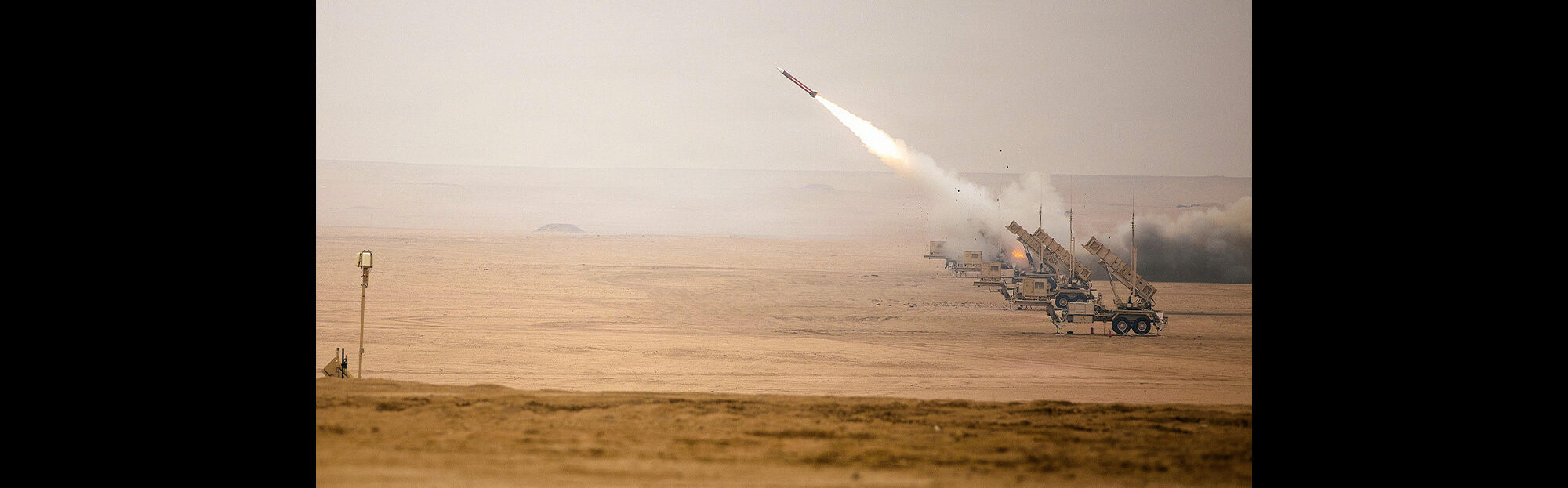
Over the past year, Iranian drone and missile attacks killed American Soldiers at air bases in Jordan and Saudi Arabia, destroyed an E-3 Sentry Airborne Warning and Control aircraft, and damaged other aircraft on the ground. The Combined Air Operations Center (CAOC) at Al Udeid Air Base in Qatar was also severely damaged, as were Navy facilities in Bahrain. The message is hard to miss: Airpower can be neutralized before it ever takes off.
Aircraft, weapon systems, fuel, munitions, and command nodes have always been part of the fight. Today, they are easier to find, easier to reach, and harder to protect. These vulnerabilities are precisely why Agile Combat Employment (ACE) is necessary. By dispersing forces, ACE complicates enemy targeting and gives commanders more options than concentrating combat power at a handful of large bases would. Major hubs are increasingly vulnerable to attack by missiles and drones, supported by persistent space-based surveillance, cyber exploitation, and long-range reconnaissance-strike networks. Yet distributed operations under ACE do not negate the need for fuel, munitions, maintenance, communications, security, and command and control to generate combat power. Unless those locations can detect, warn, conceal, absorb, jam, and defeat incoming threats, dispersal can become exposure by another name.
Air Force Doctrine Note 1-21, “Agile Combat Employment,” provokes a sharp warning from retired Air Force Col. Mark Gunzinger, now Director of Future Concepts and Capability Assessments at the Mitchell Institute for Aerospace Studies: “The best place to kill an enemy’s air force is on the ground.” The danger is greatest, he argued, when that force is postured at bases lacking passive defenses, including shelters and decoys, and active defenses, including kinetic and nonkinetic interceptors, electronic warfare, and directed-energy weapons.
ACE must plug into joint air defense when it is available, and bring its own organic capabilities, as well.
The April 2025 Air Force Doctrine Advisory, “Point Defense of Air Bases,” plainly recognizes the challenge. Today’s limited joint air defense capacity, when combined with ACE, “will stress air defense resources.” Therefore, the advisory warned, “future unit-of-action commanders should not assume that joint capabilities will be available or sufficient.” That is more than a doctrinal footnote. It is the clearest signal yet. ACE is not only a basing concept; it is a force protection problem.
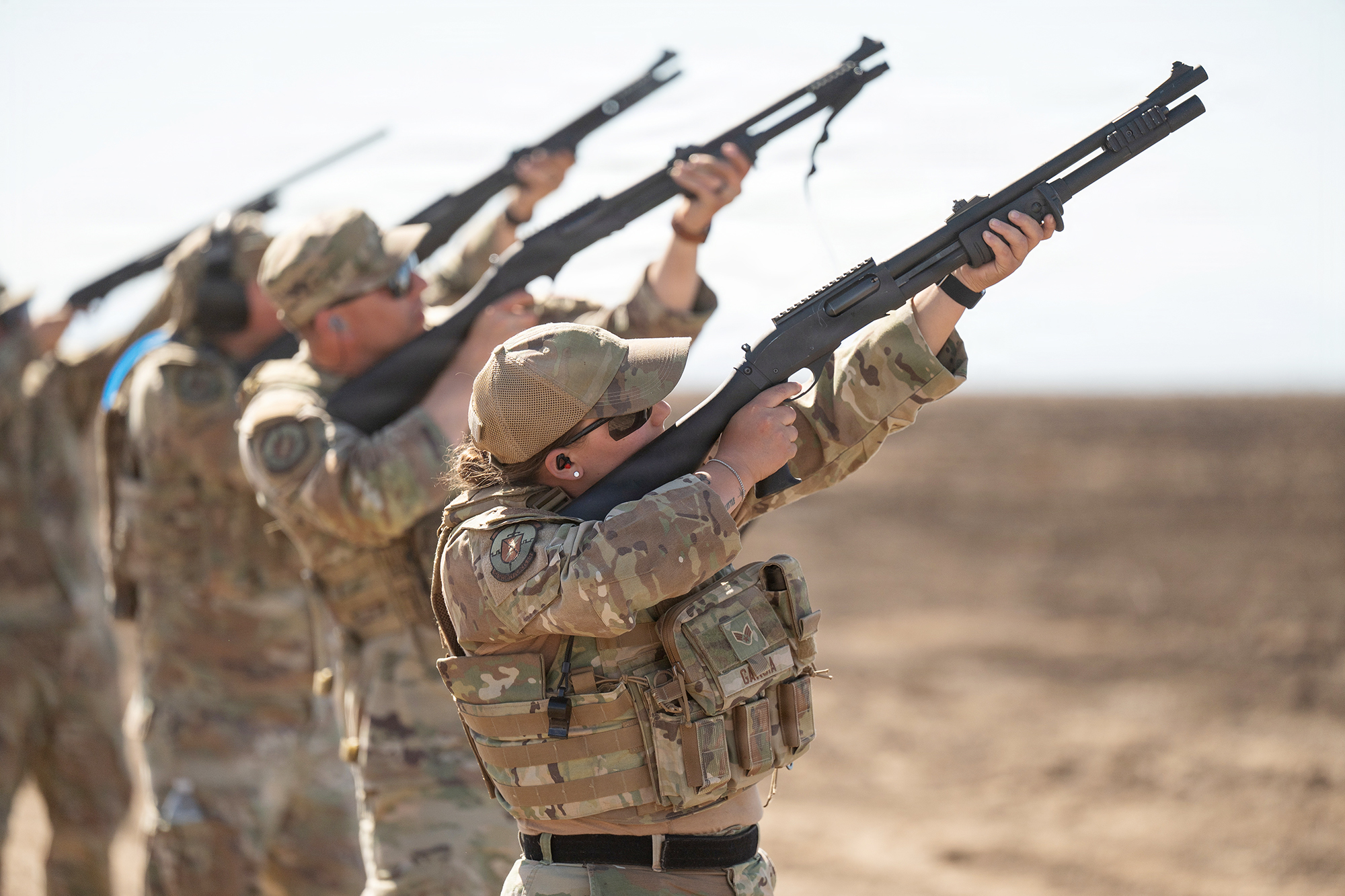
Iran’s response to Operation Epic Fury sharpened the point. Losses at Prince Sultan Air Base, Saudi Arabia, and Al Udeid were significant. While operational control of air assets in the region had already shifted to Shaw Air Force Base, S.C., the loss of the CAOC demonstrated a fundamental fact: In a modern missile and drone war, sanctuary is disappearing. Geography is no longer a defense plan.
DISPERSAL OPENS NEW SEAMS
A force that remains concentrated at a few large bases gives the enemy valuable targets. A force that disperses without an organic defensive baseline does not solve this problem, but complicates it, giving the enemy more targets. The answer is not to abandon dispersal, but rather to make point defense a more integral part of ACE from the start.
ACE is often discussed in terms of movement: move the aircraft, people, munitions, fuel, and command post. That is only half the problem; the other half is whether the force that moved can remain operational after it arrives.
Air Force Doctrine Note 1-21, “Agile Combat Employment,” describes base clusters built around an enduring location and one or more contingency locations. It uses hub-and-spoke distribution to explain how cargo moves between a hub and a spoke. The next step is to translate those location types into a defensive baseline. A hub, spoke, and temporary operating location do not carry the same defensive burden. A hub does not need the same package as a temporary strip. None should be defended by assumption.
ASSIGNED RESPONSIBILITY
If each location type carries a different defensive burden, someone must define who owns that burden before the force disperses.
Traditionally, when a base needed air defense, the Army was tasked with providing it. The National Security Act of 1947, Executive Order 9877, and the Key West and Newport Agreements of 1948 assigned the Air Force responsibility for air superiority, air defense, and strategic warfare. Those agreements set the broad roles-and-missions backdrop, but they did not settle the specific problem of ground-based defense of Air Force bases. In 1956, Secretary of Defense Charles E. Wilson’s roles and missions memorandum assigned the Army responsibility for point air defense and the Air Force responsibility for area air defense. In 1984, that division of responsibility was translated into air-base terms through an Army-Air Force memorandum of understanding (MOU).
The 1984 Memorandum of Understanding on United States Army and USAF Responsibilities for Air Base Air Defense did not assign air base air defense to the Army exclusively. Rather, it stated that air base air defense at USAF bases was a joint Army-Air Force responsibility, with the Air Force responsible for submitting air base air defense requirements to the Army, and the Army responsible for providing support. It also made the Army primarily responsible for ground-based air defense at Air Force main operating bases worldwide.
The MOU required biennial review and became void if two consecutive review cycles passed without one. It expired years ago.
In “Air Base Defense: Rethinking Army and Air Force Roles and Functions,” a 2020 RAND report, researchers concluded that the Air Force “lacks clear authority to develop and procure surface-based air and missile defense (AMD) systems” to protect its own forces. The Army fields robust systems such as THAAD, Patriot, C-RAM, Avenger, and newer short-range air defense programs, while the Air Force has the greatest operational stake in defended air bases. Meanwhile, the Air Force lacks organic ground-based air and missile defenses of its own. The result is not an absence of base defense, but a gap between those with the equipment to defend airfields and those most dependent on them. An arrangement that was already fragile when the problem was defending a limited number of large, established bases becomes untenable under ACE. Dispersal multiplies the number of sites that must be defended without multiplying the Army air defense forces available to defend them. Every hub, spoke, and temporary operating location creates another point defense requirement. Meanwhile, Army air defense remains focused on theater missile defense, maneuver-force protection, and other joint priorities.
JOINT, INTEGRATED, AND ORGANIC
ACE, however, turns operating locations into a form of maneuver. Airmen are no longer tenants on a fixed base waiting for theater defenses to appear, but maneuvering forces operating in and out of a network of smaller sites, sometimes with limited infrastructure, uncertain host-nation support, and compressed decision timelines. In that environment, commanders need more than a general expectation of joint support. They need a defined defensive package, delegated authorities, and a clear way to connect local defense to the broader Integrated Air and Missile Defense (IAMD) enterprise.
Joint integration remains essential. The Air Force cannot and should not try to recreate the entire joint IAMD architecture at every ACE site. Patriot, THAAD, Aegis, theater sensors, air defense command relationships, and the area air defense commander all remain central to the fight. Joint integration, however, is not the same as guaranteed availability. Army air defense capacity is finite. Priorities shift. Distances matter. Communications fail. Legal authorities differ between the homeland and overseas theaters. A commander at a dispersed site may be part of a larger architecture and still have no timely protection at the point of need.
The Air Force, therefore, needs a hybrid model. ACE sites must plug into joint air defense when it is available—but must also arrive with enough organic capability to survive when it is not.
THE THREAT HAS CHANGED
Increased drone incidents make the problem more urgent—both overseas and even in the United States. Unauthorized drone activity over JB Langley-Eustis, Va., in 2023, Royal Air Force bases hosting U.S. forces in the United Kingdom in 2024, and Barksdale Air Force Base, La., in 2026 has little to do with ACE, but it demonstrates that air bases everywhere can be watched, harassed, slowed, or forced into protective postures.
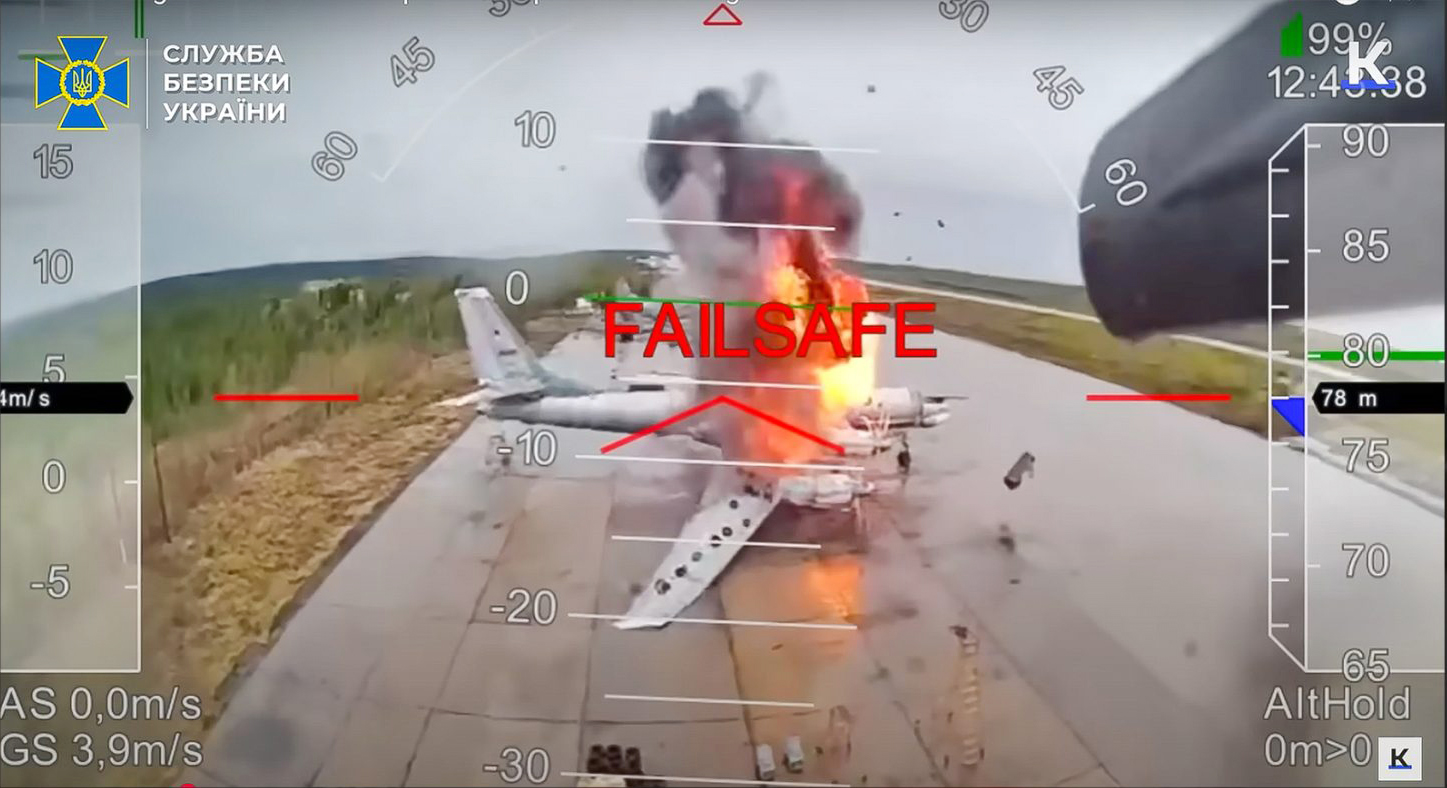
A drone loitering over a flight line, weapons storage area, or command facility does not have to strike to have an effect; it can force commanders to slow operations, protect exposed assets, and change risk calculations under pressure. At U.S. bases at home and abroad, especially near populated areas or allied communities, commanders also face tighter limits on their use of kinetic defeat options. The defensive problem is tactical, legal, political, and operational all at once.
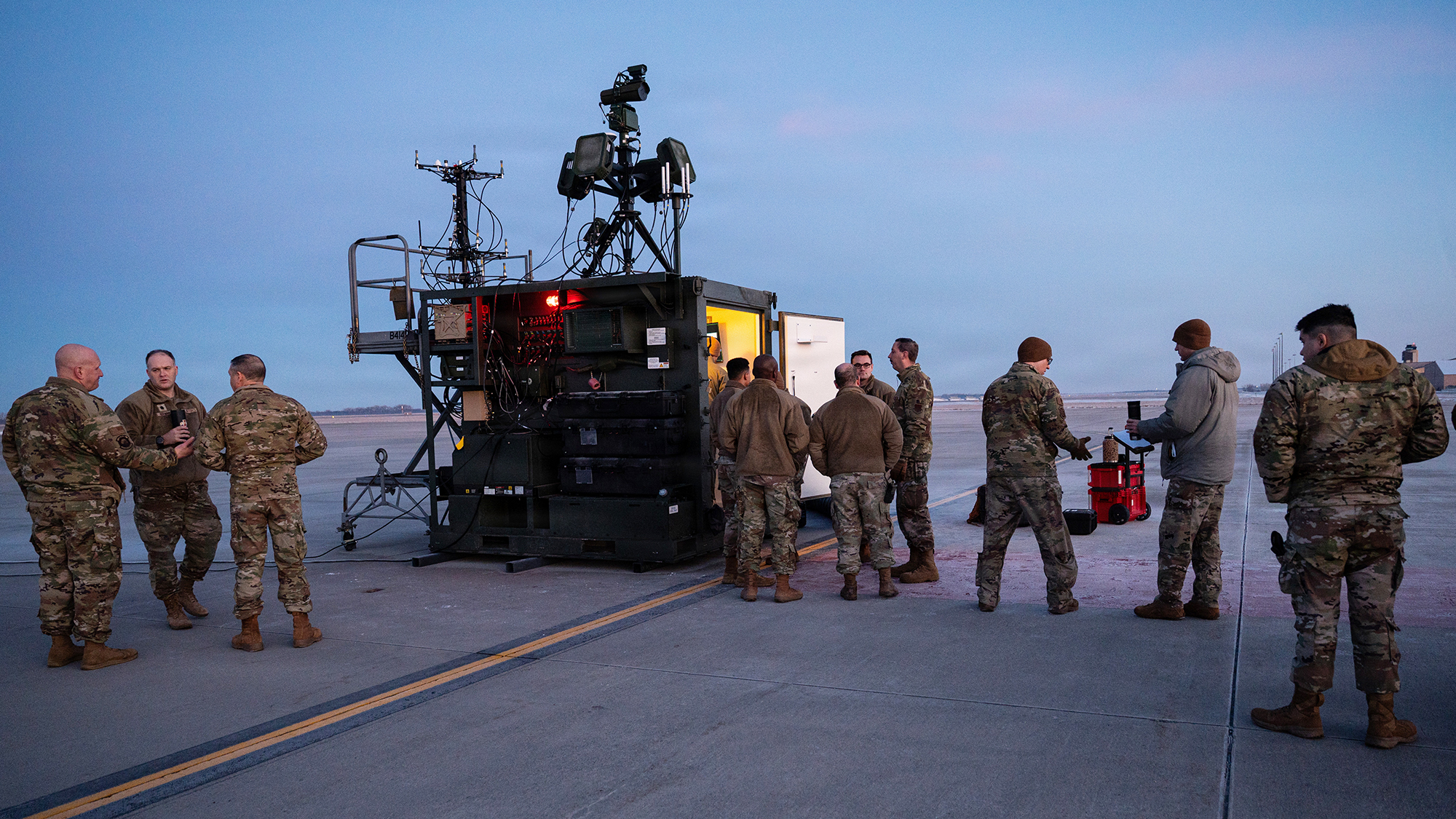
Ukraine’s Operation Spiderweb adds to the warning signs. Using low-cost drones launched from concealment inside Russia, Ukraine damaged or destroyed 41 military aircraft at four air bases thousands of miles from the Ukrainian border. Total losses were valued at approximately $7 billion. For Air Force planners, the lesson is that a runway, fuel point, aircraft shelter, munitions pad, communications node, or parked aircraft need not be obliterated to create strategic effect. It only has to be disrupted at the wrong time.
PROGRESS WITHOUT A BASELINE
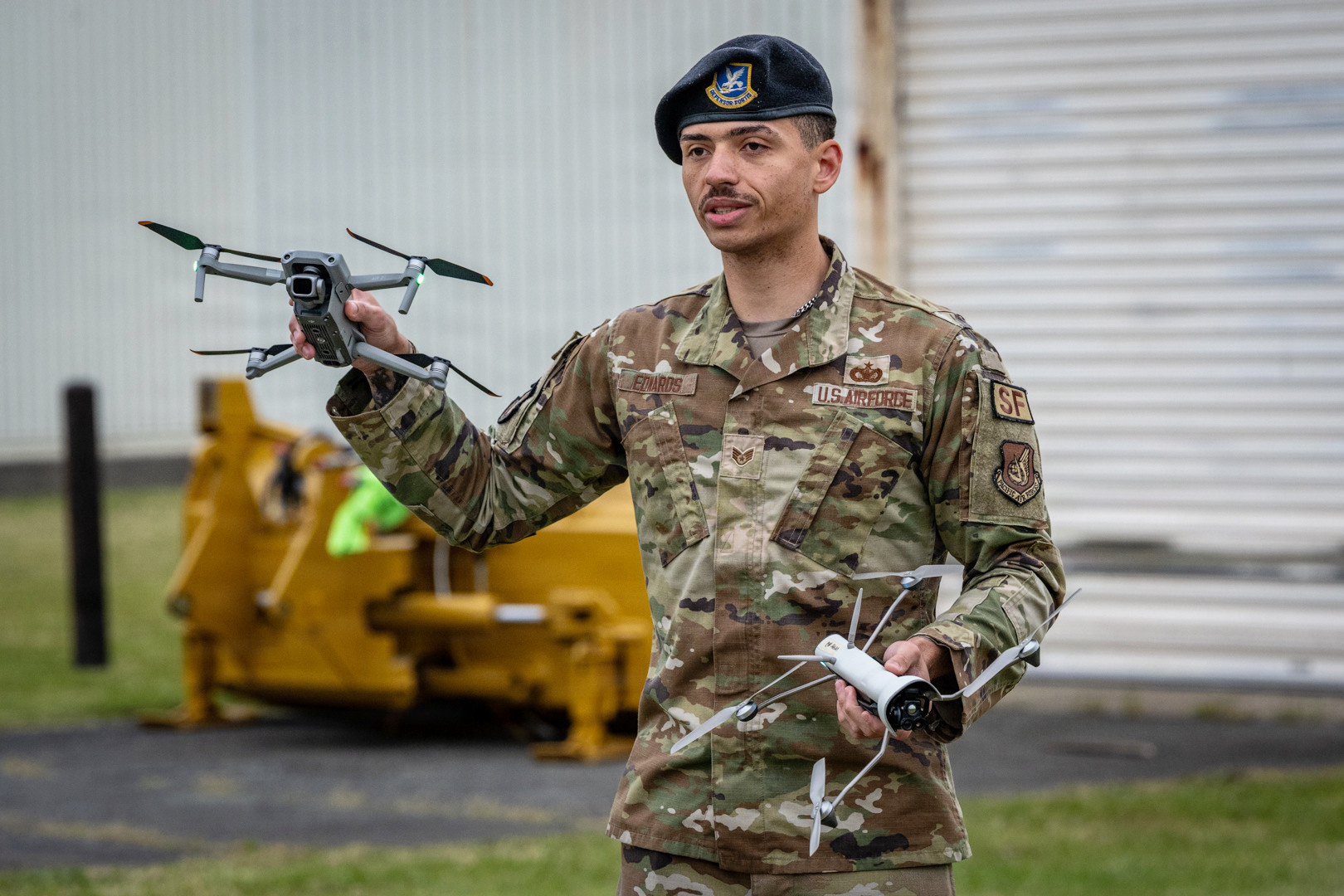
The Air Force is creating point defense teams, a new air base defense specialty, and is experimenting with counter-drone technologies. Air Combat Command’s Point Defense Battle Lab is helping evaluate emerging point defense and Counter-
Unmanned Aerial Systems (C-UAS) capabilities, integrate them into operational practice, and translate lessons into tactics, techniques, and procedures.
USNORTHCOM is doing its part to shore up domestic security. In his April 2026 written statement to Congress, Gen. Gregory M. Guillot said that, in the early hours of Operation Epic Fury, a deployed C-sUAS (Counter-small Unmanned Aerial Systems) Flyaway Kit “successfully detected and defeated sUAS operating over a strategic U.S. installation.” While encouraging, that success also reveals the gap: A rapid-response kit is not the same as a standing point defense package. A kit is not a concept of operations. A sensor is not an authority. A defeat mechanism is not a command relationship.
The Marine Corps offers a useful comparison. Marine littoral regiments include organic air defense capabilities through littoral anti-air battalions, while systems such as the Marine Air Defense Integrated System reflect a service-level decision to integrate expeditionary maneuver with local air defense. That model is not a plug-and-play answer for the Air Force, which faces a broader challenge: defending bombers, tankers, fighters, mobility aircraft, command nodes, munitions, fuel, and maintenance spread across global theaters. But the principle behind the Marine Corps solution is transferable. Maneuver forces that expect to operate inside enemy reach need local defense as part of the formation—not as an emergency attachment.
The Air Force need not copy the Marine Corps, build a miniature Army air defense branch, or turn every ACE location into a fortress. It must, however, stop treating point defense as a support function. ACE is only credible if distributed teams can fight through surveillance, harassment, and attack.
FROM BLIND SPOT TO BASELINE
The solution is layered defense: integration with joint and theater air defenses where available, organic point defense integrated with conventional perimeter security at the site level, and commander-ready decision support that links data, authorities, and risk thresholds before the force disperses. At the enterprise level, the Air Force must define the doctrine, force design, and acquisition path. At the commander level, every ACE package must know what it can defend on its own, what capabilities it can or must request, who can authorize action, and when the site is too exposed to continue operating.
The strategic answer begins with ownership. ACE was introduced to solve a force-generation problem: how to generate combat power when fixed bases are fewer, more visible, and more vulnerable. The Chief of Staff of the Air Force should direct the Curtis E. LeMay Center to develop a point defense annex to ACE doctrine. Headquarters Air Force A5/7 Force Modernization, under the Chief Modernization Officer, should lead enterprise point defense force design and requirements for ACE. Working with major commands and relevant functional authorities, A5/7 should define what protection travels with ACE forces, what remains theater-provided, what depends on host-nation support, and what capabilities must be developed or acquired. The annex should establish defensive expectations for hubs, spokes, and temporary operating locations; identify what protection must move with the force; and explain how local point defense connects to theater IAMD, host-nation support, and homeland defense authorities.
The tactical answer begins with a baseline. Every ACE location should have minimum planning assumptions for passive defense, camouflage, deception, warning, local sensing, communications, C-UAS measures, emergency repair, casualty care, and integration with higher air-defense authorities. Commanders should know five things before dispersal: what must be defended first, what can detect threats locally, what can defeat or disrupt them, who can authorize action, and when risk exceeds the site’s ability to continue operating.
Every ACE package should also deploy with a point defense operational data package: a standardized, machine-readable, releasable, and interoperable data product that identifies the aircraft, weapon systems, fuel, munitions, and command nodes most likely to be exposed first; the local sensors and defeat options available; the authorities governing their use; and the joint, host-nation, and logistical dependencies required to keep the site operating under attack. The package should federate authoritative data from existing operational systems rather than duplicate or replace them, providing commanders and supporting air-defense nodes with a common, decision-ready picture. It should be integrated into the concept of operations, updated throughout planning and execution, exercised before deployment, and usable by commanders, joint air-defense nodes, and host-nation partners in both connected and degraded environments.
Force design should follow. The Air Force should create deployable force protection and point defense teams at the wing or expeditionary level, built to attach to ACE elements rather than remain tied to fixed-base routines. Security forces should be central to those teams, but the teams should also include communications, intelligence, civil engineering, emergency management, spectrum, logistics, and C-UAS expertise. Their purpose would be to help commanders integrate passive defense, local sensing, C-UAS options, communications, recovery, and risk decisions into the maneuver plan from the start.
ACC’s Point Defense Battle Lab can help inform that requirement. The lab is already part of the Department of the Air Force’s broader C-sUAS effort and serves as a hub for developing and evaluating technologies to defend installations from sUAS threats. Its mission—developing and validating tactics, techniques, and procedures for C-sUAS detection, tracking, interception, and neutralization—fits the problem ACE will face at dispersed locations.
That does not mean the battle lab owns deployed-location defense, however. Those decisions remain commander dependent. It means installation-defense experimentation should inform dispersed-operation defense.
Training must make the concept real. ACE exercises should make point defense and force protection core events, not supporting assumptions. Commanders should be forced to operate with intermittent communications, delayed joint support, contested spectrum, limited interceptors, uncertain authority, and visible drone threats. If the first time a unit tests its local point defenses is during combat, the lesson will come too late.
Acquisition, meanwhile, should follow doctrine. Better sensors, cheaper interceptors, directed energy, electronic warfare, low-collateral defeat options, and automated command and control tools all matter. But the Air Force should not buy isolated point defense tools; it should buy systems that fit within a defined ACE defensive architecture. If the past is indicative of the future, buying hardware before defining roles, authorities, force packages, data standards, releasability rules, and risk thresholds will produce disconnected capabilities. The Air Force must define what an ACE site must be able to detect, decide, defend, repair, and report. Then it should acquire the tools necessary to support that operating concept.
This is both a doctrinal problem and an acquisition problem. Doctrine must define the operating concept. Acquisition must provide the tools. Training must make the concept real. Force design must put the right people in the right places before the first missile or drone arrives.
THE PRICE OF AMBIGUITY
The Air Force has spent years learning how to disperse. It now has to define how dispersed forces stay in the fight. Commanders should not be left to improvise point defense under fire, guess what support will arrive, or assume that joint assets will be available at the tactical edge. The lesson from recent air base attacks strongly suggests that ACE is the right strategy, but not yet a complete concept of operations. Distributing forces can reduce the payoff of any single enemy strike, but only if dispersed nodes can fight through pressure and attack. Otherwise, the Air Force merely trades concentrated vulnerability for distributed fragility.
Point defense must become a core element of ACE doctrine, and commanders must be given scalable organic protection, trained force protection teams, delegated authorities, interoperable point defense data packages, and defined links to joint IAMD before they disperse.
Doctrine cannot remove uncertainty from war, but it can reduce and simplify the critical decisions commanders must make under fire. For ACE, that means defining not only where Airmen will move, but how they will detect, defend, recover, and continue generating combat power once they get there.
The Air Force has built a concept for dispersing the force. Now it must build the defensive backbone that allows that force to survive, fight, and win.
Garrett F. Aziz is a technology and defense leader with more than 20 years of experience across private industry, aerospace and defense R&D, enterprise modernization, and military operations. He was a foundational member and integration lead with Air Combat Command’s Point Defense Battle Lab, helping move next-generation air base defense capabilities from concept through experimentation toward operational fielding. His work centers on advanced technology integration, rapid capability development, and future operational solutions that improve interoperability and enable decision advantage across U.S., allied, and coalition missions.
