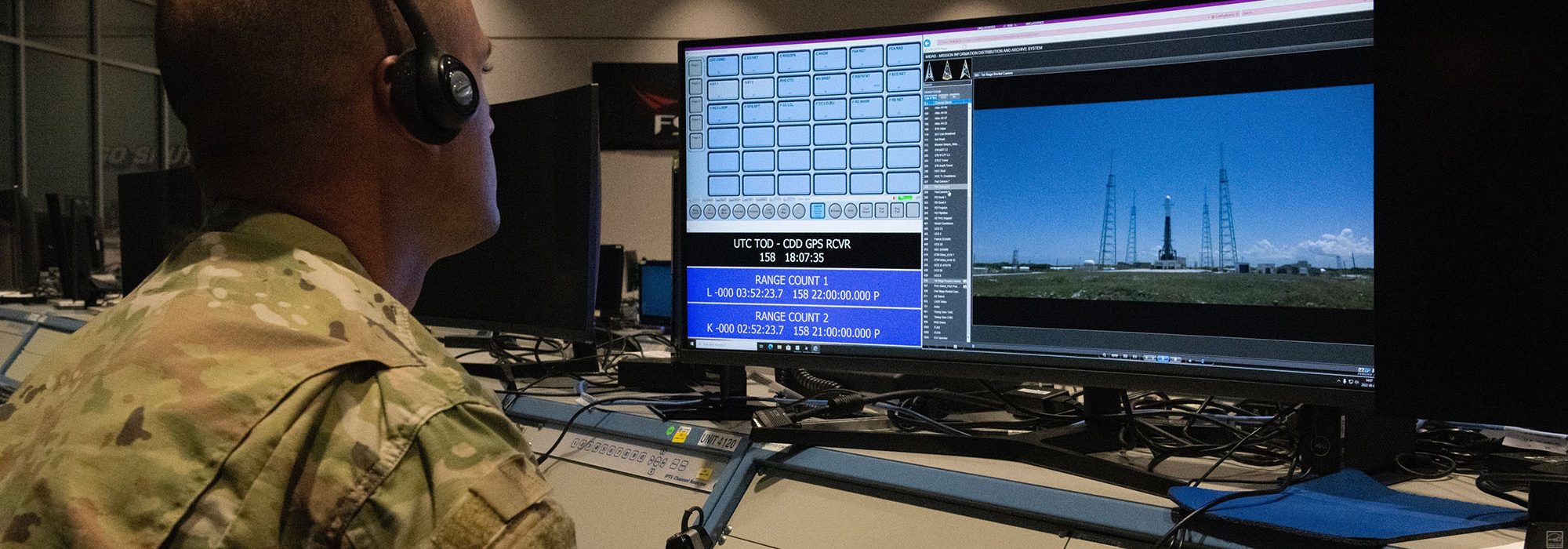
U.S. Space Force Capt. Mark Conque, 1st Range Operations Squadron assistant director of operations, uses the Range Application Deployment system to assess Space Launch Complex 40 at Cape Canaveral Space Force Station, Fla., in 2022. Tech. Sgt. James Hodgman/USSF
Photo Caption & Credits
2023 USAF & USSF Almanac: U.S. Space Force
June 22, 2023
Share Article
Audio of this article is brought to you by the Air & Space Forces Association, honoring and supporting our Airmen, Guardians, and their families. Find out more at afa.org
Audio of this article is brought to you by the Air & Space Forces Association, honoring and supporting our Airmen, Guardians, and their families. Find out more at afa.org
After scrapping a long-delayed program to build a next-generation GPS ground system earlier this year, the Space Force and prime contractor Lockheed Martin are pushing toward delivery of the capability in time to support the first launch of the newest GPS satellites, currently planned for 2028.
The Space Force is looking for industry feedback on its plans to create a new “Mission Development Zone” at Vandenberg Space Force Base, Calif., to support launch providers with space for additional payload processing capacity, test and assembly facilities, and potentially rocket and spacecraft manufacturing infrastructure.
All 12 American bombers deployed in Britain rapidly returned to the U.S. on Oct. 4 following security concerns about a potential Iranian threat to their base in the U.K.
The Space Development Agency is set to launch 21 Tranche 1 data transport satellites on Oct. 5—its fourth Tranche 1 mission since last fall and the first to carry Northrop Grumman-built satellites.
The Air Force adjusted its fiscal 2026 recruiting goal down by a few hundred enlisted Airmen due to higher-than-expected retention and the number of available training slots—but it is aiming high in fiscal 2027 with its biggest goal for the Active-Duty Air Force in nearly 25 years, and the Space…
Some lawmakers in the Senate are advocating for a more bipartisan approach to paying for the Pentagon’s $185 billion Golden Dome missile defense project, arguing that the effort’s goal of bolstering homeland defenses has support across ideological lines but the process for funding it has been politically charged—leaving the program’s…
More than 50 years after the U.S. military launched its first Defense Support Program satellite, the Space Force has officially decommissioned the missile warning constellation as it prepares to start fielding its next-generation architecture.
The long-standing method for communicating data down from space via radio frequencies has the potential to create deadly data bottlenecks that could slow and stymie future operations, according to a new report from AFA’s Mitchell Institute for Aerospace Studies. The report makes the case for combining RF with optical communications…
In a “State of the Force” address Sept. 30, Secretary of Defense Pete Hegseth announced plans for a new four-star command to lead the military-wide push to field autonomous systems, one of several initiatives meant to further his sweeping transformation of the Pentagon.
✓
Thank You!
Check your inbox to verify your email address and finish setting up your AFA account.
★
Welcome Back!
An account with this email already exists. Please log in to continue.
Subscribe to the Air & Space Forces Daily Report
The latest news from Air & Space Forces Magazine, as well as news from other leading publications, delivered right to your inbox every morning!
We’re sorry, there has been an error. Please review your input or try again later.