
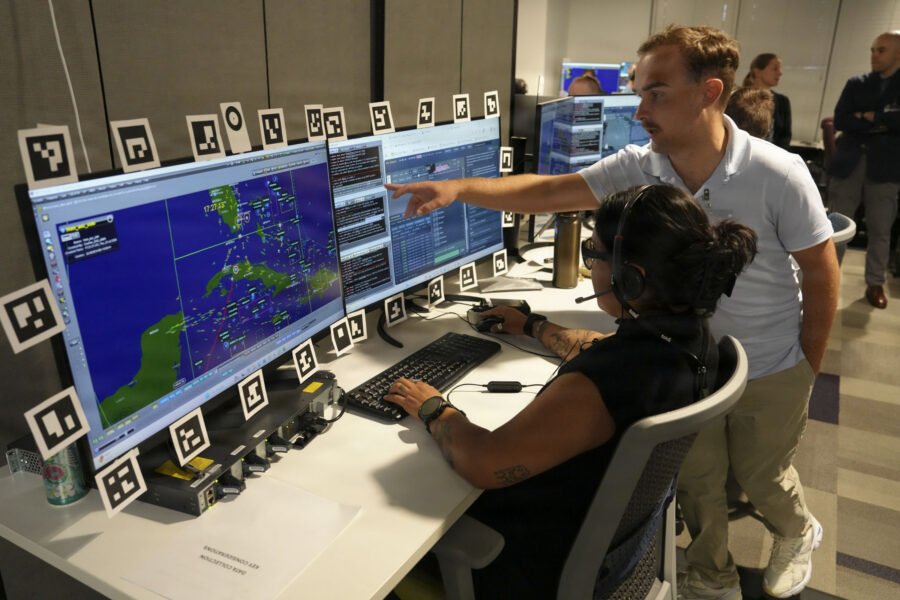
A recent two-week experiment tested how Airmen and Guardians can team with machines and artificial intelligence to enhance command and control in complex scenarios—with researchers measuring everything from participants’ heart rates to the quality of their decision-making.
A Space Force crew led an integrated operational crew with Air Force battle managers and industry software developers at USAF’s Shadow Operations Center-Nellis for the July test. It is the fourth iteration of the Decision Advantage Sprint for Human-Machine Teaming series and the first time a Guardian led the C2 team.
That team worked through different scenarios for the July 13-24 experiment, validating software and technical capabilities to support operators across the Air Force and Space Force, according to a service release.
The Air Force Research Laboratory and its 711th Human Performance Wing were on hand to assess the effects of the new AI tools. The wing analyzed the speed, quality, and decision accuracy of a human-machine team versus a human-only team. They also measured heart rate, real-time cognitive workload, and tracked gaze fixation patterns to better understand human reaction and response.
“This biometric and behavioral analysis mapped visual attention distribution, evaluated cognitive workload thresholds, and analyzed workflow dynamics during high-tempo operational scenarios,” Amanda Szczublewski, AFRL’s technology transition office acquisition program management specialist, told Air & Space Forces Magazine.
The 805th Combat Training Squadron at Nellis Air Force Base, Nev., hosted the experiment, and participants got a taste of scenarios operators would face in the heat of battle.
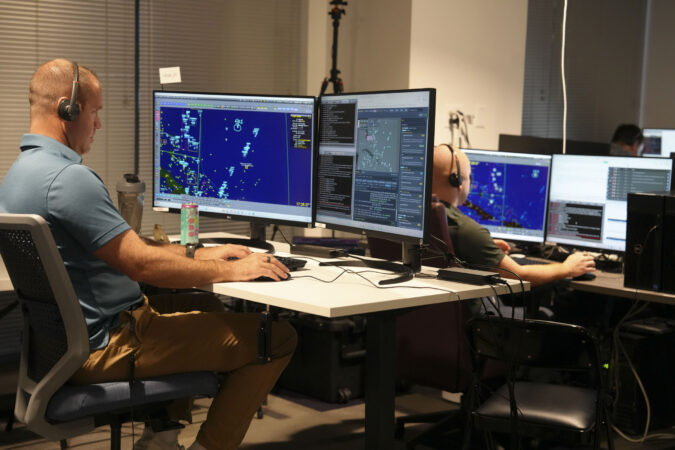
“This isn’t a scenario from a video game. It is one crafted to challenge operators and engineers alike,” said Air Force Lt. Col. Wesley Schultz, squadron commander. “We reflect the real-world challenges of geography and logistics, and even real-time changes in the rules of engagement, because that reflects the reality of modern warfare.”
The Space Force portion of the DASH specifically used existing operational data such as simulated space domain awareness and electromagnetic warfare parameters, Space Force Col. Teina Stallings-Lilly, deputy director of operations integration for the Advanced Battle Management System Cross Functional Team, told Air & Space Forces Magazine in an email.
“This enabled the artificial intelligence decision aids to evaluate how space asset positioning and readiness directly impact theater-wide courses of action in real time,” Stallings-Lilly said.
Air Force Col. John Ohlund, ABMS-CFT Director, said the experiment focused on “game theory” to test battle managers.
“We are moving beyond simple, reactive scenarios and presenting our warfighters with complex, ambiguous problems where they must be proactive, weigh tradeoffs, and make decisions when there is no perfect answer,” Ohlund said. “This approach is essential for developing the cognitive superiority our joint force needs to out-think and outmaneuver a peer adversary in a high-end conflict.”
The 805th, also known as the Shadow Operations Center-Nellis, made sure the experiment “generates authentic, high-tempo combat data,” Schultz said.
“By immersing operators in complex, game-theory-driven scenarios, our battle lab allows the AFRL and 711th teams to capture both real-time system performance metrics and objective warfighter feedback, producing rigorous, scientifically validated insights into human-machine teaming,” Schultz said.
The combined human and machine data gave observers a clearer picture of the demands of air and space battle management at a high operational tempo.
“Our data and direct observations confirm that the fundamental cognitive challenges for a battle manager are domain-agnostic,” Dr. Elizabeth Frost, AFRL’s DASH lead, said in the release. “Both Airmen and Guardians are tasked with synthesizing vast amounts of complex data and prioritizing actions under intense time pressure. This event demonstrated that a well-designed human-machine team can effectively free up an operator’s cognitive resources.”
The analysis will help quantify cognitive workload mitigation, validate trust in autonomy, and inform future interface and architecture training requirements for battle management systems, Szczublewski said.
Government assessors evaluated team effectiveness using key metrics:
- Number, Speed, and Quality of Decisions: Assessing how effectively the system supported risk-versus-opportunity evaluations, time-critical execution, and prioritizing mission tasks aligned with the commander’s intent.
- Contribution to Human-Machine Team Performance: The primary objective was to help the human operator make higher-quality, faster decisions by synthesizing complex data and delivering actionable posturing directions and options for the operator to select and execute.
The DASH experiment isn’t just about generating research insights. The ShOC-N also serves as an operational proving ground for new software, hardware, and tactics, techniques, and procedures to evaluate before deploying across the force, Schultz said.
For operators, having quick access to these software tools proved their worth quickly.
“These sprints represent the biggest shift in battle management in my career,” Schultz said. “We’re taking what technology allows for and shaping it in a way that magnifies the skills and training of warfighters to ensure we maintain decisive advantage in conflict.”
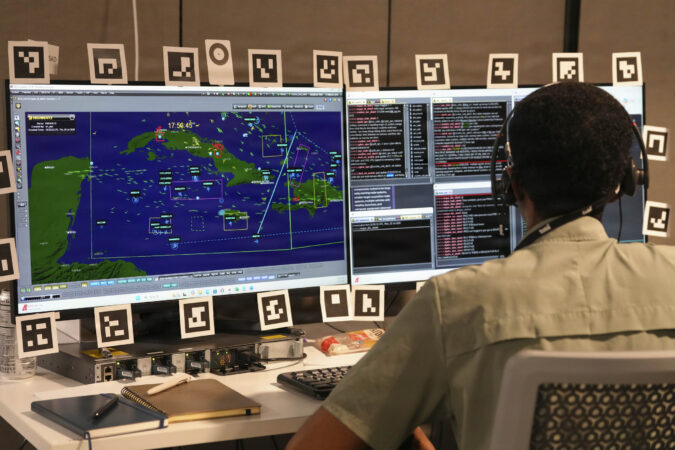
The Air Force has conducted four DASH events since March 2025 and a single Multi-Decision Advantage Sprint for Human-Machine Teaming, or MASH, in May, Air & Space Forces Magazine reported.
“Every event in the DASH and MASH series is uniquely designed around specific operational objectives. Rather than simply making a scenario ‘harder,’ the 805th scenario design team crafts tailored, high-fidelity threat environments based on targeted operational requirements,” said Schultz, the 805th’s commander.
The squadron’s domain experts inject operational complexities, such as contested logistics, dynamic geography, and shifting rules of engagement, Schultz said.
Then, the modeling and simulation team translates the variables into digital representations and ensures the software tools are evaluated against authentic combat conditions rather than idealized laboratory settings, he said.
The MASH experiment launched a government-owned software orchestrator, and the July DASH event validated the “plug-and-play” software design by linking the system with various software solutions. The government’s orchestrator interface let users test multiple, competing industry applications on the system.
The orchestrator is a “tool-agnostic decision engine” that determines which vendor decision function to call on based on the state of the current operational environment, Szczublewski said.
The interface is designed to work with any vendor’s decision tool and allows a mix-and-match of vendor solutions, giving users diverse options to deal with posture and sustainment asset problems, she said.
“Our goal is to get the most advanced capabilities into the hands of the joint force at speed,” Air Force Lt. Col. Corey Ellsworth, ABMS-CFT integration lead, told Air & Space Forces Magazine. “This entire framework was built from the ground up to ensure that once a capability is validated here, we can securely and efficiently transition it to the classified networks where our Airmen and Guardians will actually use it in a high-end fight.”
Officials declined to disclose the industry participants, citing operational security risks.
“By executing these sprints in an unclassified environment, the experiment demonstrated how the department can leverage rapid industry innovation within a modular, microservices-based architecture,” an Air Force spokesperson told Air & Space Forces Magazine in an email.
