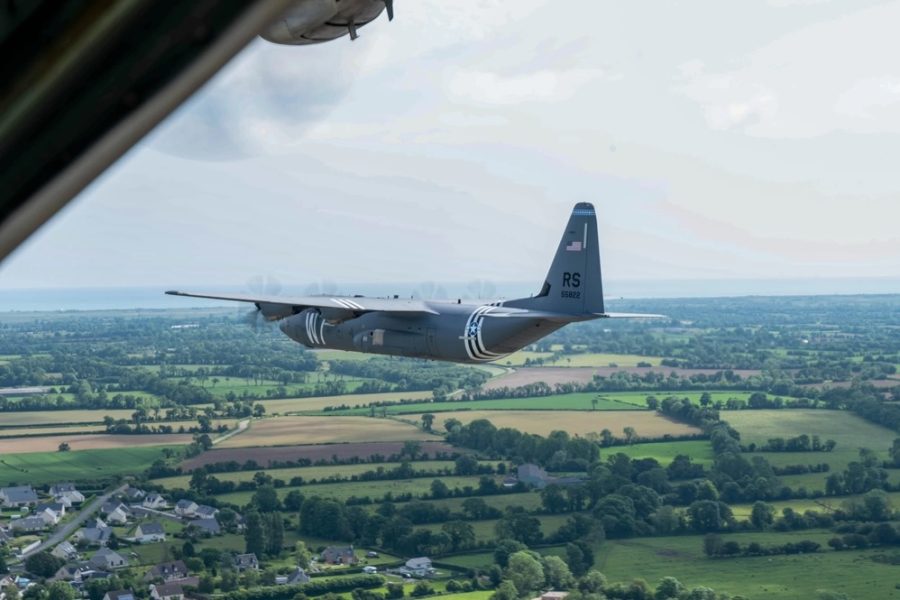
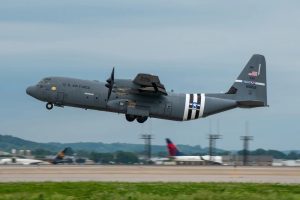
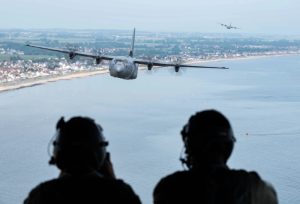
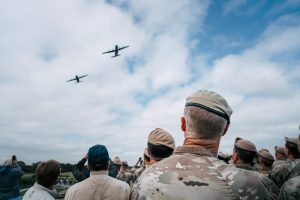
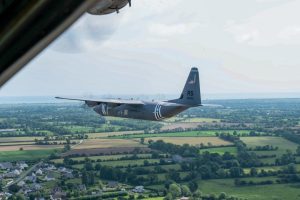
A U.S. Air Force C-130J Super Hercules assigned to the 37th Airlift Squadron, Ramstein Air Base, Germany, gets ready to fly over a commemorative ceremony for the 80th anniversary of D-Day at Sainte-Mere-Eglise, France, June 3, 2024. (U.S. Air Force photo by Senior Airman Jordan Lazaro)
Audio of this article is brought to you by the Air & Space Forces Association, honoring and supporting our Airmen, Guardians, and their families. Find out more at afa.org
Air Force crews flew over France this week in C-130 transport planes decked out in black-and-white “invasion stripes” for the 80th anniversary of D-Day, the June 6, 1944 battle where U.S. and allied troops began the liberation of Nazi-occupied France during World War II.
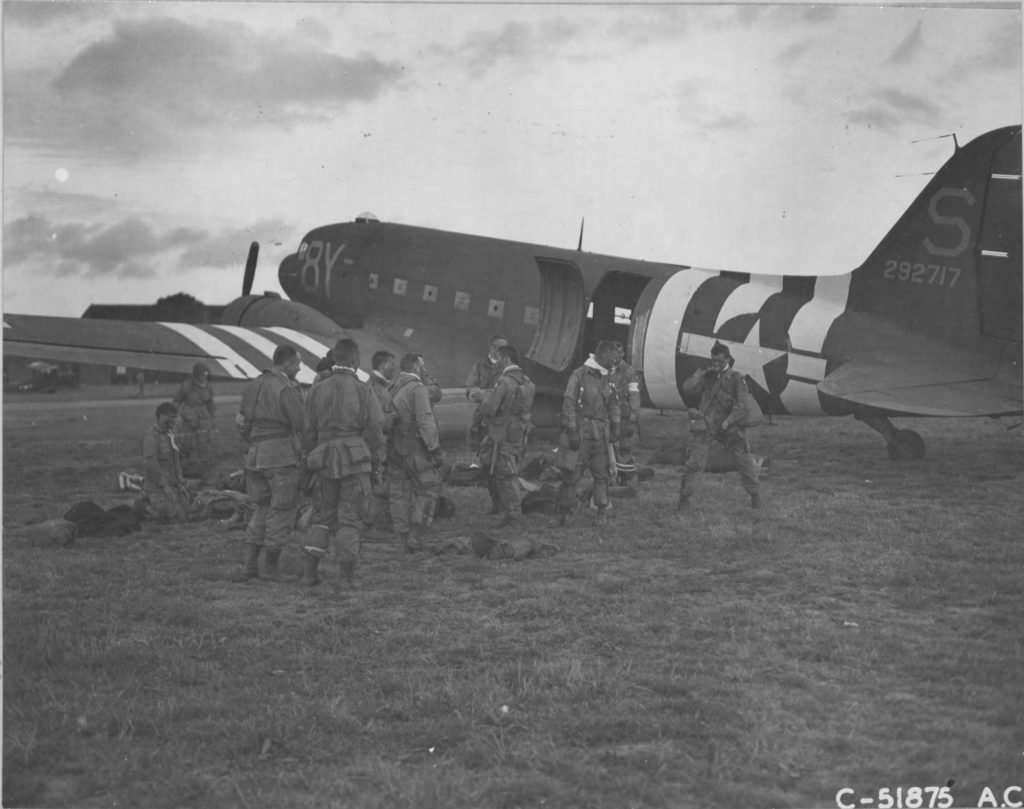
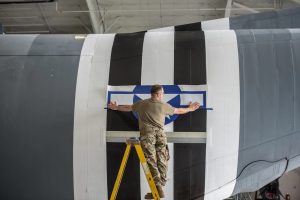
The stripes commemorate the patterns painted on allied aircraft during the invasion so that ground troops could quickly identify them as friendly forces. A year earlier, during the 1943 invasion of Sicily, Allied naval gunners mistakenly shot down 23 C-47 transports and heavily damaged another 37, killing dozens of paratroopers and air crew members.
“The incident would lead to better coordination between units and the black and white recognition stripes used on aircraft at Normandy,” according to the National World War II Museum.
Many of the stripes were hastily painted on June 3 for troop transports and June 4 for fighter and bomber squadrons—the short notice was part of an effort to keep the plan a secret, according to the National Air and Space Museum.
American paratroopers prepare to board their C-47 for their jump into Normandy. (U.S. Air Force photo / National Archives and Records Administration)
Over the years, many U.S. and allied air forces have sported the invasion stripes in honor of D-Day, including A-10 and F-15 fighter jets; C-17 and C-130 transport planes; and the United Kingdom’s Typhoon fighter jet.
For the 80th anniversary celebration, which will include dozens of events across France over several weeks, multiple USAF aircraft are sporting invasions stripes.
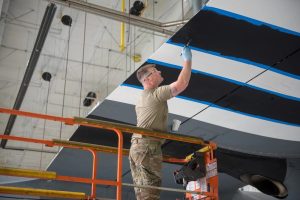
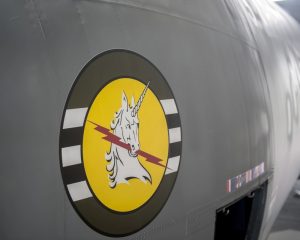
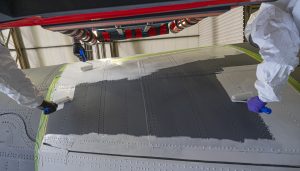
One is a C-130J assigned to the Kentucky Air National Guard. Besides the stripes, the Super Hercules also featured nose art based on the squadron patch of the WWII-era 368th Fighter Squadron which eventually became one of the first units of the Kentucky Air National Guard.
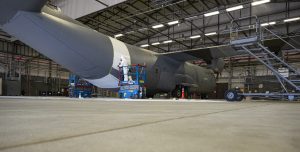
“I feel honored to be part of this 80th anniversary—to pay tribute to the men who gave so much so we could secure our freedom,” Master Sgt. Lee Stanley, aircraft structural shop chief for Kentucky’s 123rd Maintenance Squadron, said in a press release. Stanley led the paint effort, which started in late May.
“Designing the nose art is something I took a lot of pride in, and something I didn’t take lightly,” he added. “I wanted to make sure we got all the details historically accurate.”
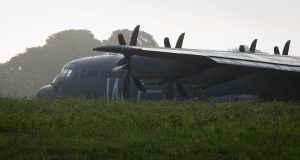
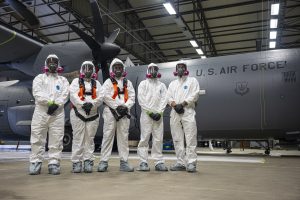
Multiple C-130s from Ramstein Air Base, Germany, also got the stripes, with maintainers painting them on months ago.
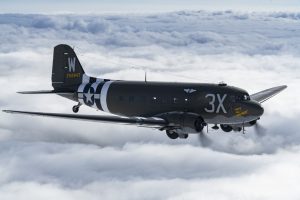
Also included in the celebration was the legendary C-47 “That’s All, Brother” that led more than 800 C-47 Skytrain transports that ferried troops and cargo on D-Day.
“A steady and proven aircraft, the C-47 earned for itself a reputation hardly eclipsed even by the more glamorous of combat airplanes,” wrote Air Mobility Command Museum in a tribute to the C-47, which was widely known as the “Gooney Bird.”
The C-47 also evacuated wounded troops, dropped flares for bombing attacks at night, flew reconnaissance and psychological warfare missions, and served as a gunship during the Vietnam War, the museum wrote
All told, more than a dozen U.S. Air Force aircraft are participating in the 80th anniversary events, mostly C-130s. The 93rd Air Ground Operations Wing from Moody Air Force Base, Ga., also sent 30 Airmen to parachute in a June 9 display.
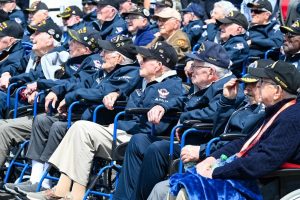
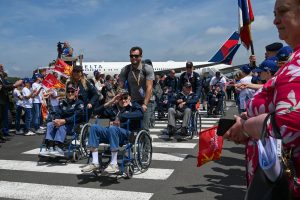
Several dozen D-Day veterans attended the 80th anniversary, which may be the last time many of them see invasion stripes flying overhead.
“For a lot of those guys who fought at D-Day, this might be the last chance they get to see this,” Stanley said. “So we really took a lot of care to make sure we got everything right.”
Audio of this article is brought to you by the Air & Space Forces Association, honoring and supporting our Airmen, Guardians, and their families. Find out more at afa.org
U.S. Northern Command plans to sign an agreement with its European and Pacific counterparts to enhance coordination and close security seams in the Arctic, a strategically vital region that spans all three commands. The agreement comes at an important moment in NORTHCOM's evolution, as its mission grows more complex.
The Anduril-built Barracuda cruise missile recently received certification as the Air Force’s first large-scale production munition compliant with open systems architecture.
The Air Force has invested $87.4 million to upgrade the F-16 Fighting Falcon's electronic warfare capabilities, bolstering the fighter's self-protection against increasingly advanced threats. Bringing the total program value to $1.92 billion, the move is expected to jump-start fielding by funding low-rate initial production of the AN/ALQ-257 Integrated Viper Electronic…
One of the Air Force and Navy’s most common air-to-air missiles is falling short of a key readiness metric, and the services are ramping up stocks of a vital air-to-ground missile, according to recent Pentagon reports.
Nellis Air Force Base, Nev.—a longtime hub for A-10 Thunderbolt II tactical training, operational testing and maintenance—ended nearly a half-century of flying the venerable Warthog on Sept. 22.
Chinese President Xi Jinping’s state visit to Washington D.C. has been filled with signs of American airpower: U.S. Air Force B-1 and B-2 bombers and F-22 fighters have all performed flyovers Sept. 23-24.
The Air Force’s HH-60G Pave Hawk helicopter made its final flight earlier this month. The 129th Rescue Wing retired its last HH-60G with a final flight and ceremony on Sept. 10 at Moffett Air National Guard Base, Calif. The Pave Hawk is being replaced by an updated model, HH-60W Jolly…
General Atomics Aeronautical Systems Inc. and Anduril Industries both say they’re ready to produce Collaborative Combat Aircraft at a rapid clip and even expand that production, as they wait for a fiscal 2027 budget to fund that work.
A misaligned vane in an F-16 engine that field-level maintainers cannot see to inspect caused one of the U.S. Air Force's Thunderbird jets to crash last December, a new report concludes. The same problem led another F-16 to crash 20 months earlier.
✓
Thank You!
Check your inbox to verify your email address and finish setting up your AFA account.
★
Welcome Back!
An account with this email already exists. Please log in to continue.
Subscribe to the Air & Space Forces Daily Report
The latest news from Air & Space Forces Magazine, as well as news from other leading publications, delivered right to your inbox every morning!
We’re sorry, there has been an error. Please review your input or try again later.