
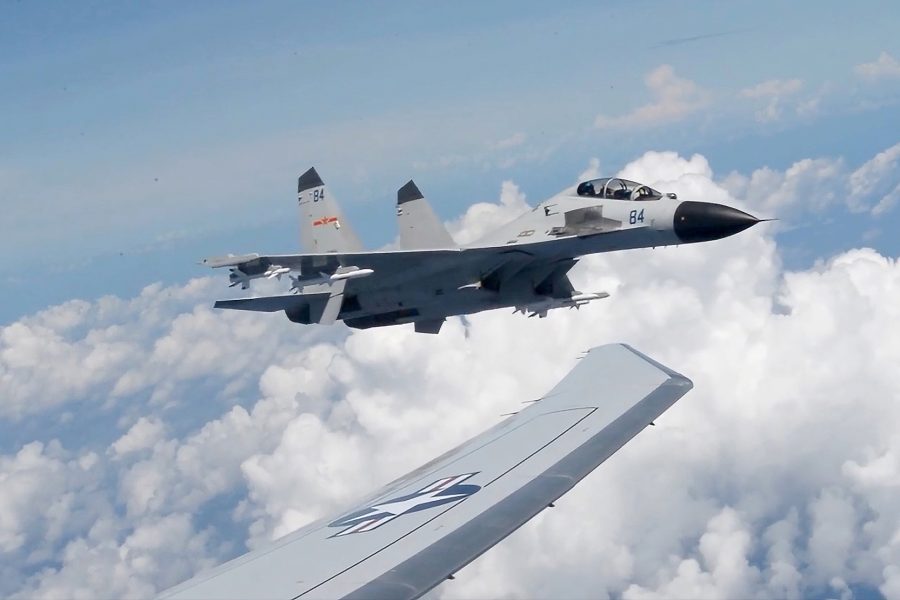
The Air Force is slashing all civilian positions at its premier research institute for Chinese military aviation, prompting concern among experts who say it will dilute the service’s focus on the Pentagon’s most significant long-term adversary.
“We are disappointed to have to announce that Air University has decided to close the China Aerospace Studies Institute,” Brendan Mulvaney, the institute’s director, wrote in a message released Sept. 22.
The China Aerospace Studies Institute has been staffed primarily by civilian scholars and analysts who work for Air University, which is part of Air Education and Training Command. For years, they have been preparing reports on the Chinese military, translating Chinese military doctrine, and contributing to what is widely considered to be the largest open-source repository of information on the People’s Liberation Army’s military aviation, space, cyber, and missile forces.
An Air Force spokesperson told Air & Space Forces Magazine that the institute “is not closing” and said its mission of analyzing developments in Chinese airpower will continue—but acknowledged that its eight civilian positions have been targeted for downsizing and did not explain in detail how the institute would continue once the staff in those positions find new jobs. Four military personnel currently work for CASI, including two military fellows, and one uninformed position remains unfilled.
“Air University continues to evaluate the alignment of the CASI mission to best support DAF priorities,” the spokesperson said. “The mission will continue using assigned military personnel and civilian personnel to execute priorities outlined in their charter.”
Mulvaney, in his update, said that as of Oct. 1, the start of the new fiscal year, all civilian positions at the research center will be considered “unfunded,” though the positions still exist—for now. “CASI has commitments that it has made and will honor, to the best of our ability, through at least March of 2027,” he wrote.
“Unless we find a new home within the Department for the whole CASI team, I expect people to find other jobs and move on,” Mulvaney added. “Once all of the civilians eventually depart, CASI will close.”
The Air Force spokesperson did not detail how CASI could be restructured or how its expertise and workflow would be preserved.
The announcement came a day before Chinese President Xi Jinping’s visit to Washington D.C., to meet with President Donald Trump, though Air & Space Forces Magazine understands CASI’s status has been on shaky ground for months.
No changes have been announced to similar institutions run by the Navy and Army. The U.S. Naval War College’s China Maritime Studies Institute and the U.S. Army War College’s China Landpower Studies Center will continue their work.
Experts say the open-source nature of CASI’s work enabled Congress and much of the public to get a better understanding of the Air Force’s primary long-term challenger.
China’s military advances have driven much of the Air Force’s thinking on its future force design and justification for new platforms such as the B-21 Raider stealth bomber, the F-47 Next-Generation Air Dominance fighter, and Collaborative Combat Aircraft. Service leaders said the decision to field those programs was influenced by the need to counter China in the Pacific.
But despite the service’s stated focus on China, the future of the center was impacted by the Department of the Air Force’s push to cut civilian jobs. Air University is prioritizing funding for more traditional civilian teaching positions for professional military education, people familiar with the matter told Air & Space Forces Magazine.
One China expert said this move could hurt the Air Force’s ability to explain its funding needs on Capitol Hill.
“I think the Air Force probably undervalues open-source intelligence and underappreciates this type of scholarly research on the People’s Liberation Army,” said J. Michael Dahm, a senior fellow for aerospace and China studies at AFA’s Mitchell Institute for Aerospace Studies. “Leaders seem to think classified information is somehow more valid than something gleaned from open-source. But the focus on the classified record undermines the Air Force’s ability to tell its story, especially on Capitol Hill and to the American people.”
“Having unclassified, open-source intelligence about the Air Force’s pacing challenge helps tell that story,” Dahm added. “Getting rid of CASI would be a self-inflicted wound that exacerbates a long-standing Air Force problem.”
Dahm, a former intelligence community professional who served as the Senior Naval Intelligence Officer for China at the Office of Naval Intelligence and the assistant U.S. Naval Attaché in Beijing, said institutions such as CASI have filled a gap in U.S. research into the opposing militaries.
“You can make the argument that collecting and analyzing Chinese-language open-source information should be a mission for the U.S. intelligence community. But the IC is consumed with analyzing and processing a torrent of classified information,” Dahm said. “The researchers at CASI are a force multiplier that provide the intelligence community with valuable context, often pointing them toward issues they might otherwise miss.”
China has put a “much greater emphasis on open-source intelligence than we do in the U.S.,” he noted.
“China’s military has closed many of its gaps with the West by digesting and analyzing the volumes of open-source information we put out there,” Dahm said. “They institutionalized open-source scientific and technical research in the 1950s, and they have continued to harvest the volumes of scientific journal articles, trade brochures, operator manuals, and anything else they can lay their hands on to develop countermeasures against our technology and fuel their own military development. They are also downloading and translating U.S. military doctrine, safety manuals, incident reports, and lessons learned to inform their tactics and procedures.
“Eliminating CASI would be divesting the Air Force of its only institutional counterweights to China’s open-source intelligence machine.”
