
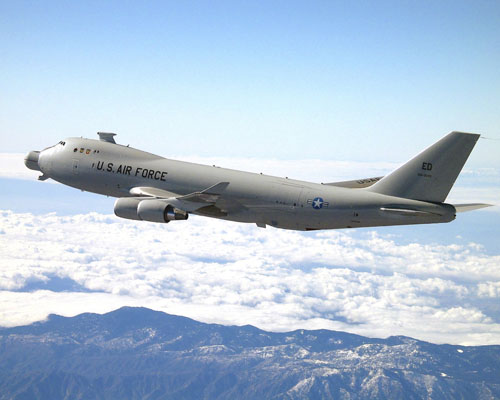
 The sole Airborne Laser aircraft—YAL-1— stopped over at Andrews AFB, Md., just outside Washington, Thursday and offered visitors a rare look inside the boost phase missile interceptor. While the converted Boeing 747 was missing its main weapon—the Chemical Oxygen Iodine Laser, which is currently undergoing testing at Edwards AFB, Calif.—senior government officials and media got a walk through the aircraft, getting a good look at the beam transfer assembly, known by the engineers as the “wall of fire,” the collection of optical mirrors that amplify the laser’s effect as it travels through the aircraft and out of the turret, the targeting stations, and the assemblies for housing the laser. According to Air Force Col. John Daniels, the Missile Defense Agency’s ABL program director, the COIL will be integrated into the aircraft starting later this year, in preparation for a planned 2009 live shootdown. The aircraft returned to Edwards Thursday evening, where it will continue testing with its surrogate low energy laser. On the ground, the COIL has been test fired more than 70 times over the past three years and has made significant progress toward completing ABL “knowledge points.” The hardest part now? “Putting it all together and making it work,” Daniels said. Joining up the COIL, targeting laser, atmospheric sensors, and telescoping sensors is what the ABL team has to pull off before the system is complete.
Air Force depots are not typically meant for quick repair jobs, but during Operation Epic Fury, the service moved some of its stateside heavy maintenance capability forward to fix battle-damaged aircraft closer to the fight.
