
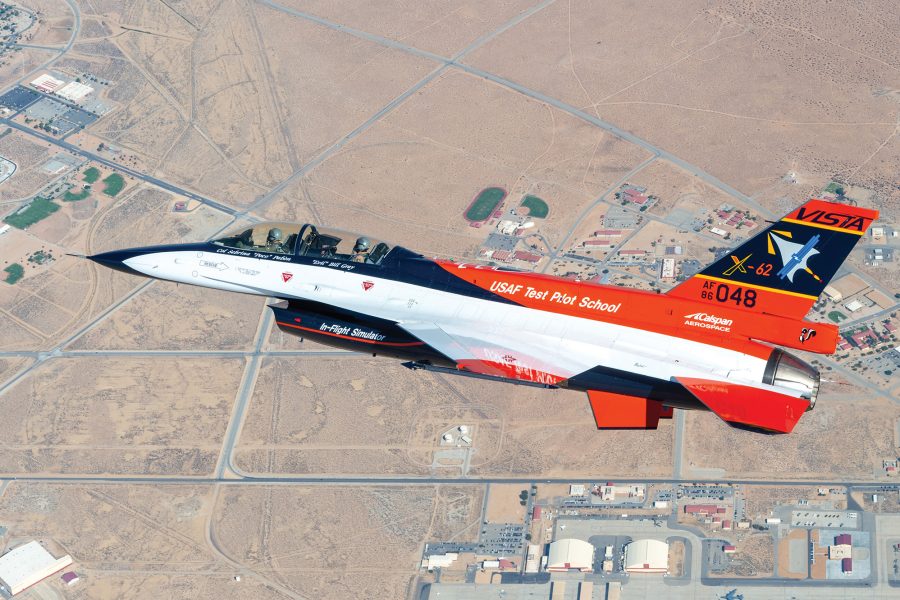
The X-62 Variable-stability In-flight Simulator Test Aircraft (VISTA) is a highly modified F-16D Block 30 capable of replicating the flight characteristics of a wide array of aircraft. VISTA was initially modified to support the Multi-Axis Thrust-Vectoring (MATV) program that tested the combat potential of high-angle-of-attack maneuvers starting in July 1993. VISTA completed 95 test flights with the Axisymmetric Vectoring Exhaust Nozzle (AVEN) and General Electric F110-GE-100 engine before the program terminated in 1994.
The aircraft subsequently became a mainstay of the USAF Test Pilot School, training test pilots and flight-test engineers to evaluate unstable or unpredict-able aircraft with relative safety. The VISTA aircraft more recently aided in the development and testing of Automatic Integrated Collision Avoidance Systems (ICAS), enhancing the safety of the F-16 and other fighter fleets.
Originally designated NF-16D, the aircraft was equipped with the VISTA Simulation System (VSS), which could generate differing flight dynamics for the pilot linked to a second control stick in the cockpit. VISTA incorporates an enlarged dorsal spine for additional equipment, as well as a drag chute in common with some export variants of the F-16. It was redesignated X-62 in 2021 as part of a radical modernization that included upgrading VSS and integrating the new System for Autonomous Control of Simulation (SACS) and Model Following Algorithm (MFA).
SACS permits the aircraft to be remotely controlled from the ground or operated via reprogramable synthetic artificial intelligence (AI), though with a safety pilot onboard. Open-architecture upgrades permit rapid reprogramming of various AI or control dynamics to replicate a broader variety of aircraft including uncrewed platforms.
X-62 became the first supersonic aircraft to fly under AI control in December 2022, completing a series of 21 flights before advancing to dogfight scenarios that built from defensive to offensive, eventually countering conventional, manned fighters in 2023. The Air Force Research Laboratory is employing X-62 as a surrogate to test software for the Skyborg paired, autonomous aircraft program. Algorithms flown on the X-62 enabled an unmanned XQ-58A Valkyrie to successfully fly via synthetic AI control.
USAF is also modifying six F-16s with autonomous flight controls under the separate Viper Experimentation and Next-gen Operations Model-Autonomy Flying Testbed program (VENOM-AFT), which is likewise developing Collaborative Combat Aircraft (CCA) concepts.
X-62 is slated for a Mission System Upgrade that will add AESA radar and advanced sensors, expanding the complexity of experiments and scenarios it can undertake.
X-62 Variable-Stability In-Flight Test Aircraft Technical Data
Contractors: Lockheed Martin; Calspan Aviation (VISTA VSS).
First Flight: April 1992 (NF-16D VISTA).
Delivered: January 1995.
IOC: 1992.
Production: One.
Inventory: One.
Operator: AFMC (AFRL, AFTPS).
Aircraft Location: Edwards AFB, Calif.
Active Variants: •X-62A. Highly modified F-16D Variable stability In-Flight Simulator Aircraft (VISTA).
Dimensions: Span 32.8 ft, length 49.3 ft, height 16.7 ft.
Weight: Max T-O 42,300 lb.
Power Plant: F100-PW-229 augmented turbofan, 29,000 lb thrust.
Performance: Speed Mach 2+, range 3,200 miles.
Ceiling: 50,000 ft.
Accommodation: Two pilots on ACES II zero/zero ejection seats; remote or AI algorithm control (with safety pilot).