
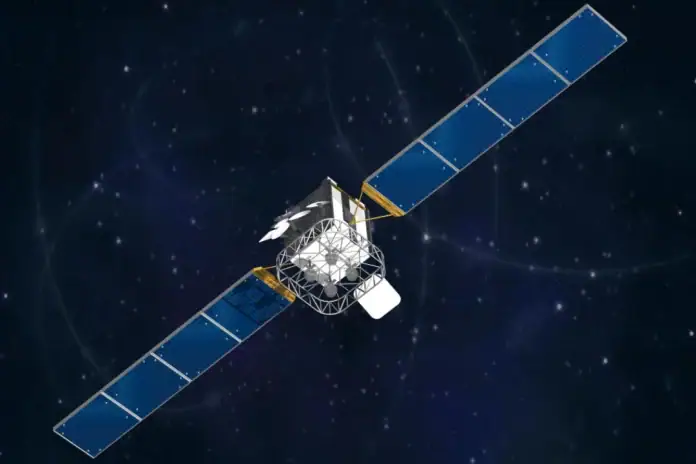
The UHF Follow On (UFO) satellite series provides critical ultra-high frequency communications for the U.S. Navy's global network, serving ships at sea and various military terminals. These satellites replaced the Fleet Satellite Communications (FLTSATCOM) and Hughes-built Leasat spacecraft, establishing a more capable and flexible communications infrastructure.
While a total of 11 were launched, beginning in 1993, only four remain operational today.
The UFO satellites utilize a modular payload architecture operating in geosynchronous orbit. Earlier satellites (UFO-4 through UFO-7) were built by Hughes and incorporated an EHF payload alongside UHF and SHF capabilities, providing protected communications with anti-jam features. Block 3 satellites (UHF-8 to -10) replaced the SHF payload with the Global Broadcast Service (GBS) package and included four 130-watt, 24 Mbps military Ka-band (30/20 GHz) transponders with three steerable downlink spot beam antennas and dedicated uplink antennas. This technical configuration delivered a 96 Mbps data transmission capability per satellite—a significant increase over previous generations. Block 4 of the UFO was designed by Boeing and consists of a single satellite (UFO-11) launched on Dec. 18, 2003. It was intended to serve as a gap filler between the UFO and MUOS constellations.
UFO-11 satellite incorporates the enhanced 20-channel EHF package first introduced on UFO-7, while adding an upgraded UHF payload with a new digital receiver that provides two additional UHF channels and greater flexibility in configuring communication services. UFO-11 maintains the same physical dimensions as earlier non-GBS Block 2 satellites. The UFO has been fully replaced by the Mobile User Objective System (MUOS). Although it is still in orbit, it is no longer being modernized. The FY26 budget included $49 million for MUOS upgrades, and USSF projects around $50 million in upgrades per year over the next five years.
Ultra-High Frequency Follow-On Technical Data
Contractors: Hughes (Block 1-3); Boeing (Block 4).
Operator/Location: 10th Operations Squadron, USSF (Mission Delta 8). Point Mugu, Calif.
Acquisition Organization: Space and Naval Warfare Systems Command's Communications Satellite Program Office, USN.
First Launch: UFO-1, March 1993.
IOC: UFO-2, Sep. 3, 1993.
Launch Vehicle: Atlas 3-B, Atlas-2A, Atlas-2, Atlas-1.
Constellation: Four GEO sats.
Active Satellites: •UFO 8 (Block 3). Launched in 1998; active. •UFO 9 (Block 3). Launched in 1998; active. •UFO 10 (Block 3). Launched in 1998; active. •UFO 11 (Block 4). Launched in 2003; active.
Dimensions: 75 ft x 11 ft x 11 ft (Block 3), 60 ft x 11 ft x 11 ft (Block 4). Weight: 7,068 lb. (Block 3), 6,704 lb. (Block 4).
Orbit Altitude: Geostationary.
Power: Solar arrays: 3,800 watts (Block 3), 2,800 watts (Block 4), batteries.