
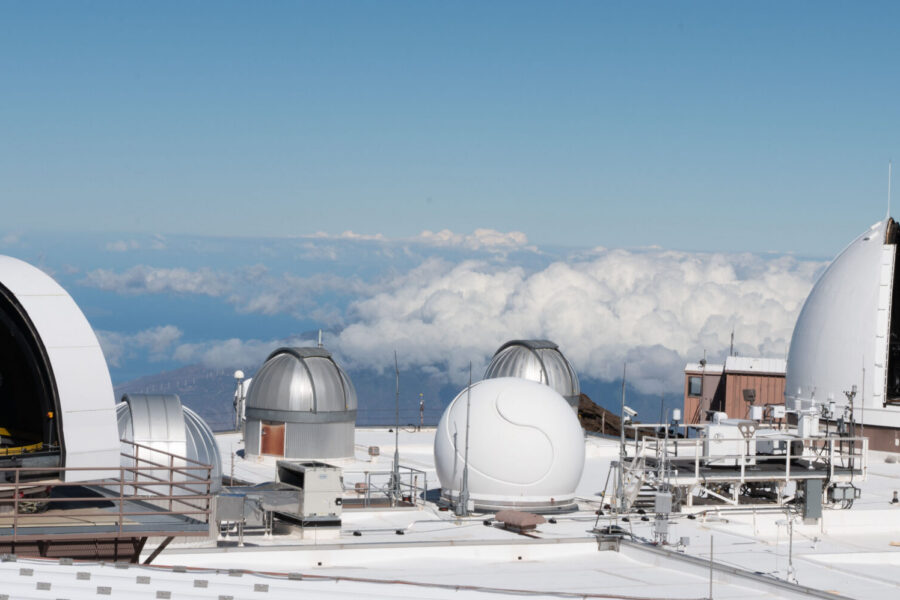
The Maui Space Surveillance Complex (MSSC) is national space surveillance and research asset. Located at the 10,023-foot summit of Haleakala on the island of Maui, Hawaii, the MSSC hosts small-, medium-, and large-aperture tracking optics, including the DOD’s largest optical telescope designed for tracking and imaging satellites, with visible and infrared sensors to collect data on near-Earth and deep-space objects. The MSSS is operated by the 15th Space Surveillance Squadron. The AEOS 3.6 m and other smaller contributing telescope systems validate and develop advanced technology for transition to the dedicated sensor baseline while also executing a contributing SDA mission on behalf of the USSF. These contributing sensors support experiments and leverage R&D capabilities by AFRL.
DOD began conducting research and development and operational missions on Mount Haleakala in the early 1960s at the Advanced Research Projects Agency Midcourse Observation Station, which is known today as the Maui Space Surveillance Complex. Originally built as an electro-optical observation platform for missile tests, the site has evolved into a world-class observatory supporting missions in space control, laser propagation, and other related fields. Testing of the modernized telescope, the Ground Based Optical Sensor System (GBOSS) began in October 2025. It has double the view of the previous variant, more rapid scanning, and is three times more sensitive to light. This falls under the L3Harris’ MOSSAIC upgrade program. This will bring increased visibility into orbit for the Maui Space Surveillance System.
Maui Space Surveillance System Technical Data
Contractors: University of Michigan (initial telescope RDT&E); Lockheed Martin (O&M); Rockwell (O&M); Raytheon (optical upgrade).
Operator/Location: 15th Space Surveillance Squadron (Mission Delta 2), Air Force Maui Optical and Supercomputing Site, Hawaii.
IOC: 1977 (SAC takes operational control).