
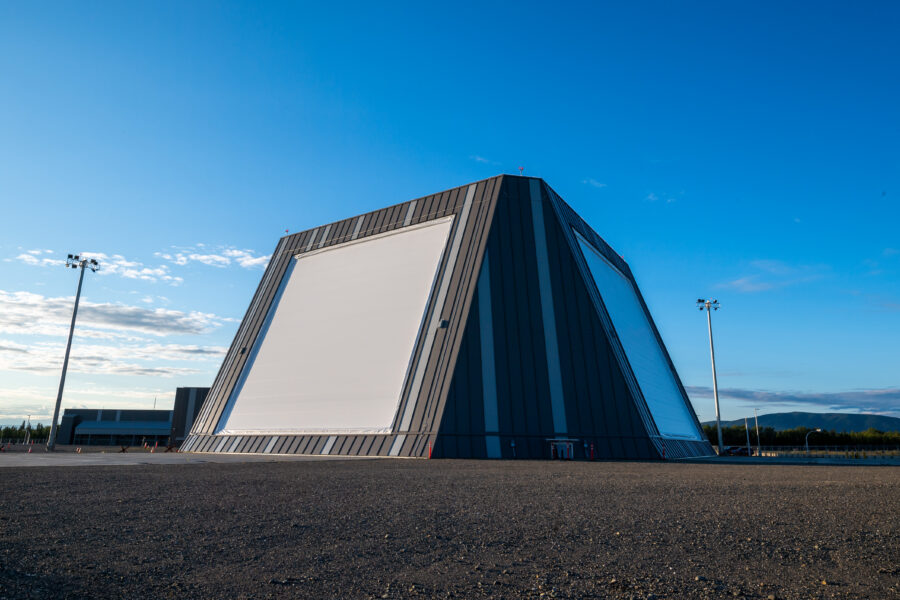
The Long Range Discrimination Radar (LRDR) is an advanced S-band radar system designed to distinguish between enemy intercontinental ballistic missiles (ICBMs) and decoys, serving as a crucial component in the defense of the American homeland. The system is based at Clear Space Force Station in Alaska and will be operated by the U.S. Space Force. Full operational acceptance of LRDR by Space Force Combat Forces Command occurred in December 2025. The LRDR serves as a critical piece of a layered defense system for the United States. It supports the ballistic missile interceptors belonging to the Ground-Based Midcourse Defense system, which are primarily designed to counter missile threats from nations such as Iran and North Korea.
In addition to its primary mission of missile defense, the LRDR will also track objects in space, providing space domain awareness capabilities. The S-band radar system is specifically designed to distinguish between enemy ICBMs and decoys. Built by Lockheed Martin, the LRDR was initially fielded at Clear Space Force Station near central Alaska in late 2021. However, the system has some delays in its operational timeline. A critical assessment test, Flight Test Other-26 (FTX-26), was rescheduled to 2025 after a “target anomaly” canceled the previous year’s planned test. The test took place in June 2025, with the radar successfully detecting, tracking, and discriminating a live ballistic missile threat in a complex environment. LRDR will likely be a key element in the architecture of the Golden Dome missile defense shield.
Long Range Discrimination Radar Technical Data
Contractor: Lockheed Martin.
Operator/Location: U.S. Space Force; Clear Space Force Station, Alaska. • 7th Space Warning Squadron, Mission Delta 4 (Delta 4), CFC, Beale AFB, Calif. (remotely operate). •13th Space Warning Squadron, Mission Delta 4 (Delta 4), CFC, Clear SFS, Alaska.
First Deployment: Late 2021.
IOC: December 2025.
Active Systems: One radar.