
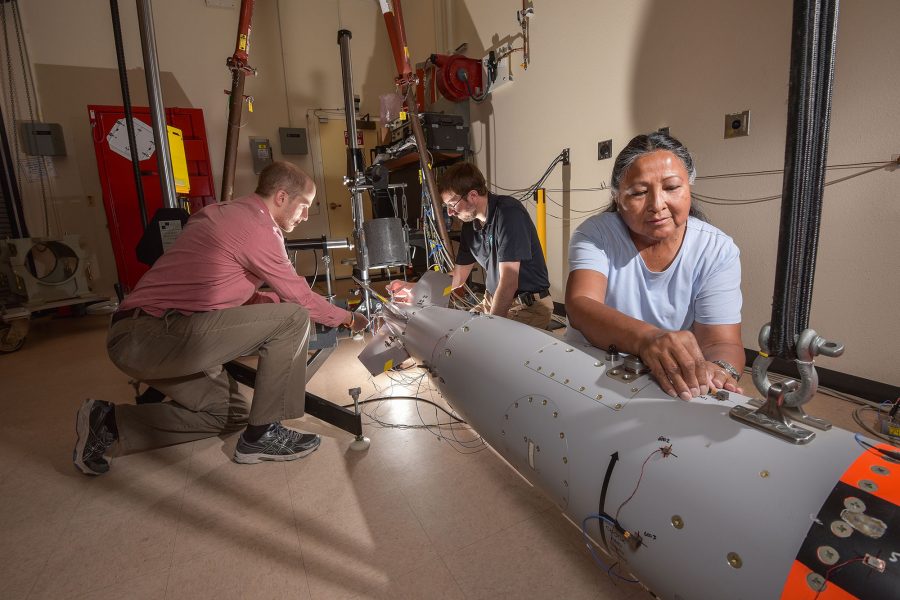
B61 is an air-dropped battlefield/tactical nuclear weapon equipping the F-16 and F-15E in the forward-deployed, allied extended deterrent role. It is also the B-2’s primary strategic weapon.
B61 was first delivered in 1966, and the B61 Mod 11, introduced in 1997, adds a ground-penetrating capability, enhancing its effect against buried and hardened targets. The weapon incorporates several preselectable yield options tailored to mission requirements.
The B61 Mod 12 Life Extension Program (LEP) begun in 2016 consolidated the B61-3, -4, -7, and -10 into a single, standardized configuration. The LEP refurbished the warheads to improve the safety, security, and reliability through 2040. B61-12 also added a guided tail kit, making it the first precision guided weapon of its type, thus permitting higher effectiveness at lower yields.
USAF and the National Nuclear Security Administration finished B61-12 qualification flight-testing on June 9, 2018. Operational flight-testing certified the F-15E as the first aircraft capable of delivering the B61-12 in 2020, followed by a full weapon system demo on the B-2A. The F-35A achieved nuclear certification on Oct. 12, 2023, with B61 integration as part of Block 4 upgrades.
The first production B61-12 was produced in 2021 prior to full-rate production ramp-up the following year. The entire inventory was upgraded through 2024 and manufacture of spares and components will continue through FY26. Congress approved DOD plans to develop the next B61-13 variant using -12 enhancement to modernize the higher yield -7 in August 2024. B61-13 will modernize the existing weapons for use against “harder and large area military targets,” replacing the 1.2 megaton B83-1 and the approximately 360 kiloton-yield B61-7 without increasing the existing stockpile. The National Nuclear Security Agency announced completion of the first B61-13 a year ahead of schedule on May 19, 2025.
B61 Thermonuclear Bomb Technical Data
Contractors: National Nuclear Security Agency Los Alamos National Laboratory, Sandia National Laboratory, Kansas City National Security Campus, Y-12 National Security Complex, Savannah River Site, and Pantex Plant (weapon); Boeing (B61-12 tail kit).
Delivered: 1979-1998 (legacy stockpile); 2022-present (B61-12 mod).
IOC: 1968.
Production: Approx. 1,840 (current active variants).
Inventory: Approx. 725 (including stockpiled and deployed).
Operator: AFMC, USAFE.
Deployed Locations: Aviano AB, Italy; Büchel AB, Germany; Ghedi AB, Italy; Incirlik AB, Turkey; Kleine Brogel AB, Belgium; Volkel AB, Netherlands.
Active Variant: •B61-11. Ground-penetrating free-fall thermonuclear weapon with 400kt fixed yield. •B61-12. Modernized free-fall thermonuclear weapon with 0.3-50kt selectable yield and precision-guidance tail kit. •B61-13. Prototype modernized free-fall thermonuclear weapon with higher yields for use against hardened targets, based on the B61-12 precision guided weapon.
Dimensions: Length 11 ft 8 in., diameter 1 ft 1 in.
Weight: 700 lb; 825 lb (B61-12).
Performance: 0.3-400 kiloton thermonuclear yield air-droppable at speeds exceeding Mach 1.
Guidance: None (B61 Mod 1 to 11); unknown, likely INS (B61 Mod 12).
Warhead: One B61 -3, -4, -7, or -11.
Estimated Yield: 0.3 kilotons, 1.5 kilotons, 10 kilotons, 50 kilotons, (pre-selectable); 360 kilotons (B61-7), 400 kilotons (B61-11) (fixed yield).
Integration: B-2A, F-15E, and F-16C/D; NATO: F-16A/B Mid-Life Upgrade (MLU), and Panavia Tornado IDS.
