
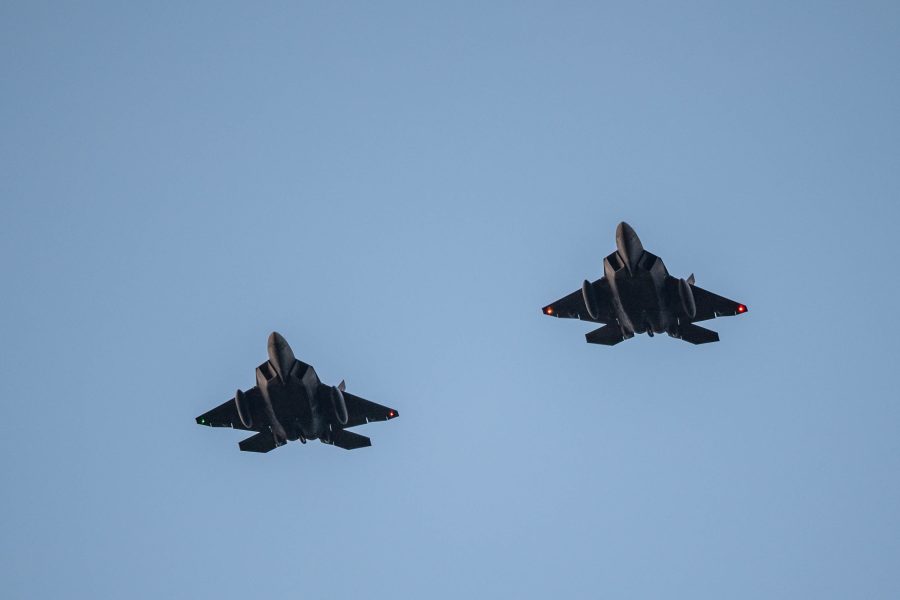
The Air Force has surged F-22 Raptor air superiority fighter jets and aerial refueling tankers to Israel for possible combat operations against Iran, as the Trump administration continues to weigh embarking on an air campaign against the Iranian regime.
And more fighters appear to be possibly making their way to the Middle East, with fresh F-35 Lightning II and F-15E Strike Eagle jets arriving Feb. 26 at RAF Lakenheath in England, a base which is often used as a stopover point for fighters on their way to the Middle East from the United States.
U.S. Central Command, which oversees forces in the Middle East, declined to comment.
Twelve F-35As from Hill Air Force Base, Utah, arrived at Lakenheath on Feb. 26, according to observations from local aircraft spotters, flight tracking data, and air traffic control communications.
A dozen F-15Es departed Seymour-Johnson Air Force Base, N.C., the same day and later arrived at Lakenheath, flight tracking data and air traffic control communications indicate. Ten more F-15Es arrived at the base, also from Seymour-Johnson, Feb. 27, according to open source data and local aircraft spotters.
The Raptors’ deployment is the first time F-22s, which helped escort B-2 Spirit stealth bombers during last June’s Operation Midnight Hammer strikes on Iran’s nuclear facilities, have been deployed to Israel for possible combat operations in the Middle East.
“It is a very significant signal of the seriousness of intent of the United States to act with lethal force if Iran does not comply with the U.S. requests—most likely in conjunction with Israel, but if necessary, individually,” said retired Lt. Gen. David A. Deptula, who played key role in planning the Desert Storm air campaign and is now dean of AFA’s Mitchell Institute for Aerospace Studies.
The U.S. has so far sent 11 F-22s to the Ovda airbase in southern Israel, according to commercial satellite photos released by a Chinese company.
The jets, which are assigned to Joint-Base Langley Eustis, Va., had been temporarily stationed at RAF Lakenheath before they transitioned towards the Middle East. One of the dozen F-22s that took off turned back, apparently because of a maintenance issue, according to open source air traffic control and flight tracking data.
Like Langley’s F-22s, Hill’s F-35s also participated in last year’s mission against Iran, conducting suppression of enemy air defense operations.
At least six more F-22s arrived at Lakenheath earlier in the week, according to local spotters, flight tracking data, and radio communications. In addition to Operation Midnight Hammer, F-22s have also been deployed to the Middle East in recent years to deter Iranian drone and missile attacks against U.S. bases and America’s partners in the region.
American and Iranian negotiators met Feb. 26 in Geneva on Iran’s nuclear program. But the two sides appear to remain far apart on key issues, including the U.S. demand that Tehran end uranium enrichment.
Oman’s foreign minister said that talks by technical experts will continue in Vienna next week. Oman has helped facilitate the talks.
In addition to enrichment, other issues include what to do about Iran’s uranium stockpiles and U.S. demands that Iran limit its ballistic missiles. Iran is not currently enriching uranium, following Operation Midnight Hammer’s strike on three of its nuclear facilities, but the Trump administration wants the suspension to be permanent.
The Ovda base has been used by American aircraft during exercises with the Israelis, the Jewish Institute for National Security of America wrote in a 2025 report, which was authored by regional security experts, including two former U.S. Air Force generals. The 1980s-era base has shelters for aircraft and ammunition storage facilities, and accommodates more than 100 aircraft, including tankers. It is possible Ovda could host even more aircraft soon.
In addition to the F-22s, dozens of other fighters are in the Middle East. Around 30 F-35As from Lakenhealth’s 48th Fighter Wing and the Vermont Air National Guard’s 158th Fighter Wing are deployed to a base outside Israel. One squadron of F-15Es from Seymour-Johnson is also currently deployed to the Middle East, along with a squadron of Lakenheath’s own F-15Es from the 48th Fighter Wing. Numerous F-16 Fighting Falcons and A-10 Thunderbolt II attack aircraft are also stationed in the region.
There are also other aircraft deployed in the Indian Ocean. Multiple F-16s and other military aircraft are currently deployed to Diego Garcia, satellite images show. Last year, F-15Es deployed to the British outpost, which hosts a key U.S. base, to protect the island while B-2 and B-52 bombers were stationed there. The B-2s carried out attacks against Houthi targets in Yemen during last spring’s Operation Rough Rider.
There are also USAF KC-46 Pegasus and KC-135 Stratotanker aerial refueling aircraft stationed at Ben Gurion International Airport, Israel’s main commercial airport located near Tel Aviv, flight tracking data and photos posted on social media show. Within the span of a few hours between Feb. 26 and Feb. 27 local time, at least eight KC-46s arrived at the airport, a remarkable buildup at a civilian airport in a highly fraught region.
Dozens of tankers have already been moved to Europe and the Middle East in recent weeks.
The USS Gerald R. Ford aircraft carrier, which carries squadrons of F/A-18 fighters and EA-18 electronic attack aircraft, is due to arrive near the coast of Israel in the coming days. The Abraham Lincoln carrier, with F-35Cs, F/A-18s, and EA-18s is already in the waters south of Iran.
Both the Ford and the Lincoln are accompanied by warships capable of defending against ballistic missiles that could be launched by Iran and launching Tomahawk land attack cruise missiles.