
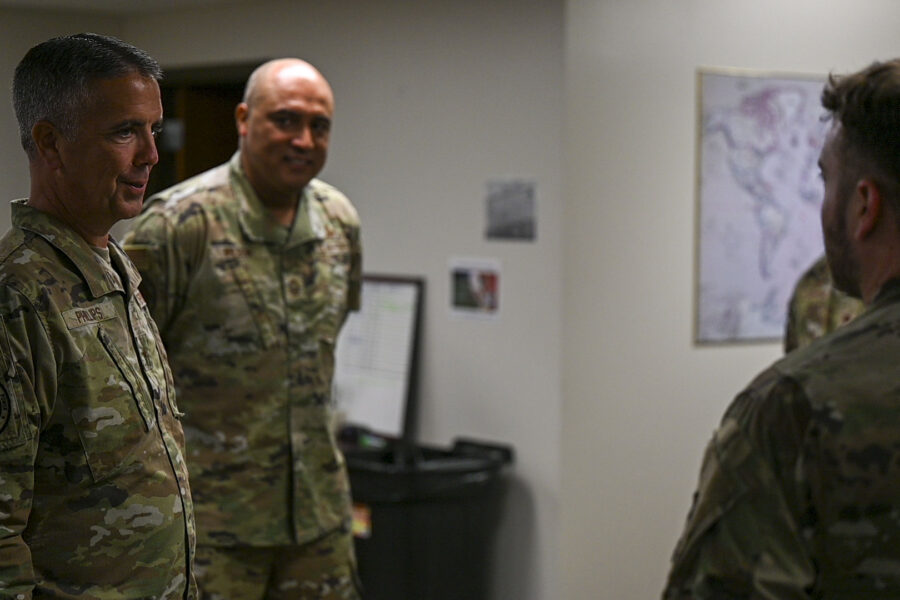
Just over a year ago, in July 2025, the Air Force established a dedicated office on the Air Staff for communications/cyber functions, separate from the intelligence directorate it had long been attached to. The new Warfighter Communications and Cyber Systems directorate now focuses on secure communications, cyber operations, and information technology systems as they support the frontline Airman or Guardian.
The move, leaders said at the time, was a major shakeup necessary to support the service’s need for resilient, reliable communications and cyber operations, and the equipment and personnel associated with those capabilities.
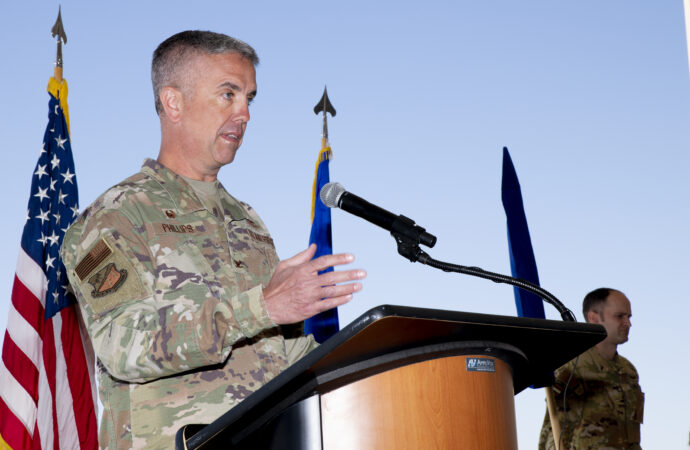
In June, Brig. Gen. Jeffrey A. Phillips took over as Deputy Chief of Staff for Warfighter Communications and Cyber Systems from interim deputy chief Brig. Gen. Joy Kaczor, who filled the role following the retirement of Maj. Gen. Michele C. Edmondson.
Phillips, a prior-enlisted Airman, started his career as a computer programmer and serving six years wearing stripes before commissioning through Officer Training School at Maxwell Air Force Base, Ala., in 1999. He previously commanded the 67th Cyberspace Wing at Joint Base San Antonio-Lackland, Texas, and served as Director of Cyberspace and Warfighting Communications at the headquarters of Air Combat Command at Joint Base Langley-Eustis, Va.
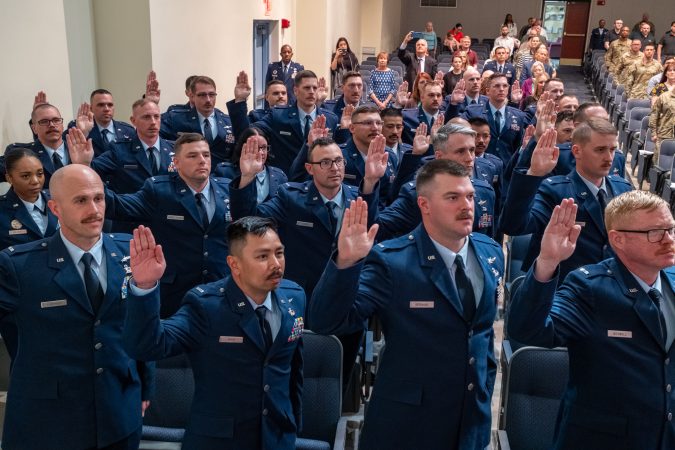
The one-star now serves a community of about 30,000 enlisted, 3,000 officers, and nearly 100 newly minted warrant officers. He recently sat down with Air & Space Forces Magazine for an interview about where the office stands after a year in operation and his priorities moving forward for the position, the equipment, and the people involved in vital communications and cyber work for the Air Force.
Editor’s Note: The following Q&A has been edited for length and clarity.
Q: What is your office doing to modernize both the equipment and support the Airmen in communications and cyber jobs?
A: We have to stop getting stuck in five-year acquisition cycles that end up delivering a product that’s outdated by the time we put it on the battlefield, and so that’s my number one priority. And we’re doing that through a few different lines of effort. Theater deployable communications, or TDC, is really important. We learned in operations like Operation Epic Fury that when we’re out in the field at several locations, we need to be connected at all those locations. So, we need to get that equipment out to the people who need to be connected, and we need to have Airmen out there who know how to operate it or make it simple enough for anyone to operate.
And there’s enterprise communications; those are the foundational networks that we connect back into from the edge, and a lot of those have been underinvested in over the past 30 years, so we’re playing a catch-up game. A big focus for Chief Information Officer Ashley Devoto and me is making sure we can modernize that enterprise network, so I came in with that as my number one priority.
My second priority is the continued evolution of our talent management processes. I think we’ve come a long way in the time that I’ve been part of it, and we need to do that for our enlisted Airmen, our warrant officers, and our officers. In the last few years, we created an executive development forum that all the cyber general officers sit on. It’s really a development team for our colonels. Now all of our general officers mentor all of our colonels.
This year we had what we call our Champions Initiative, and the colonels who were part of our development team were mentors to each O5 and below that we’re meeting on that development team. On the enlisted side, our 1D7 [Cyber Defense Operations] career field has obviously been in a state of flux and change for probably the last 10-plus years, we’ve changed those AFSCs and what they represented several times over that time period, and I kind of put a chalk line in the sand and I said we’re not going to make any more changes until we figure out what’s right, what’s wrong. We get the Airmen the career development courses that they need and then get them the education they need so they can test for promotions on their specialty knowledge tests. So that’s the number two priority.
There are a lot of key partners and stakeholders that we need to work with, so my goal is to rebuild those bridges because we can’t do anything alone. We have to partner with organizations like the Secretariat of the Air Force, the Office of the CIO, and DAF CIO Devoto. We have to partner with our acquisition organization, primarily under Air Force Life Cycle Management Center, and we work with the [Command, Control, Intelligence and Networks Directorate] within AFLCMC primarily for our theater deployable communication and our enterprise IT.
Q: What are some of the key technologies or equipment that your office is helping roll out, use, or upgrade across the communications and cyber areas of the Air Force?
A: Our legacy communication equipment is our Flexible Communication Package, or FCP. It’s been around probably for about the last decade. When you deploy an FCP, the only way a combatant commander can task it is through a unit type code that requires 10 pallet positions on an aircraft, about 40 people, and about 20 short tons to move. It includes things like bulldozers and huge satellite dishes, and it’s been modernized to the point that we don’t need such a big footprint anymore. Our new deployable comm kits—we have two of them: the ACP, the Agile Communications Package, and the Fly-Away Communications Terminal. They’re similar equipment, but a Fly-Away Comm Terminal supports fewer users than an ACP would. So, if we deploy somewhere we need to run command and control applications, we might need more compute and storage power. We can put that on the ACP. If we go someplace where we don’t have terrestrial internet, we can attach a satellite, our commercial satellite comm terminal. So agnostic transport is really big. We can set up a 5G bubble and use that as our transport. That gives us modular equipment so we can reduce our footprint and deploy with a couple of Airmen who know how to use it, providing connectivity for a whole mission-generation force element versus 10 pallet positions and, you know, 20 short tons.
We are in the midst of fielding ACPs. We have a lot of FACTs that are fielded. Now we’re working toward our next-generation ACPs. This technology changes very rapidly, and so keeping up with it is very challenging.
Q: You mentioned work to develop officers; what is your office trying to do for the enlisted and new warrant officers in the ranks?
The 1D7 Cyber Defense Operations career field, for example, has five “shreds.” At different points in time, there have been more or fewer shreds. Those shreds have meant different things, and so you could ask an Airman, or you could ask some senior leaders, “Hey, you know, what’s the definition of a 1D7X1 today? And unless you’re keeping up with the change, which was constant, it was very hard to define it clearly. So, freezing any further changes for Airmen in that career field is crucial because they want that stability, so they can develop more technical expertise and depth.
With warrant officers, we’re not asking them to lead people, we’re asking them to lead efforts. We’re asking them to become technical experts. We’ve put warrant officers in our cyberspace operations career field at the 67th Cyberspace Wing, and we’re starting to put them in the 688th [Cyberspace Wing] and get them into some staff positions as advisors to senior leaders who might not have the technical depth warrant officers have.
Q: How has working in Air Forces Cyber, and the cyber officer’s role, changed over the course of your time in uniform?
A: When I came in, we were support officers. Now we’re operations officers, and I think that’s a huge difference. I was proud of being a support officer. I had a great boss when I was a second lieutenant who pulled me in at Shaw Air Force Base, and he said, “Hey, Munster, this is your role as a communications officer at this base. You’re supporting the SEAD mission.” I said, “Sir. What’s the SEAD mission? He explained it as Suppression of Enemy Air Defenses, and I started to link my service to that mission, and I was very proud of that. As we transitioned to a more of an operational community, I got to lead a cyberspace operations squadron, and I saw how we were out there creating effects that supported whatever the goals of the operation might be, and I’m proud of that too. I think, you know, we’re proving that we are integral to most operations that happen.
