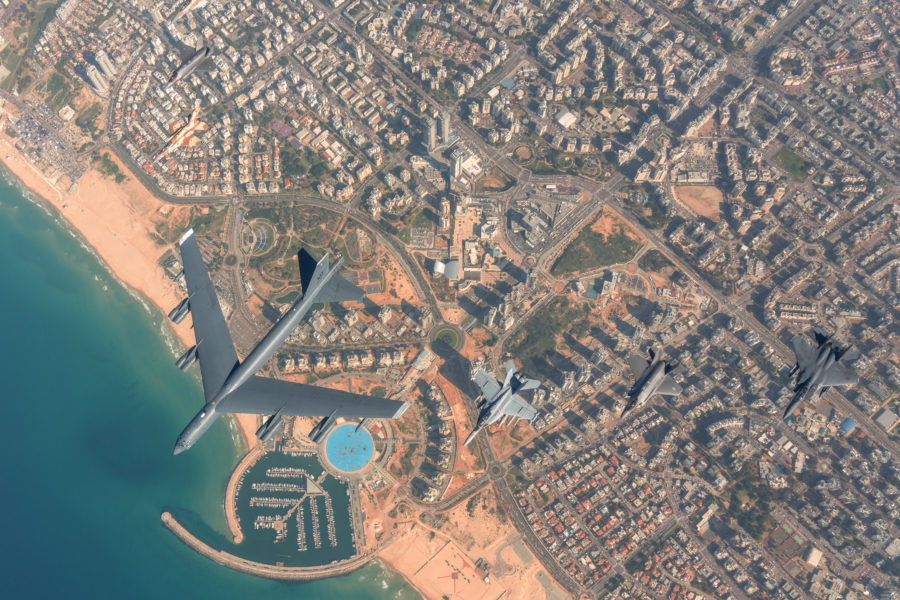
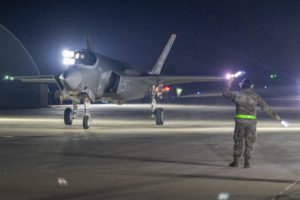
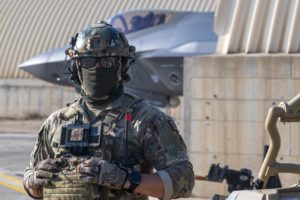
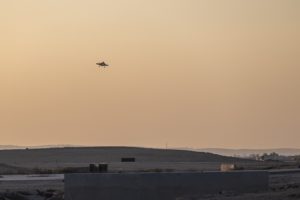
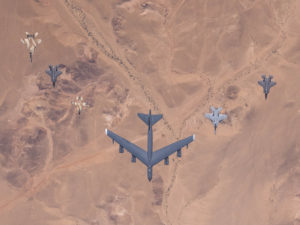
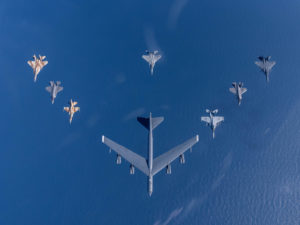
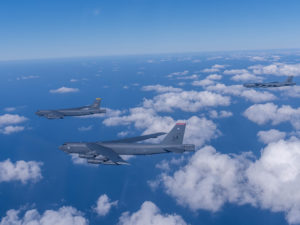
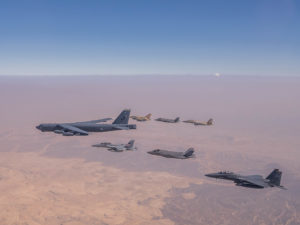
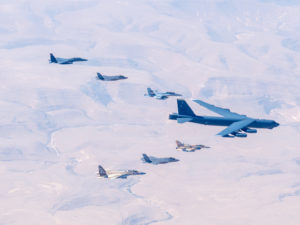
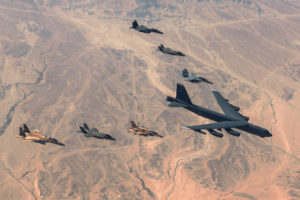
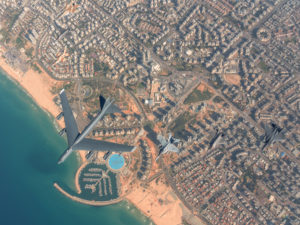
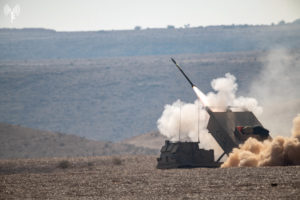
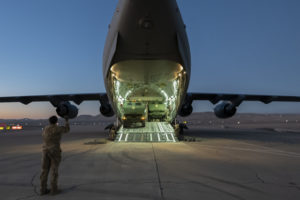
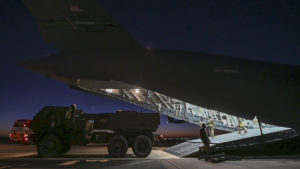
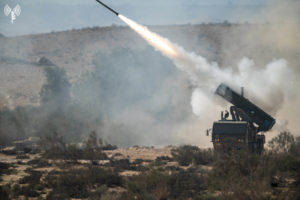
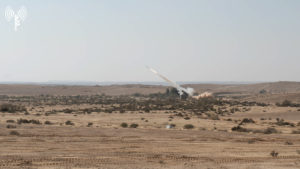
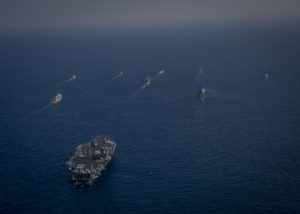
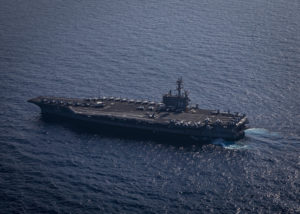
Juniper Oak 23-2 is a bilateral military exercise designed to enhance interoperability between the U.S. and Israel militaries. Photo courtesy of the IDF Spokesperson's Office
Audio of this article is brought to you by the Air & Space Forces Association, honoring and supporting our Airmen, Guardians, and their families. Find out more at afa.org
The recently-concluded Juniper Oak, an “all domain” exercise carried out from Jan. 23-26, was the “largest U.S.-Israel partnered exercise in history,” according to U.S. Central Command. The exercise was intended to demonstrate that the U.S. can rapidly deploy massive firepower to the region even as it shifts its focus away from the Middle East and towards the Pacific and Europe. Photos and videos recently released by the Department of Defense show the scale of the operation.
The complex exercise included integrated bomber and fighter missions, naval operations involving the George H.W. Bush carrier strike group, combat search and recuse, precision long-range artillery, combat search and rescue, close air support, and Space Force assets.
Israel is a recent partner for CENTCOM, formally becoming part of the command’s area of responsibility in 2021.
“We’re working side-by-side with our Israeli counterparts here and really with other regional partners over the longer term that’s going to make sure we can defend our forces,” Lt. Gen. Alexus G. Grynkewich, the head of Air Forces Central, said in a DOD video promoting the exercise. “It’s really part of integrating CENTCOM into the AOR and building that partnership in depth and breadth.”
All told, 142 U.S. and Israel aircraft directly participated in the exercise.
Four American F-35 Lightning IIs joined six Israeli F-35s, in a rare appearance of Air Force F-35s in the region—the U.S. sometimes sends fifth-generation F-22 Raptors to CENTCOM to quickly respond to contingencies.
The exercise also included a large bomber presence—the U.S. has conducted Bomber Task Force missions in the region, most recently in November. Juniper Oak included four B-52s, twice as many as a typical Bomber Task Force mission, and involved aircraft from both B-52 bases: Minot Air Force Base, N.D. and Barksdale Air Force Base, La.
Air Force Special Operations Command joined in the efforts with an AC-130 gunship, which conducted live-fire drills.
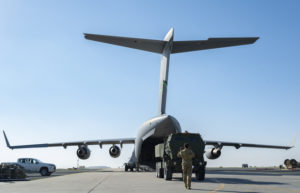
Air Forces Central also provided logistical support with C-17 Globemaster III aircraft, transporting the HIMARS launchers used in long-range precision artillery strikes.
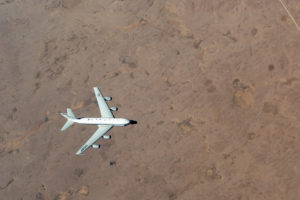
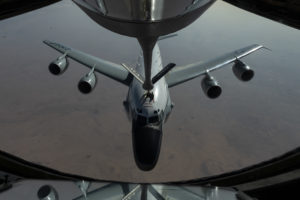
As part of the expanded scope of the exercise, U.S. officials underscored the use of Space Force assets for joint command and control and reconnaissance. Juniper Oak involved CENTCOM’s newly activated SPACECENT component and included an RC-135 Rivet Joint surveillance plane.
Israel has previously been part of the U.S. European Command’s AOR, which reflected some Arab nations’ uneasiness working with the country. But after the Abraham Accords were signed in 2020, and given the continued threat of Iran, the U.S., Israel, and many Arab nations see a common foe.
“Most of the countries in the region look to the east when they think of the threat of Iran and its threat network,” Grynkewich told Air & Space Forces Magazine in September. Grynkenwich said at the time “there’s a lot of opportunity” to expand Israel’s role in CENTCOM, which was demonstrated by Juniper Oak.
While the U.S. military has reoriented itself towards Europe and the Pacific after 20 years of focusing on counterinsurgency operations in the Middle East, U.S. defense officials and military leaders have sought to assure allies the U.S. is still a reliable partner in the region and that if the U.S. and its allies work together more, it can make up for the smaller day-to-day presence in the Middle East.
“Over the longer term, we know that this is one of the places where strategic competition happens on a day in and day out basis,” Grynkewich said of Juniper Oak. “The Central region is central to strategic competition, whether that’s against Russia or against the Chinese.”
Audio of this article is brought to you by the Air & Space Forces Association, honoring and supporting our Airmen, Guardians, and their families. Find out more at afa.org
Startups Anduril Industries and Heremus have agreed to integrate Anduril’s autonomy software onto Hermeus’ hypersonic demonstrator aircraft “Quarterhorse”—uniting two technologies that have drawn keen interest and investment from the Air Force.
In a dramatic flare-up in the hostilities between the U.S. and Iran, American forces struck and destroyed five Iranian oil tankers Sept. 8, U.S. Central Command said. Iran retaliated by lobbing ballistic missiles toward a major U.S. base in Jordan.
After months of delays, the first F-15EX fighter jet the U.S. Air Force will permanently base overseas left Boeing’s facilities in St. Louis on Aug. 28. Eventually, the aircraft will fly to Kadena Air Base in Japan and join the 18th Wing there, but for now it is going to…
The Space Force expects the scope of its main launch program to grow by 91 missions and nearly $17 billion by fiscal 2032 as demand for national security space capabilities soars.
The Air Force is accelerating its plans to field an MQ-9A replacement in the wake of heavy Reaper losses in operations against Iran, top officials said Sept. 3, and they’re targeting a price point of just $10 million per aircraft.
The U.S. is rotating fresh fighter squadrons to the Middle East to support the Trump administration’s open-ended campaign of economic and military pressure against Iran.
As U.S. allies look to establish sovereign military space launch capabilities, the Space Force is exploring ways to transfer lessons learned from its National Security Space Launch program to support its international partners.
An F-16 Air National Guard unit’s six-month deployment to Kadena Air Base, Japan, this year illustrated the capabilities the Guard’s oldest fighter units can still offer—but also the challenges they face, officials told reporters this week.
✓
Thank You!
Check your inbox to verify your email address and finish setting up your AFA account.
★
Welcome Back!
An account with this email already exists. Please log in to continue.
Subscribe to the Air & Space Forces Daily Report
The latest news from Air & Space Forces Magazine, as well as news from other leading publications, delivered right to your inbox every morning!
We’re sorry, there has been an error. Please review your input or try again later.