
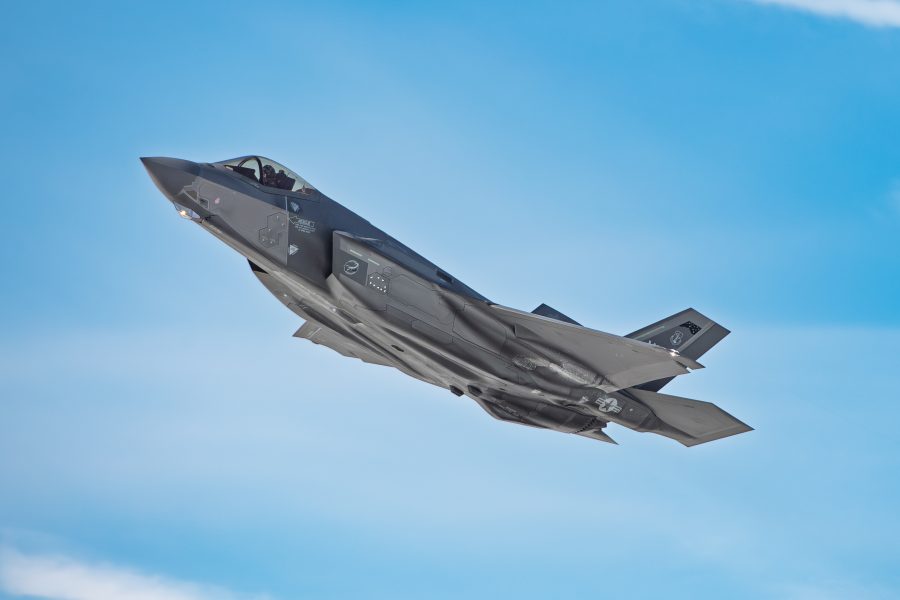
More stealthy U.S. fighter jets moved closer to the Middle East on Feb. 9, with a half dozen F–35A Lightning II fifth-generation planes landing at RAF Lakenheath, U.K., after crossing the Atlantic, flight tracking data and air traffic control communications show.
The U.S. has bolstered airpower and air defenses in the Middle East and Europe as the Trump administration has threatened to strike Iran if a deal constraining its nuclear program is not reached.
The F-35s from Vermont Air National Guard’s 158th Fighter Wing departed Burlington Air National Guard base on the morning of Feb. 9 using the callsigns “Tabor 41” through “Tabor 46.”
The F-35s were accompanied by three KC–135 Stratotankers refueling aircraft that departed from Bangor Air National Guard Base, Maine, using the callsigns “Gold 81,” “Gold 82,” and “Gold 83.” Those tankers landed at RAF Mildenhall, a base near Lakenheath, flight tracking data shows.
The jets add to six other F–35s from the squadron, which have made their way to Spain. Those jets first arrived in Europe last month from Puerto Rico, stopping over in the Portuguese Azores.
Early this year, the unit, which specializes in the suppression of enemy air defenses, participated in Operation Absolute Resolve, the U.S. mission to capture Venezuela’s former president Nicolás Maduro.
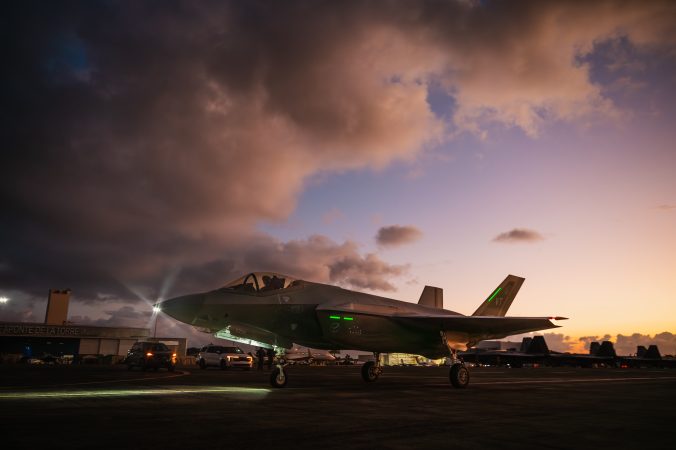
Air Force F–35As, along with other aircraft, were also used to suppress Iranian air defenses and escort the seven B–2 Spirit bombers that participated in Operation Midnight Hammer, the operation to bomb Iranian nuclear sites last June.
At that time, Trump said the U.S. had “obliterated” those facilities. The U.S. attack consisted of 14 GBU-57 Massive Ordnance Penetrator bombs from the B-2s and submarine-launched Tomahawk cruise missiles against three facilities. Pentagon spokesman Sean Parnell provided a more qualified assessment in July, telling reporters that the U.S. strikes had “degraded their program by one to two years.”
There are already F-35s in the region embarked on the USS Abraham Lincoln aircraft carrier. Those aircraft saw action this month when an F-35C from the ship shot down an unarmed Iranian Shahed-139 drone that appeared to be maneuvering toward the carrier.
The Lincoln carries F-35Cs from Marine Fighter Attack Squadron (VMFA) 314, in addition to other warplanes, including F/A-18 Super Hornet fighters and EA-18 electronic attack aircraft. Middle East envoy Steve Witkoff and the president’s son-in-law Jared Kushner, who led indirect talks with Iranian officials in Oman on Feb. 6, later visited the Lincoln with Adm. Brad Cooper, the head of U.S. Central Command, which oversees forces in the Middle East, on Feb. 7.
The U.S. military has yet to acknowledge the fresh F-35 arrival at Lakenheath, which is often used as a stopover point for fighters bound for the Middle East from the United States.
Lakenheath deployed 12 of its own jets, F-15E Strike Eagles from the 494th Fighter Squadron, to the Middle East last month. As of Feb. 9, the Air Force had boosted its fighter footprint in the Middle East to three squadrons of F-15Es, one squadron of F-16 Fighting Falcons, and one squadron of A-10 Thunderbolt II attack planes. One of those F-15E squadrons, from Mountain Home Air Force Base, Idaho, has been in the region for roughly 10 months, an unusually long deployment.
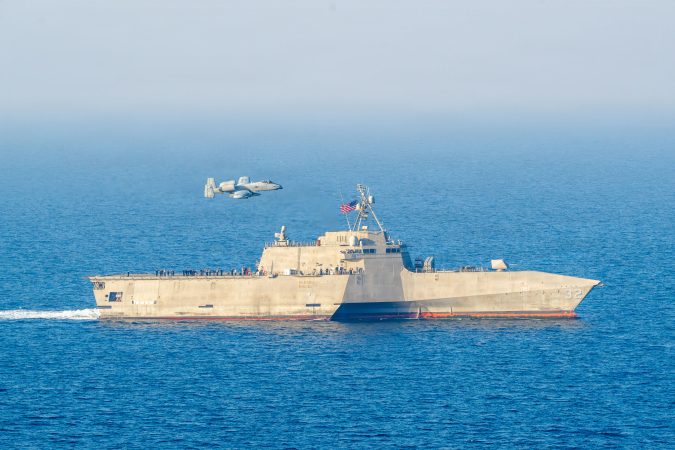
In addition to aircraft, the U.S. has bolstered its air defense assets in the region by deploying additional Patriot and THAAD missile defense systems. There have been more than 100 C-17 Globemaster III and C-5 Galaxy flights flying to the Middle East, according to flight tracking data.
The U.S. has also deployed its newest search-and-rescue helicopters, the HH-60W Jolly Green II, to the region, according to U.S. officials and publicly released images from the U.S. military.
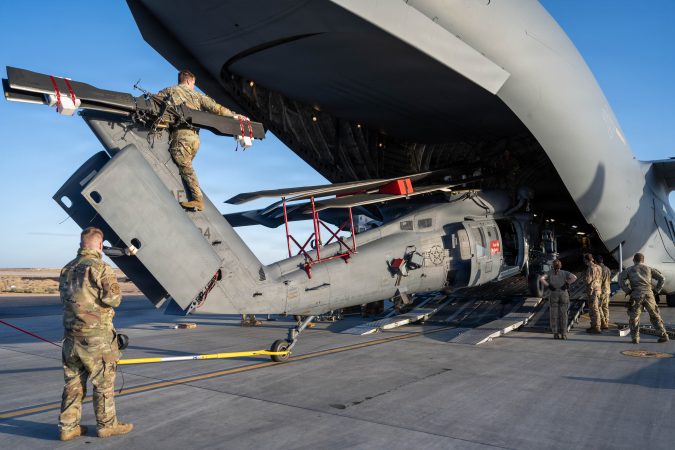
Helicopters of the same type arrived in Puerto Rico, where the U.S. staged the majority of its aircraft used in the Maduro operation, in the weeks before the U.S. raid on Venezuela in early January. It was not immediately clear whether the HH-60Ws were replacing a search and rescue helicopter unit already deployed to the region or were boosting the number of rescue aircraft in the Middle East.
Some of the U.S. airpower that has amassed in the region was shown during a tribute to the military prior to the Super Bowl Feb. 8. F-15Es and Airmen assigned to the 332nd Air Expeditionary Wing were shown saluting during television coverage of the national anthem before the game. The broadcast identified the location as the “Middle East.”