
Clearer 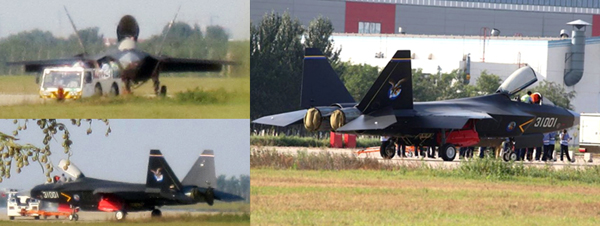 photos of China’s second stealthy-looking fighter design emerged on the Internet as Defense Secretary Leon Panetta kicked off his diplomatic visit to Beijing last week. The Shenyang F-60—also called the J-21 or J-31—resembles the F-22, but with the intakes of an F-35 strike fighter. The F-60 appears to lack the Raptor’s stealthy thrust-vectoring engines, and there appear to be no attempts at a reduced radar cross section with the engines currently installed in the airplane. The F-60’s canopy, nose, and planform seem to be nearly identical to that of the F-22, and the airplane appears to be not too much different in size from the F-22. The photos seem to show internal weapon bays arranged similarly to the F-22’s, as well as a ruggedized undercarriage potentially suited to carrier-deck operations. Photos earlier this year of a heavily shrouded F-60, partially disassembled en route to testing, revealed that the aircraft is smaller than the Chengdu J-20, which the Chinese unveiled at the end of 2010, but little else. While the larger J-20 is likely designed for longer range strike, the F-60 may be optimized for an air superiority role similar to the F-22’s.
When Space Force leaders started talking about expanding the service early this year, the idea was simple: double the size of the force in the next five years. At AFA’s Air, Space & Cyber conference this week, officials detailed just how they’re planning to grow so much so quickly.
