
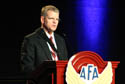
 Private investment could well be the key to winning the Long Range Strike Bomber competition, said retired Lt. Gen. Mark Shackelford, former Air Force military deputy for acquisition, Tuesday. Like the KC-46A tanker acquisition, there’s likely to be a large number of “threshold” requirements for a company to be competitive—tanker had 372—and likely some limited money for “desired” capabilities, he said at AFA’s 2013 Air and Space Conference in National Harbor, Md. However, it will all have to come in under a hard cost ceiling of $550 million a copy for the new bomber. “There have been risk-reduction contracts” to bridge industry from the cancelled Next Generation Bomber to the LRS-B, said Shackelford, but there’s an incentive for companies to invest their own money. The Pentagon won’t ask, but “will, definitely, reward companies” that come forward with “low-risk technical proposals with some capability in areas beyond” the threshold requirement. As evidenced by recent acquisitions, Shackelford noted, “he who invests is likely to improve his likelihood of winning.” The clue as to what extras the Pentagon wants may lie in those bridging, risk-reduction areas; there were five, though Shackelford didn’t say what they were. However, due to the hard cost ceiling, if there are too many extras, the government “won’t pay for it,” he said. Overall, the bomber will be about “innovation, not invention,” he added.
Seven F-22 Raptor pilots have recently been awarded one of the military’s highest decorations for their actions during operations in the Middle East. Six of the pilots were decorated with the Distinguished Flying Cross for their role in Operation Midnight Hammer, the June 2025 strikes against Iranian nuclear facilities.