

Sentinel ICBM is 37% Over Cost
By John A. Tirpak
T
he new Sentinel intercontinental ballistic missile program being developed by the Air Force and Northrop Grumman will cost 37 percent more than expected and take at least two years longer than previous projections before achieving initial operational capability—compelling the service to extend the life of some of its Minuteman ICBMs, senior service and Northrop officials told Air & Space Forces Magazine.
Just before close of business Jan. 18, the Air Force sent Congress notification of a Nunn-McCurdy breach on the Sentinel program. The Nunn-McCurdy Act requires the Pentagon to inform lawmakers if a program incurs a cost or schedule overrun of more than 15 percent. Any breach over 15 percent is considered “significant,” while a breach of 30 percent is considered “critical.”
The Sentinel’s Program Acquisition Unit Cost (PAUC)—which includes development, acquisition, and construction costs—is increasing by 37 percent, making its Nunn-McCurdy breach “critical,” the senior official said. Its Average Unit Procurement Cost—which is focused on acquisition costs—will rise by 17 percent. The two figures are not additive.
An Air Force spokesperson said that when the program was baselined in 2020, the PAUC was $118 million. The 37 percent increase now puts that estimate at $162 million for the PAUC, the spokesperson said.
Under Nunn-McCurdy, programs in “critical” status are assumed to be headed for termination, unless the Secretary of Defense certifies there’s no alternative. Defense Secretary Lloyd Austin is expected to make that certification, given the time it would take to start over and the urgency with which the 50-year-old Minuteman missiles must be replaced.
The estimated cost of Sentinel before the “program deviation” was $95.3 billion, indicating its new cost could be more than $125 billion. The Air Force expects to have a new cost and schedule for Sentinel by summer 2024, Assistant Secretary of the Air Force for Acquisition, Technology, and Logistics Andrew Hunter said. That assumes the Nunn-McCurdy process takes its full course and the program is allowed to continue.
The cost and schedule growth stems largely from the ground element of Sentinel. These include the command and launch segment—silos and launch control facilities, which will be “significantly bigger” than those for Minuteman—as well as the communications infrastructure the Air Force had hoped to reuse from the Minuteman, but which is too old and lacking in necessary bandwidth to do the job. A big element of that will be cabling and cable ducting which must be replaced, as well as land easements and other infrastructure expenses not well understood when the program baseline was set.
Inflation also played a role. Air Force Secretary Frank Kendall has also noted Sentinel has struggled with issues such as adequate labor and security clearances for workers.
While there is some escalation in the cost of the LGM-35A missile itself, it was not a major factor in the Nunn-McCurdy breach, Hunter said.
“There’s been a little bit of cost growth on the missile side, but comparatively much less than what you see with command and launch segment. [The missile] would not probably, on its own, have triggered any kind of a breach in terms of cost,” he said.
The schedule slip also adds cost to the program, since engineers and workers have to be kept on the project longer than expected. Moreover, some previously unexpected costs “were not included” in the Milestone B review of the program in 2020, a USAF official said.
Sentinel and Minuteman will also have to operate simultaneously for a time, creating challenges for the communications network.
In years to come, Hunter said, “there will be significant budgetary changes as a result of this cost growth, on both the Sentinel and Minuteman side.”
Work continues on the program while the Nunn-McCurdy process plays out; no stop-work order has been sent to Northrop Grumman or its subcontractor team.
While no Sentinel-related financial changes are expected to the fiscal 2025 budget request soon to go to Capitol Hill, the cost increases will be reflected in the five-year program objective memoranda (POM).
According to the Sentinel’s Selected Acquisition Report for 2022, procurement accounts for $61.6 billion of the program cost estimate, while research, development, test and evaluation is $25.5 billion and military construction is $8.7 billion.
In order for Sentinel to continue, Defense Secretary Lloyd J. Austin III must certify the program is crucially needed. The certification requires five conditions be met:
The program must be deemed essential to national security.
- The root cause of the overrun must be clearly understood.
- New cost estimates must be validated by the Pentagon’s Cost Assessment and Program Evaluation shop as reasonable.
- There are no lower-cost alternatives to the program.
- The program is a higher priority than other programs that must be reduced or eliminated to pay for the overrun.
A Nunn-McCurdy breach must also be addressed by restructuring the program in a way that corrects the root cause of the overrun, and new program milestones must be set.
Programmatically, the Sentinel is expected to go through a series of “rolling” critical design reviews in the coming months, a Northrop official told Air & Space Forces Magazine.
There may be ways to mitigate the two-year delay, he said.
“There’s IOC and there’s FOC,” he noted, referring to Initial Operational Capability and Full Operational Capability. “IOC is when you get started and FOC is when you are done. What really matters for Minuteman III is when are you done. … FOC is obviously farther out in time. So there will be options to really look at to how do we perhaps keep [the] FOC date from moving as much as other parts of the program.”
The Sentinel program calls for production of 634 missiles. Of those, 450 will replace Minuteman III missiles now in silos, 184 will be used to demonstrate periodically—to allies and potential adversaries alike—that the system works, and 25 will be developmental test vehicles
The program also calls for dozens of launch control facilities; maintenance and management buildings; integrated control centers at F. E. Warren, Malmstrom, and Minot Air Force Bases; weapons storage facilities; 56 loading and transport vehicles, and some 7,500 miles of cabling, a Northrop official said. Collectively, the massive program is “like five MDAPs (Major Defense Acquisition Programs) combined,” he said.
In response to the Nunn-McCurdy notification, Northrop said it and the Air Force “continue to make significant progress on this highly complex program, achieving key milestones to mature the design and reduce risk.” As part of its engineering and manufacturing development contract, “our team is committed to supporting the Air Force as it assesses and updates acquisition cost forecasts for the future phases of the program, to include construction projects, production, and deployment of the weapon system.”
“We are focused on continuing to perform and meet our commitments under the EMD contract as we move toward delivery of this essential national security capability,” a spokesperson added.
Northrop CEO Kathy Warden will preside over the company’s fourth-quarter 2022 earnings call on Jan. 25.
USAF Orders 1,500 Small Diameter Bombs
By John A. Tirpak
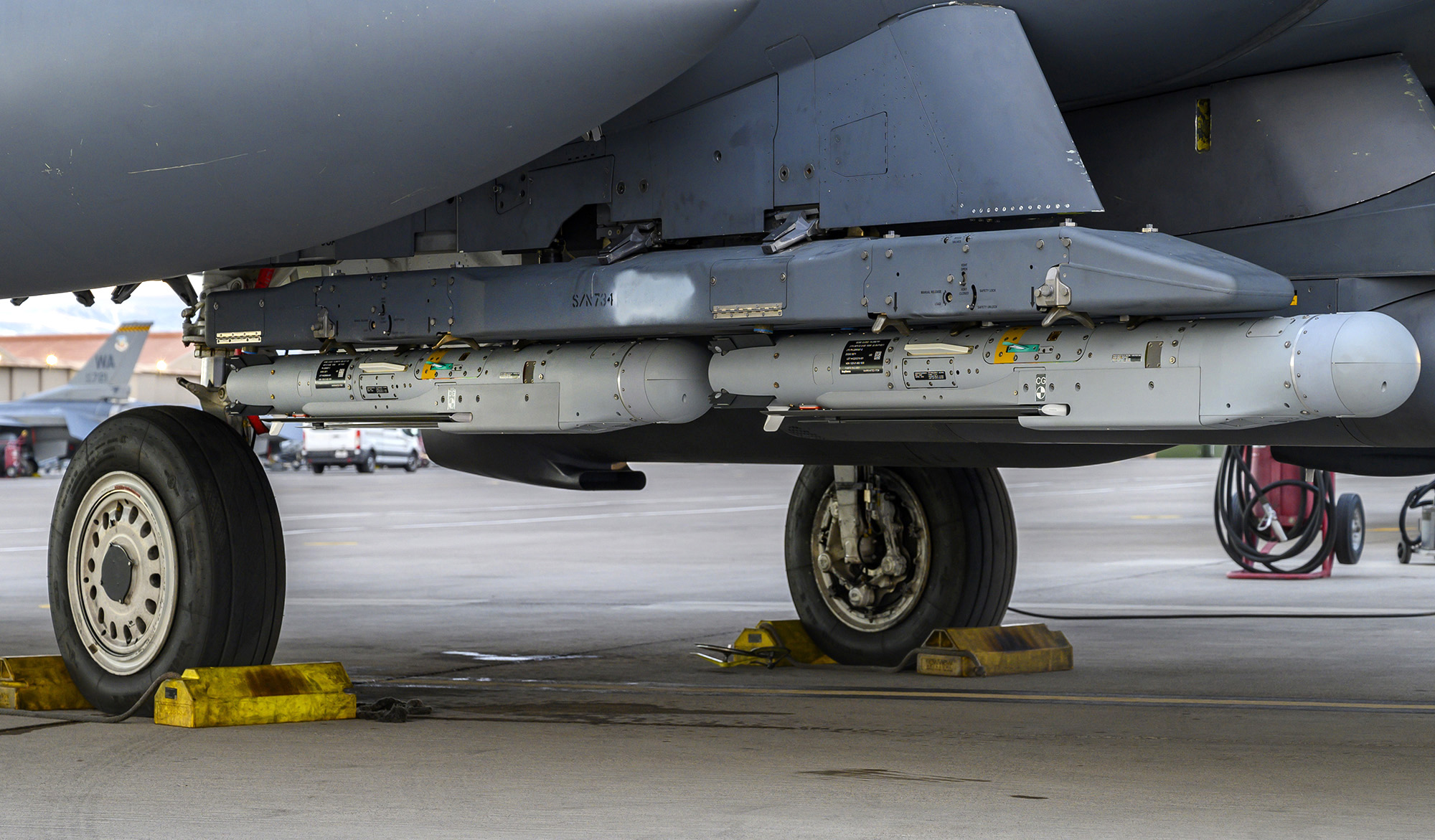
The Air Force awarded Raytheon a $345 million contract to build more than 1,500 Small Diameter Bomb II/GBU-53/B munitions—called “StormBreaker” by the company—for the Air Force, Navy, and Foreign Military Sales users, under the 10th production lot. The work is to be completed by August 2028.
The SDB II is a smart bomb with pop-out wings that can be carried on BRU-55 and BRU-61 multiweapon racks and increase the loadout and targets struck per sortie by fighter aircraft. Certified for use on the Air Force F-15E and Navy F/A-18E/F and being integrated with the joint-service F-35, the weapon is planned to be fitted eventually for nearly all U.S. fixed-wing strike aircraft and bombers.
The munitions will be made primarily at Raytheon’s Tucson, Ariz., facilities. The contract also covers containers and training gear.
The Pentagon’s fiscal 2024 budget request asked for 920 SDB IIs for the Air Force, down from 1,214 in fiscal 2023 and 976 in fiscal 2022. The Air Force has also shifted from buying the bulk of its Small Diameter Bombs from the first iteration, made by Boeing, to the StormBreaker weapon made by Raytheon.
The total planned acquisition of StormBreaker, according to budget documents, is 21,610 for the Air Force and 5,800 for the Navy. The Jan. 3 contract also covers Foreign Military Sales to Finland, Germany, Italy, and Norway, collectively worth $2.1 million. The contract includes $101.4 million from the Air Force’s fiscal 2023 budget and $183.1 million for the fiscal 2024 budget.
Production of StormBreaker was paused in 2019 due to a parts quality issue. Raytheon retrofitted the weapons built to that point and production resumed in 2020.
Air Force budget documents say the service’s goals for the weapon in 2024 include a technology refresh to change out “obsolete seeker components.”
The 204-pound SDB II has a multimode seeker—including millimeter wave, imaging infrared, and a semi-active laser—with a 105-pound multimode shaped blast/fragmentation warhead. It can prioritize targets autonomously, and its GPS/INS guidance allows it to be retargeted after the weapon’s release.
Stormbreaker is described by the company as a “network-enabled” munition. Its wings provide a standoff glide capability of more than 45 miles, according to Raytheon, reducing the launch aircraft’s exposure to enemy defenses. The precision weapon can work in all weather or obscurants and can engage moving targets as well.
The F-15E can carry up to 28 SDB IIs by using seven BRU-61A racks, each with four weapons. With modifications, SDB II racks will be able to fit inside the F-22 and F-35. The weapon is 69 inches long. Raytheon reported that StormBreaker completed 28 test drops in 2023, across all user platforms.
The first operational use of the SDB II was with the 391st Fighter Squadron in 2021, which employed four of the weapons against moving ground vehicles at the Utah Test and Training Range in a Weapon Systems Evaluation Program (WSEP) test.
WC-135 ‘Nuke Sniffer’ Upgrade Complete
By Unshin Lee Harpley
The Air Force took delivery on the third and final WC-135R “Nuke Sniffer” aircraft, completing its transition from its two-aircraft WC-135C/W fleet.
The new fanjet aircraft arrived at Offutt Air Force Base, Neb., on Dec. 4.
“Having this third jet really opens up a lot of options for us,” said Col. Mark Howard, 55th Wing commander, in a release.
The aircraft sample the air for particles and gases indicating nuclear activities to ensure compliance with the Limited Test Ban Treaty of 1963, a global agreement to restrict nuclear weapons testing. There are few missions like it anywhere else in the U.S. military.
“Most people think of radiation and think ‘avoid it,’” one Constant Phoenix crew member told Air & Space Forces Magazine in May. “With this jet we’re able to go and actually do that safely, which I think is really cool.”
Having three jets rather than two gives Constant Phoenix crew members much more flexibility to take samples in more parts of the world, which is especially important as the number of potential nuclear foes increases.
“For the first time in our nation’s history we have the ability to respond to simultaneous events without mission degradation or diversion of assets,” said Col. James Finlayson, commander of the Air Force Technical Application Center. AFTAC oversees the U.S. Atomic Energy Detection System, which monitors foreign compliance with nuclear testing treaties. The WC-135Rs are flown by the 55th Wing’s 45th Reconnaissance Squadron, while AFTAC provides the special equipment operators who run the airborne sampling equipment.
The “new” WC-135Rs are converted KC-135R aerial refuelers. Their transformation from Stratotankers to nuclear-sniffers began in 2019 at the 645th Aeronautical Systems Group, a maintenance depot best known as “Big Safari.” The third R-model, tail number 64-14829, was initially delivered to the Air Force in 1964 and most recently operated by the Arizona Air National Guard before its makeover.
The new jets feature a brand-new cockpit and CFM-56 turbofan engines, the same as the other two WC-135Rs. The earlier aircraft were dissimilar, so this will make training and maintenance more efficient.
“Having the same engines across the entire fleet is huge for our pilots as well as our maintainers,” Howard said.
The new engines also fix a problem that afflicted the older WC-135W fleet, whose engines went out of production decades ago and often suffered dangerous failures.
The first WC-135R was delivered in July 2022, followed by the second aircraft last May. The 55th Wing retired the first WC-135C/W aircraft in November 2020, and the second one in fall 2022.