
The Rocket
At first, the California airfield went by an inelegant name—Fairfield-Suisun. Then came the horrific aircraft accident. That is how it got the name “Travis.”
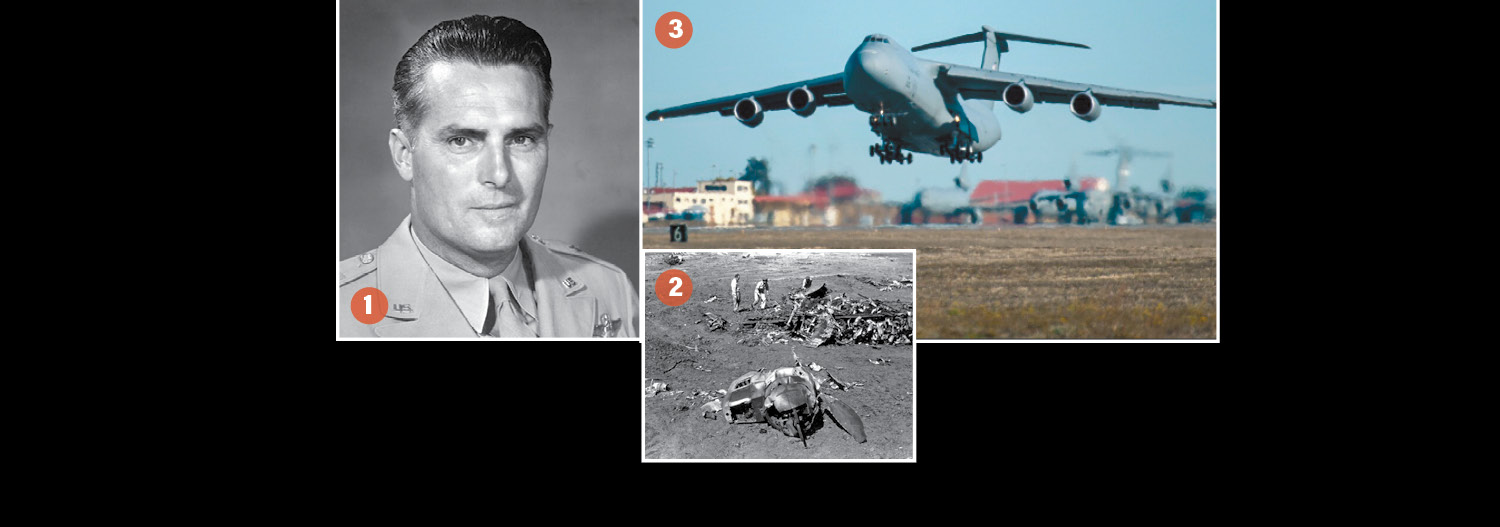
The base was rechristened in honor of Brig. Gen. Robert Falligant Travis, a true World War II combat hero who died Aug. 5, 1950, when his B-29 bomber crashed just after takeoff at Fairfield-Suisun. It marked the end of the meteoric rise of a commander.
Travis was born on Dec. 26, 1904, in Savannah, Ga., into a military family. Relatives included Lt. Col. William Barrett “Buck” Travis, commander of Texas regulars who died at the Alamo in 1836. His father, Robert J. Travis, was a decorated World War I officer and later a major general in the National Guard.
In 1928, Travis graduated from West Point and received a commission in artillery. The new second lieutenant immediately sought and received a transfer into aviation. He entered Primary Flying School at Brooks Field, Texas. In September 1929, he graduated as a pilot from the Advanced School, Kelly Field, Texas.
Tall, handsome, and athletic—and an expert poker player—Travis was a classic fast burner. Steady advancement propelled the youthful airman into command of 72nd Bombardment Squadron at Hickam Field, Hawaii, in July 1939. He was there a year before he was assigned as materiel officer of 5th Bombardment Group. In mid-1943, he took over the First Bomber Command at El Paso, Texas.
With the US at war, Travis soon joined Eighth Air Force in England, heading up 41st Combat Bombardment Wing at RAF Molesworth, RAF Kimbolton, and RAF Grafton Underwood.
Travis personally led his aircrews on 35 missions over Nazi-occupied Europe in 1944. He tended to fly on missions known to all as the most dangerous. Travis was only 39 when he was promoted to brigadier general.
After the war, Travis returned to Hickam as 7th Air Force chief of staff and then as its commander. In September 1948, he was appointed commanding general of Pacific Air Command.
On June 17, 1949, Travis arrived in California to take charge of Fairfield-Suisun Air Force Base and Strategic Air Command’s 9th Strategic Reconnaissance Wing, which within the year would be recast as 9th Bombardment Wing.
On the night of Aug. 5, 1950, Travis boarded a B-29 on a mission to carry an atomic bomb casing to Guam. On takeoff, the No. 2 propeller malfunctioned and the main gear failed to retract, leading to a crash. Travis died on the way to the hospital. He was one of 19 crew and ground personnel who perished.
Today, Travis Air Force Base handles more cargo and passenger traffic than any other military air terminal in the US. The base’s host unit, the 60th Air Mobility Wing, is the largest wing in Air Mobility Command, with a versatile fleet of C-5 and C-17 airlifters and KC-10 tankers.
Robert Falligant Travis
Born: Dec. 26, 1904, Savannah, Ga.
Died: Aug. 5, 1950, near Fairfield, Calif.
Colleges: University of Georgia (1922-24); United States Miliary Academy, West Point, N.Y.
Services: Army, Infantry (1928); Army Air Corps (1928-41); Army Air Forces (1941-47); United States Air Force (1947-50)
Occupation: US military officer
Main Era: World War II
Years Active: 1928-1950
Combat: European Theater
Final Grade: Brigadier General
Honors: Distinguished Service Cross; Silver Star (3); Distinguished Flying Cross (4); Purple Heart; Air Medal (4); Legion of Honor (France); Croix de Guerre with Palm (France); DFC (Britain); Croix de Guerre (Belgium)
Travis Air Force Base
State: California
Nearest City: Fairfield
Area of Main Base: 9.95 sq mi/6,368 acres
Status: Open, operational
Opened as Fairfield-Suisun AAF: May 17, 1943
Renamed Fairfield-Suisun AFB: Jan. 13, 1948
Renamed Travis AFB: Oct. 20, 1950
Current Owner: Air Mobility Command
Former Owners: Air Transport Command, Military Air Transport Command, Strategic Air Command, Military Airlift Command