
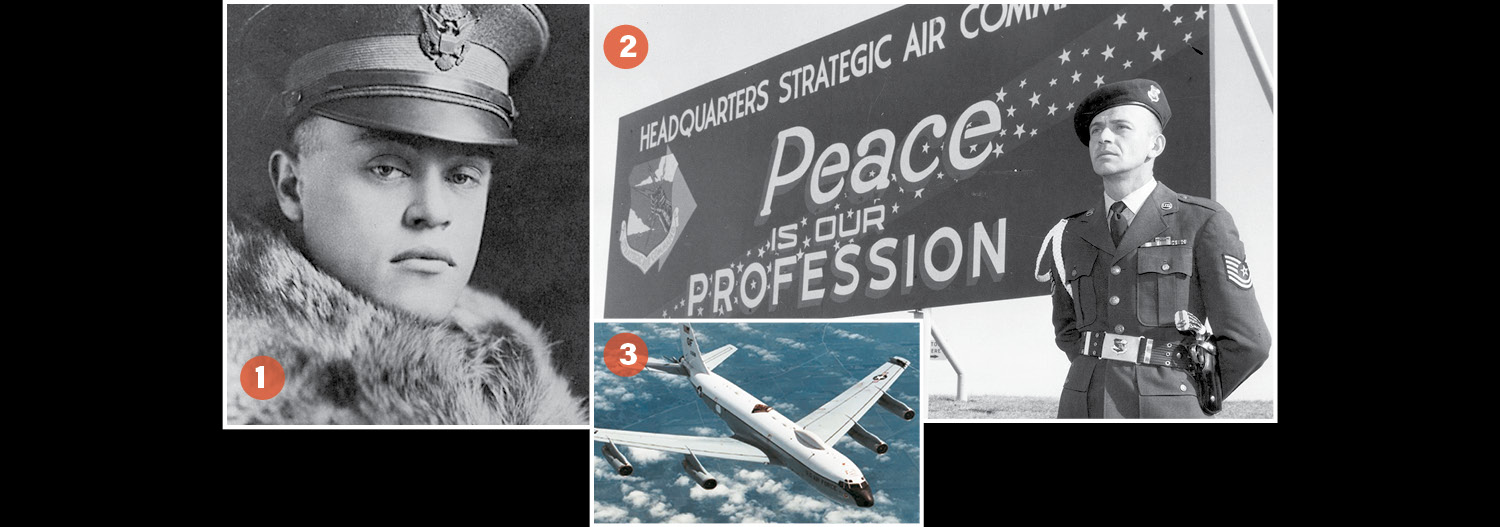
Airman From the Heartland
In today’s Air Force, Offutt is a famous name, indelibly linked to Strategic Air Command. Offutt Air Force Base, near Omaha, was the home of SAC headquarters for 44 years.
Offutt was a name of distinction long before there was a SAC—or even airplanes—but that’s getting ahead of the story.
It begins with Army Maj. Gen. George Crook, the famed 19th century Indian fighter. Based in Omaha in 1875-82, he helped subdue the Plains Indians and in time became the namesake of Ft. George Crook, an outpost built near Omaha in the early 1890s.
For the base’s first three decades, Crook’s name prevailed. Then Jarvis Jenness Offutt came on the US military scene.
Jarvis, born in 1894, was scion of a prominent family in Nebraska. His father was a well-known and influential attorney in Omaha. His mother was herself wealthy and well-connected in business and social circles.
Jarvis at first took the predictable course in life. He attended the elite Lawrenceville School in New Jersey and Chateau de Lancy, a Swiss prep school. In 1913, he entered Yale, where he became a member of the Varsity Club and was a top hurdler on the track team. He was inducted into Phi Beta Kappa.
Less predictably, however, the young Offutt also took a keen interest in military affairs. He began an Army career in 1916 while still at Yale, serving in Company B of the Army’s Yale Batteries.
Within days of his 1917 graduation, Offutt entered officer training in Minnesota. In another unexpected move, he requested and received a transfer into the fledgling Air Service, which was then in the throes of preparing for World War I.
Offutt was one of 300 US pilot candidates assigned to the Royal Canadian Flying Corps in Ontario for training. That training completed, he joined the 22nd Aero Squadron in Texas, received a commission, and left for England. In early 1918, he was detailed to the Royal Flying Corps (soon, Royal Air Force) as a ferry pilot.
Offutt, however, pushed hard for combat and was assigned to RAF No. 56 Squadron, a fighter unit in France. He arrived Aug. 12, 1918. The next day, he was dead, killed in an airplane crash. The Army could never determine whether his SE5 biplane was brought down by enemy fire or through mechanical failure.
In 1924, the Army honored him by naming the Ft. Crook airstrip “Offutt Field.” Twenty-two years later, the entire base was renamed “Offutt Field,” and the name “Crook” vanished.
Today, Offutt AFB, Neb., is home to US Strategic Command and the intel-heavy 55th Wing, the largest and most diverse wing in Air Combat Command. SAC’s famous “Looking Glass” aircraft made its final operational flight from Offutt in 1990. SAC itself was disestablished in 1992. The 55th today operates AC-, OC-, and WC-135 aircraft and E-4B command posts, among others.
Jarvis Jenness Offutt
Born: Oct. 26, 1894, Omaha, Neb.
Died: Aug. 13, 1918, Valheureaux, France
College: Yale University
Services: US Army (Artillery and Air Service)
Assigned: Royal Canadian Flying Corps; Royal Flying Corps; Royal Air Force
Main Era: World War I
Years Active: 1916-1918
Combat: Western Europe
Final Grade: First Lieutenant
Honor: Phi Beta Kappa
Offutt Air Force Base
State: Nebraska
Nearest City: Omaha
Area of Main Base: 4.3 sq mi/2,752 acres
Status: Open, operational
Opened as Ft. Crook (Army): March 3, 1891
Airstrip Offutt Field: May 10, 1924
Ft. Crook Renamed Offutt Field: June 1946
Home of: US Strategic Command, 55th Wing
Renamed Offutt AFB (USAF): Jan. 13, 1948
Current Owner: Air Combat Command
Former Owner: Strategic Air Command