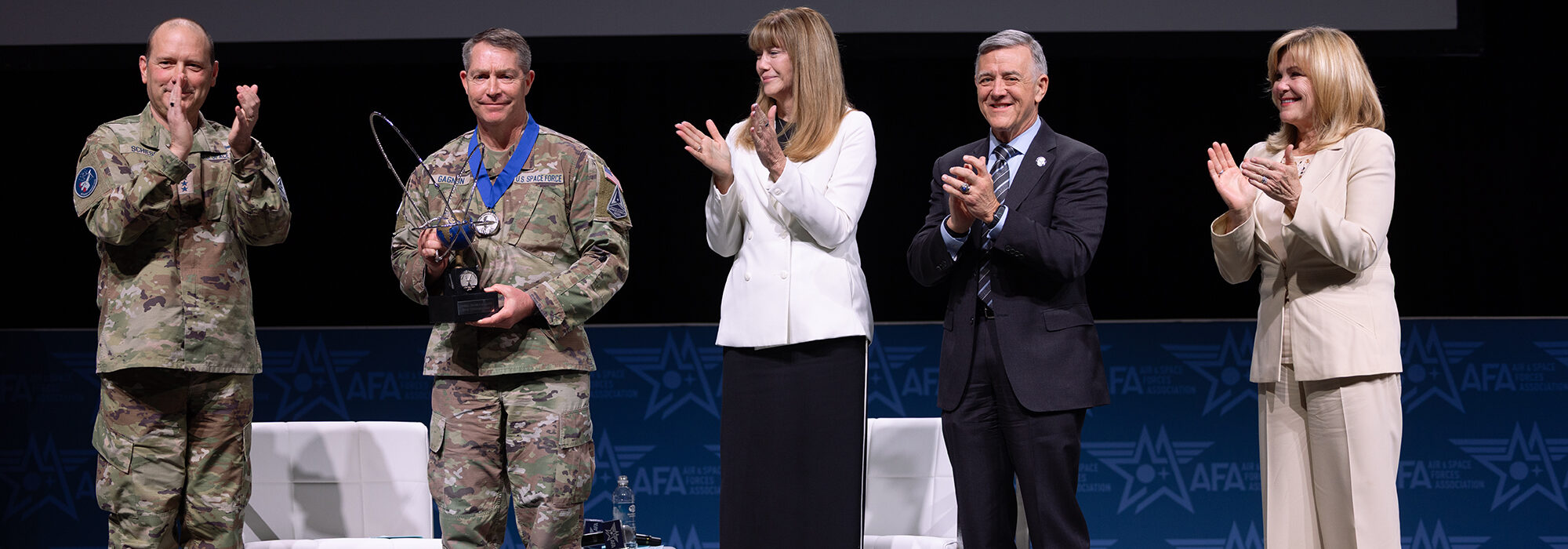
Lt. Gen. Gregory Gagnon (second from left) accepts AFA’s Jerome F. O’Malley Space Visionary Award for his leading role in reshaping space operations and his innovative thinking for combat-ready forces. Deputy Chief of Space Operations Lt. Gen. Doug Schiess, AFA Board Chair Kathleen Ferguson, AFA President and CEO Lt. Gen. Burt Field, and Shannon O’Malley Burg presented the award at AFA’s 2026 Warfare
Symposium.Jud McCrehin/staff
Photo Caption & Credits
AFA IN ACTION: Gagnon Recognized as Space Visionary
April 2, 2026
Share Article
Audio of this article is brought to you by the Air & Space Forces Association, honoring and supporting our Airmen, Guardians, and their families. Find out more at afa.org
Aurora, Colo.
The Air & Space Forces Association presented Lt. Gen. Gregory Gagnon with the Gen. Jerome F. O’Malley Space Visionary Award at the 2026 Warfare Symposium on Feb. 25. The award honors vision, risk-taking, and innovation that advance U.S. Space Force operational capabilities.
As commander of U.S. Space Force Combat Forces Command, Gagnon leads more than 12,000 Guardians and Airmen responsible for generating and delivering combat-ready space forces worldwide. Under his direction, Space Operations Command was restructured and redesignated as Combat Forces Command to better align with emerging offensive and defensive warfighting demands, reinforcing a readiness-first approach and a shift toward a true warfighting service.
A career intelligence officer and cyberspace operations expert, Gagnon brought a nontraditional background that enabled him to challenge legacy assumptions and drive operational innovation. He fostered a culture of experimentation, advanced intelligence integration, and data analytics, and accelerated force design, training, and deployment models.
Drawing on extensive joint and intelligence experience, his leadership has reshaped how the Space Force organizes, equips, and employs combat-ready space forces, exemplifying the visionary spirit embodied by General O’Malley.
The award was presented by Deputy Chief of Space Operations for Operations Lt. Gen. Douglas Schiess; AFA Board Chair Kathleen Ferguson; AFA President & CEO Lt. Gen. Burt Field, USAF (Ret.); and General O’Malley’s daughter, Shannon O’Malley Burg.
O’Malley was a pioneer of U.S. military spacepower who championed integrating space into everyday operations and emphasized agility, technological advancement, and forward-looking leadership. His legacy underscores the critical role of innovation in space for national security and future readiness.
AFA established the O’Malley Award in 2021 to recognize the critical contributions of outstanding Space Force leaders to U.S. national security. The first recipient of the award was the U.S. Space Force and last year’s winner was Gen B. Chance Saltzman, Chief of Space Operations.
Audio of this article is brought to you by the Air & Space Forces Association, honoring and supporting our Airmen, Guardians, and their families. Find out more at afa.org
All of the U.S. military services are pursuing capabilities to complement GPS amid concerns that the constellation is increasingly vulnerable to interference, but a new government watchdog report calls for better coordination and prioritization among those efforts to avoid delays and duplication.
The Air Force has begun evacuating stealth fighters, gunships, and special operations planes ahead of Hurricane Isaias expected landfall over the Gulf Coast this weekend.
The Space Force has finished transferring the last of the Air Force Reserve and Air National Guard members covered by the Personnel Management Act that created a hybrid full-time/part-time force.
After scrapping a long-delayed program to build a next-generation GPS ground system earlier this year, the Space Force and prime contractor Lockheed Martin are pushing toward delivery of the capability in time to support the first launch of the newest GPS satellites, currently planned for 2028.
Audio of this article is brought to you by the Air & Space Forces Association, honoring and supporting our Airmen, Guardians, and their families. Find out more at afa.org Military readiness requires preparation for the unexpected. Airmen and Guardians train...
A federal judge recently sentenced one Airman and a former Airman to a combined 15 years in prison and ordered them to pay $1.36 million in restitution for a two-year cyber fraud scheme they perpetrated while serving on Active-Duty at Dover Air Force Base, Del.
Air Force Explosive Ordnance Disposal technicians and officers will soon join an exclusive club of troops allowed to sport a beret marking their special community and service.
The Space Force is looking for industry feedback on its plans to create a new “Mission Development Zone” at Vandenberg Space Force Base, Calif., to support launch providers with space for additional payload processing capacity, test and assembly facilities, and potentially rocket and spacecraft manufacturing infrastructure.
The Space Development Agency is set to launch 21 Tranche 1 data transport satellites on Oct. 5—its fourth Tranche 1 mission since last fall and the first to carry Northrop Grumman-built satellites.
✓
Thank You!
Check your inbox to verify your email address and finish setting up your AFA account.
★
Welcome Back!
An account with this email already exists. Please log in to continue.
Subscribe to the Air & Space Forces Daily Report
The latest news from Air & Space Forces Magazine, as well as news from other leading publications, delivered right to your inbox every morning!
We’re sorry, there has been an error. Please review your input or try again later.