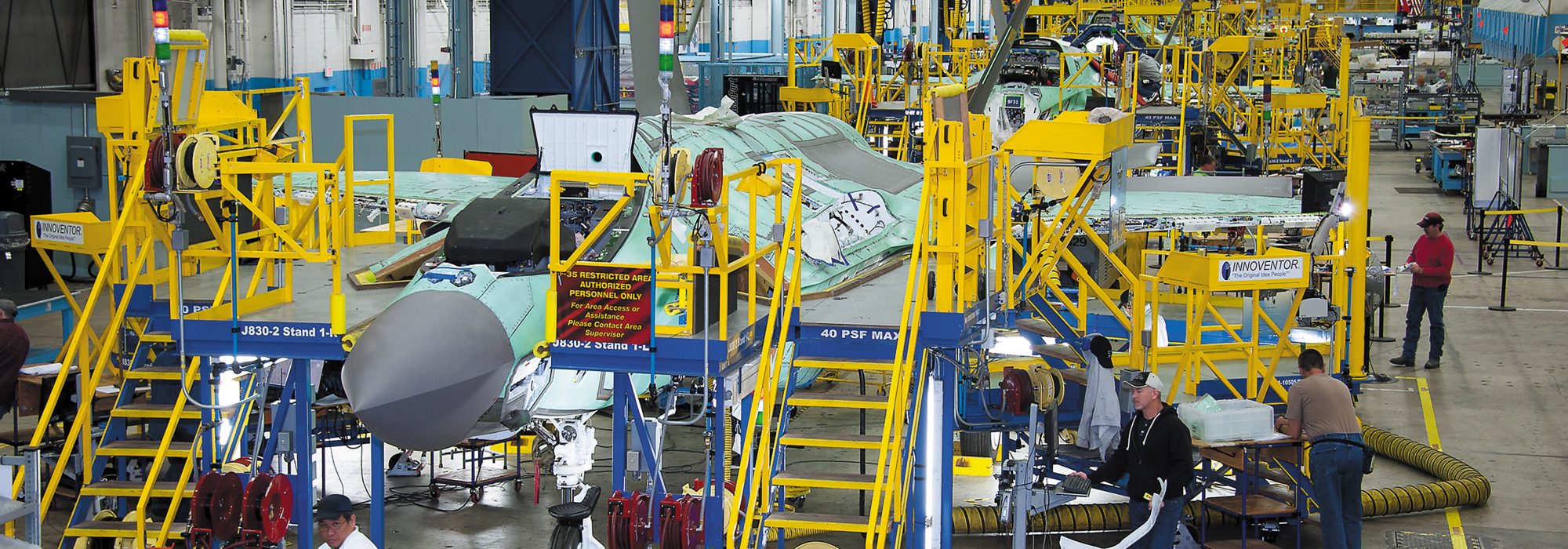
Teams at the Lockheed Martin facility in Fort Worth, Texas, work on the second F-35A for the Royal Netherlands Air Force in December 2012. Lockheed Martin photo by Randy A. Crites
Audio of this article is brought to you by the Air & Space Forces Association, honoring and supporting our Airmen, Guardians, and their families. Find out more at afa.org
USAF is probably buying fewer aircraft than you think. Here’s a look at what’s actually in a hot production line.
America’s military technology depends not just on the science of new technologies, but the ability to turn those breakthroughs into practical hardware.
The story of the “Arsenal of Democracy” runs from Rosie the Riveter and the gargantuan production plants of World War II to the heavily guarded desert factories where the Air Force’s most secret systems are sometimes hand-built to fulfill exacting missions. From massive, robot-assisted assembly operations to small companies with a few dozen workers, production lines are the Air Force’s lifeblood.
The service is ramping up production of munitions after half a decade of using them up faster than it builds them and embarking on a modernization binge after decades of having key programs canceled or postponed.
If all goes as planned, a bevy of new fighters, tankers, bombers, trainers, and surveillance aircraft will start entering service in the next few years, although the production surge won’t come close to the levels seen during the so-called “Reagan buildup” of the 1980s, when F-16 fighters were built at rates exceeding 200 a year.
The Green Mile
Lockheed Martin’s mile-long production line in Fort Worth, Texas, employs about 8,800 people who work on the F-35 Joint Strike Fighter. The famous plant—operated be predecessor entities such as Consolidated, Convair, and General Dynamics—has produced B-24 and B-58 bombers, F-106s and F-111s, among others. The last factory-fresh F-16 left the plant in December 2017, after more than 40 years of Viper production. The F-16 line will be moved to Greenville, S.C., and foreign locations to make more room for the burgeoning F-35 line.
It takes about 22 months to build an F-35, and production is slated to increase rapidly, as the plant builds jets for USAF, the Navy, Marine Corps, eight partner nations, and at least four foreign customer nations.
Last July, the Pentagon announced its 11th contract for low-rate initial production of the fifth generation fighter. The $5.6 billion contract modification covered 48 F-35A variants for the Air Force, along with 18 F-35Bs for the US Marine Corps, and eight F-35Cs for the US Navy. In Fiscal 2018, the Air Force is requesting 46 more F-35As, aiming to get to 60 per year early in the next decade. USAF wants 1,763 F-35As in all.
The program has two more production lines globally. Europe’s F-35 final assembly and checkout (FACO) facility is in Cameri, Italy, where Lockheed expects more than 6,300 people to work at peak production. The first jet rolled off the Italian line last March.
Another FACO is located in Nagoya, Japan, operated by Lockheed partner Mitsubishi Heavy Industries. At least 38 F-35s will be built there; the first Japan Air Self Defense Force F-35 rolled out last July.
Build ‘Em Big
The world’s largest building, by volume, sits on Boeing property in Everett, Wash. The 98.7-acre facility houses production for the company’s civilian airliners and the Air Force’s new tanker, the KC-46A Pegasus.
The tanker has suffered development delays but production is beginning to ramp up. The jet is adapted from the company’s 767-200ER airliner-cargo jet.
Boeing was cleared for Pegasus production in August 2016. As of October 2017, six of 24 aircraft on contract were flying and undergoing tests. The service plans to field at least 179 KC-46s, with the first operational model coming early in 2018. Boeing had previously committed to 18 tankers being delivered by that time.
Black Jets
Air Force Plant 42, north of Los Angeles in Palmdale, Calif., hosts several big contractors, all doing “special access” work. Lockheed Martin refurbishes U-2 intelligence, surveillance, and reconnaissance aircraft at its facility there, and Northrop Grumman seems to be organizing space at its portion of the sprawling plant for manufacture of the still-secret B-21 Raider stealth bomber. The B-2 Spirit stealth bomber was built in Palmdale and receives its depot maintenance there, as well.
Northrop was up to 3,000 workers at the Palmdale facility last fall, adding more at a steady clip, the Los Angeles Times reported. By 2019, the company expects to have 5,200 employees working on the Raider and other aircraft in Palmdale, wrote the Times.
Production is just beginning on the bomber. Much of its funding remains secret and the Air Force has said only that it will build “at least” 100 of the jets. The program has passed its preliminary design review, and drawings are now going to vendors to begin fabrication, according to the Air Force’s Rapid Capabilities Office, which oversees the project.
Bombed Up
The Air Force has released 54,000 precision guided weapons against ISIS since 2014, a figure that doesn’t count weapons used by the Navy, Marine Corps, and coalition partners. Wilson acknowledged in September that stockpiles haven’t been replenished fast enough.
USAF is moving to get inventories back into the black. Production of the Small Diameter Bomb 1 is accelerating from 5,000 to 8,000 units per year. The Joint Direct Attack Munition production rate is ramping up to 45,000 per year—and could go higher—though production depends on several component suppliers keeping up that pace.
In concert with the Army, USAF is stepping up production of AGM-114 Hellfire missiles, and the Air Force is working with the Navy on the Advanced Precision Kill Weapon System.
These new weapons have “changed the way we fight,” Wilson said in September, and many senior USAF leaders have suggested the service will never go back to imprecise weapons that may not hit exactly what they’re aimed at.
“We will continue to work closely with our industry partners to manage production, she said, but keeping old equipment ready “isn’t enough.” Production will have to increase.
Restarting the Raptor
The Air Force is struggling today to meet regional commander demand for the world-beating F-22 Raptor fighter. Then-Defense Secretary Robert M. Gates halted its production in 2009, and there aren’t enough to meet all of USAF’s commitments; only 187 of a required 381 were built.
Since the last F-22 rolled out of Lockheed Martin’s Marietta, Ga., facility in 2012, members of Congress have asked what it would take to restart the line and bring fleet strength up to par. In the Fiscal 2017 Defense Authorization Act, USAF was directed to study the costs, time lines, and effort required to produce up to another 194 F-22s.
In July 2017, the Air Force submitted its report, saying that another 194 F-22s would cost $50 billion. That cost includes $9.9 billion to restart the production line—a process that involves taking tooling out of storage, hiring a workforce with proper security clearance, training it, and certifying thousands of component vendors. The service has “no plans” for doing this, Air Force Secretary Heather Wilson said at the time.
Although it’s unlikely the American defense industrial base will see a return to the massive output last seen in the 1980s, the production pendulum is swinging back up. After a prolonged drought, the Air Force in the 2020s will also see warm production lines for fighters, bombers, tankers, surveillance aircraft, and trainers, and a steeply accelerating output of smart munitions. Whether production reaches a sustained plateau or continues an up-and-down cycle, assembly lines will continue to be the backbone of the fighting force.
Audio of this article is brought to you by the Air & Space Forces Association, honoring and supporting our Airmen, Guardians, and their families. Find out more at afa.org
Audio of this article is brought to you by the Air & Space Forces Association, honoring and supporting our Airmen, Guardians, and their families. Find out more at afa.org Across directed energy, precision optics, and advanced coatings, Attalon is investing...
For years, sustainment challenges and spare parts shortages have hindered the F-35 Joint Strike Fighter’s readiness. But the Air Force’s experience flying F-35s heavily in operations against Iran have showed what the jet can be capable of, if maintainers get all the supplies and support they need.
Today’s Airmen are going to have to embrace artificial intelligence the same way Chief Master Sergeant of the Air Force David R. Wolfe learned to love desktop computers and email in the 1990s, the senior enlisted Airman said Sept. 14 during AFA’s Air, Space & Cyber conference.
The Air Force has erected an inert version of its LGM-35A Sentinel intercontinental ballistic missile at Vandenberg Space Force Base, Calif., the service announced Sept. 14. Officials also confirmed at AFA’s Air, Space & Cyber conference that they still expect to finish restructuring the long-troubled Sentinel program by the end…
Ten Airmen received battlefield promotions for their roles in the daring rescue of DUDE 44, the crew of an F-15E Strike Eagle that was shot down over Iran this spring, Air Force Chief of Staff Ken. S. Wilsbach announced Sept. 14. Wilsbach revealed the promotions—a rarity in the Air Force—and…
Defense industry leaders say the Air Force needs to be able to update the software on its munitions multiple times a day, not every few months, and a new Pentagon instruction released last week could enable that.
Air Force officials are exploring the idea of creating a new acquisition office to oversee the point defense mission, in the service’s latest move to intensify its focus on defending airbases from drone and missile attacks, Air Force Secretary Troy E. Meink said Sept. 14, during AFA’s Air, Space &…
The Air Force plans to field at least 500 semi-autonomous fighter drones known as Collaborative Combat Aircraft by 2032, and another 500 cheap reconnaissance and strike drones known as Massed Modular Aircraft that same year, Air Force Secretary Troy Meink said Sept. 14.
Air Force Secretary Troy Meink revealed Sept. 14 the Space Force has “space control weapons” on orbit today—the Pentagon’s most direct acknowledgement to date that the U.S. is operating offensive capabilities in space.
✓
Thank You!
Check your inbox to verify your email address and finish setting up your AFA account.
★
Welcome Back!
An account with this email already exists. Please log in to continue.
Subscribe to the Air & Space Forces Daily Report
The latest news from Air & Space Forces Magazine, as well as news from other leading publications, delivered right to your inbox every morning!
We’re sorry, there has been an error. Please review your input or try again later.