
The A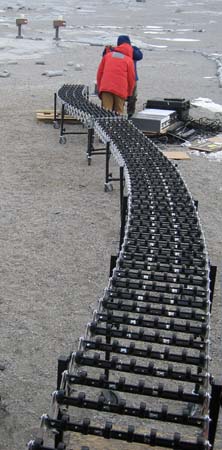 ir Force Technical Applications Center at Patrick AFB, Fla., sent a four-person maintenance team to Antarctica last fall to repair a seismic sensor, part of the global network known as the US Atomic Energy Detection System that fulfills AFTAC’s nuclear-treaty monitoring mission, according to a March 27 AFTAC release. The Bull Pass sensor site ceased operating in April 2008 and failed to respond to long-distance fixes. Since AFTAC had no idea what the problem might be, planners spent months working through various options, including possible repairs of the various elements of the hybrid power system—diesel-fueled generators, solar panels, and lead-acid batteries. “We had to prepare for the worst,” considering the -70-degree temperature, said engineer Capt. Brian Rickert. Planners definitely believed the team would need to replace the site’s 48 10-year-old, 150-pound batteries, so came up with a roller conveyor system. Armed with nearly 7,000 pounds of equipment, the AFTAC team traveled to McMurdo Station and then on to the Bull Pass, where they were able to repair the power system and replace the batteries over an eight-day period. AFTAC normally sends out enlisted-only maintenance teams to keep the detection system running smoothly, but this time the center wanted an overall assessment of its long-term viability, so it added Rickert to the team comprising SSgt. Andrew Bliss, SSgt. Mark Boris, and SrA. Damien Leppo. In the end, “It was just four guys working,” said Bliss. With repairs they made, Rickert said the sensor should “function for many years in the future.” (AFTAC report by MSgt. Patrick Murphy)
Seven F-22 Raptor pilots have recently been awarded one of the military’s highest decorations for their actions during operations in the Middle East. Six of the pilots were decorated with the Distinguished Flying Cross for their role in Operation Midnight Hammer, the June 2025 strikes against Iranian nuclear facilities.