


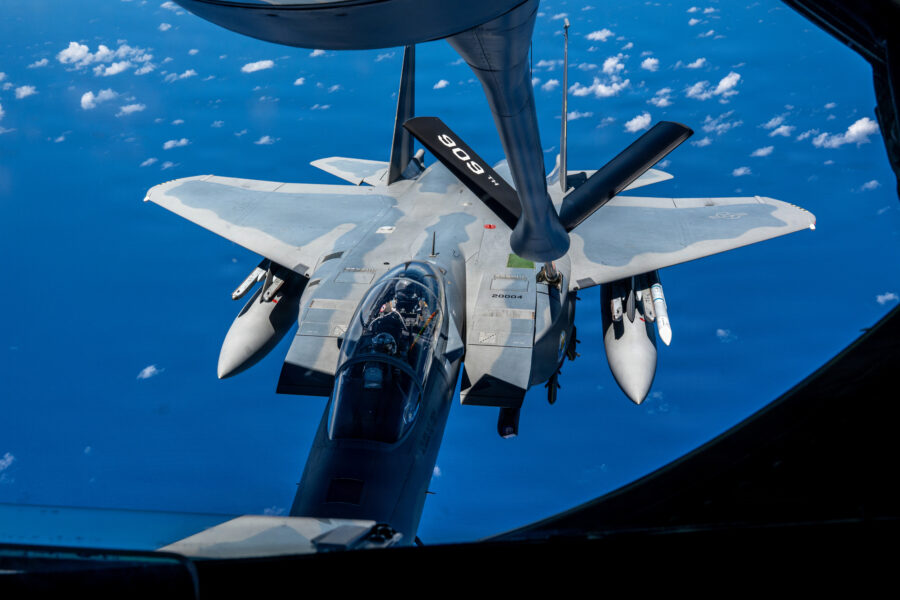
The Air Force awarded a sweeping—and potentially massive—F-15 contract to Boeing this week, one that a top aviation expert said could provide a new approach to major program acquisitions and greater stability for the defense industry.
The Pentagon on Aug. 24 announced the Air Force had awarded Boeing an indefinite-delivery, indefinite-quantity contract to support the F-15. The contract, which the Air Force is calling Eagle Crest, could be worth up to $131.2 billion over the next decade if it’s fully utilized.
The Eagle Crest contract covers a wide range of F-15 activities, including aircraft production, systems integration, modernization, upgrades, retrofits, sustainment and setting up the military’s own organic depot maintenance capabilities.
Heather Penney, a former F-16 pilot and director of studies and research at AFA’s Mitchell Institute for Aerospace Studies, said in an Aug. 27 interview that the Air Force’s wide-ranging approach with this contract appears to be unique—and could provide a template to follow for other major program acquisitions.
Contracts such as Eagle Crest “could be a really important way to accelerate the resourcing and capability to the warfighter,” Penney said. “Provide the demand signal, incentivize industry to invest, and get the defense industrial base healthy again.”
“It is because we have not had large production runs, both in annual rate and total quantity, that we’re seeing a lot of the strains across the defense industrial base today,” Penney continued. “So this IDIQ contract could be one way that the service begins to solve that problem.”
An Air Force spokesperson said in a statement to Air & Space Forces Magazine that the Eagle Crest contract is meant to streamline how the service carries out future requirements for both itself and foreign customers, and “accelerate delivery of capability to the warfighter.”
But there’s no guarantee the entire $131 billion will be spent, the spokesperson said.
“As an indefinite-delivery, indefinite-quantity contract, it provides flexibility to support future efforts up to the contract ceiling, while each award remains subject to independent decision making,” the spokesperson said. “The ceiling represents capacity for future needs, not a commitment to spend the full amount. By consolidating these efforts under a single contract vehicle, Eagle Crest will help the Air Force move faster and reduce administrative burden.”
The initial ordering period for the contract will run through August 2031 but could be extended five more years to August 2036, the contract notice said. The work will be done at Boeing’s St. Louis, Missouri, facility and is expected to be done by August 2037.
Penney cautioned that for this approach to truly work, the Air Force needs to follow through and provide clear signals to Boeing on what kind of quantities, rates, and other business they can expect in the near future. An IDIQ contract can provide the Air Force flexibility year-to-year to lessen its purchases if it doesn’t need as many, she said.
But that could be a disadvantage for Boeing, she said. If production rates aren’t stable and the company can’t predict how much business it will have from year to year, it might scale back its supply chain purchases or other operations, possibly undermining the benefits of such a long-term contract.
“The thing that industry needs is they need the demand signal, they need the stability, and they need the resourcing,” Penney said. “This could potentially provide all three of those things to Boeing in order for them to scale their production, whether or not that is simply additional tooling, another shift, or even opening up additional line capacity. That would be huge for what the Air Force needs to replace its aging fighter fleet.”
Besides providing F-15s and support to the Air Force, Air National Guard and other U.S. military customers, the contract also involves foreign military sales to Japan, Israel, Saudi Arabia, South Korea, Singapore, Indonesia, and Poland. The fact that FMS sales are included in the Eagle Crest contract is also significant, Penney said, because it could help Boeing keep down costs of building modern versions of the F-15 by leveraging economies of scale.
And as the Air Force’s fighter fleet continues to age and shrink and the service struggles to bring on more new jets as older ones retire, Penney said this kind of approach could help unlock more industry capacity.
“It’s not a secret that the Air Force needs to increase their recapitalization program,” Penney said. “This is one way they can do it.”