
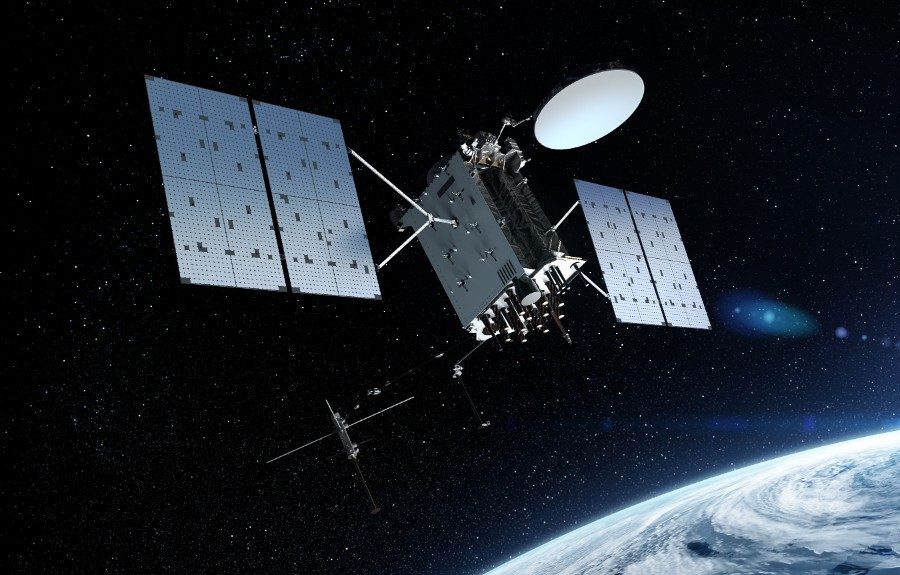
GPS supplies space-based military and civil radio-positioning for geolocation, navigation, and timing. It is a fundamental enabler of precision bombing, CSAR, mapping, and rendezvous. It provides accurate and uninterrupted 3D (latitude, longitude, and altitude) position, velocity, and time data. The last of the GPS Block IIA satellites, launched between 1990 and 1997, was decommissioned in 2020. GPS Block IIR and IIR-M (modernized) included 21 vehicles launched between 2005 and 2009. Modernization upgrades included two new signals, enhanced encryption, anti-jamming capabilities, a second civil signal, and electromagnetic pulse sensors that form part of the U.S. Nuclear Detonation Detection System (NDS).
GPS Block IIF is a follow-on to IIR-M. Upgrades include extended design life, faster processors, and improved anti-jam technology and accuracy, a new military signal, and a second and third dedicated civil signal. The GPS Block IIIA, first launched on Dec. 23, 2018, has improved accuracy, availability, and integrity, and incorporates a steerable, high-power, anti-jam capability. Lockheed Martin completed Block IIIA production at SV-10 in 2022. The company was awarded a follow-on contract for Block IIIF SV-11 and SV-12 as well as up to 22 additional vehicles in 2018.
USSF executed options for SV-13 and SV-14 in October 2020, SV-15 to SV-17 in November 2021, and SV-18 through SV-20 in November 2022. Block IIIF will add a hosted search and rescue payload, and a geographically targetable high-power military signal. USSF worked for years on the oft-delayed Next-Generation Operational Control Segment (OCX) to enable advanced GPS III features. The launch and on-orbit check segment of OCX went operational in 2017. But concurrent Blocks 1 and 2, to enable use of modernized civil, aviation, military signals, and advanced cyber defenses, were not functioning as intended, and in April 2026, the Space Force canceled OCX and awarded Lockheed Martin a contract to develop upgrades for its interim Architecture Evolution Plan software. USSF launched GPS III SV-9 on Jan. 28, 2026, and SV-10 on April 21, 2026. The first of the IIIF satellites is slated for launch as early as 2028.
Global Positioning System Technical Data
Contractors: Boeing (IIF); Lockheed Martin (IIR, IIR-M, III/IIIF).
Operator/Location: USSF CFC, Mission Delta 31 (DEL 31), 2nd Navigation Warfare Squadron (2 NWS), Schriever SFB, Colo.
First Launch: Feb. 22, 1978.
IOC: Dec. 9, 1993.
Design Life: 7.5 yr (IIR/IIR-M); 12 yr (IIF); 15 yr (IIIA).
Launch Vehicle: Delta II, Delta IV, Falcon 9.
Constellation: 31 spacecraft (not including decommissioned or on-orbit spares).
Active Satellites: •GPS Block IIR. Launched 1997 to 2004; six active. •GPS Block IIR-M. Launched 2005 to 2009; seven active. •GPS Block IIF. Launched 2010 to 2016; 12 active. •GPS Block IIIA/IIIF. New generation launched in 2018; 10 active.
Dimensions: (IIR/IIR-M) 5 x 6.3 x 6.25 ft, span incl solar panels 38 ft; (IIF) 9.6 x 6.5 x 12.9 ft, span incl solar panels 43.1 ft.
Weight: On orbit, 2,370 lb (IIR/IIR-M); 3,439 lb (IIF).
Performance: Orbits the Earth every 12 hr, emitting continuous signals, providing time to within one-millionth of a second, velocity within a fraction of a mile per hour, and location to within a few feet.
Orbit Altitude: Medium-Earth Orbit (MEO) at between 10,988 and 12,550 miles.
Power: Solar panels generating 1,136 watts (IIR/IIR-M); up to 2,900 watts (IIF).