
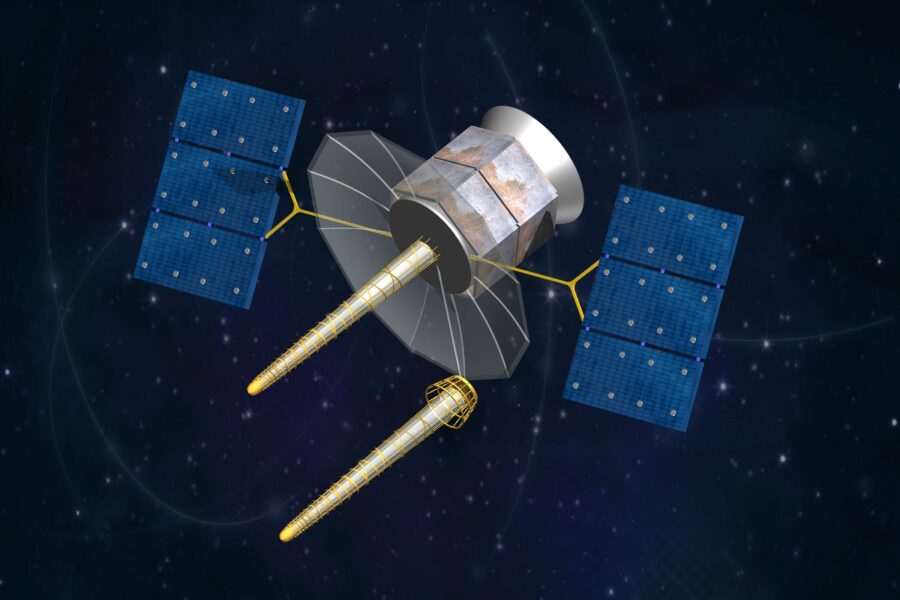
Fleet Satellite Communications System (FLTSATCOM) currently consists of two operational satellites used by the Air Force, Navy, and presidential command network. The system is designed to provide secure communications links among the three users. Each FLTSATCOM satellite includes 22 communications channels in the ultra-high and super-high frequency bands that support nuclear command and control. FLTSATCOM Block 2 (consisting of FLTSATCOM 6-8) is an upgrade from the FLTSATCOM Block 1 design and includes an Extremely High Frequency (EHF) communications package that served as a test bed for Milstar system terminals. Both 7 & 8 were transferred to the USSF in 2021 following the stand up of the Space Force. As of September 2025, one FLTSATCOM remains active, but it is nonoperational for use in secure communications. UFO/MUOS has taken over its duties.
Fleet Satellite Communications System Technical Data
Contractor: TRW (prime contractor), acquired by Northrop Grumman.
Acquiring Agency: Space and Naval Warfare Systems Command.
Operator/Location: 10th Operations Squadron, USSF (Mission Delta 8). Point Mugu, Calif.
First Launch: FLTSATCOM 7, May 1986.
IOC: FLSATCOM 7, May 1986.
Launch Vehicle: Atlas Centaur (GEO)
Constellation: Two GEO sats.
Active Satellites: •FLSATCOM 7. Launched in 1987; active. •FLSATCOM 8. Launched in 1989; active.
Dimensions: 8.2 ft diameter, 4.3 ft height.
Weight: 5,094 lb.
Performance: Geostationary orbit.
Orbit Altitude: Geostationary.
Power: Solar array, 1,400 watts (GEO), batteries.