


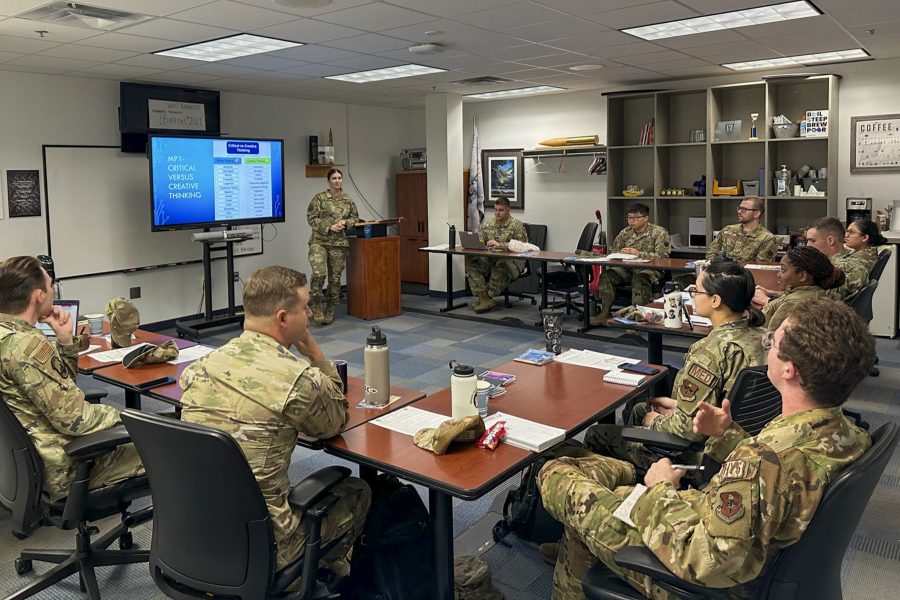
The Air Force plans to offer virtual enlisted Foundations courses Airmen can take at their convenience as part of a larger effort to modernize enlisted professional military education, or EPME.
The service established these preparatory leadership courses in 2024 to be taken in the years between traditional enlisted leadership schools such as the Airman Leadership School, or ALS, and the Noncommissioned Officer Academy, or NCOA. Foundations courses are taught at the wing level, usually by volunteer instructors when available. Offering virtual versions of the courses would give Airmen more flexible access to courses taught by highly qualified instructors, without having to leave their units to attend the course, Chief Master Sergeant Jonathan Rapelje, who is overseeing the EPME modernization, told Air & Space Forces Magazine.
“So, instead of having an in-residence, five-day Foundations course, what we will eventually achieve with [virtual] Foundations courses is allow Airmen to attend blocks taught by subject matter experts in each area that they’re learning about at a time that’s more convenient to them and not take them out of the workplace,” said Rapelje, adding that the Virtual Foundations Platform should be available before 2030. “We’re talking about better content that’s more easily accessible.”
The concept is part of a sweeping effort to modernize enlisted professional military education into a “more agile, adaptive, and dynamic delivery model,” Chief Master Sergeant of the Air Force David R. Wolfe said during an Aug. 11 speech at the 2026 Air Force Sergeants Association’s Summit.
“We built much of our educational structure for an Air Force that could periodically pause to learn; today’s Air Force must learn while climbing. Development should not wait for the Airman; it should move with the Airman,” Wolfe said in his speech, posted on his official Facebook page.
“Education should not compete with readiness; it should create readiness. Learning should not depend entirely on geography, one school date, or the availability of a seat precisely at the right moment in someone’s life. Airmen should receive the development closer to the point of need and in ways that respect the realities of operational service,” Wolfe added.
Currently, professional military education centers report to multiple commands across the Air Force. For example, large PME centers like an NCOA or ALS and development advisor on the same installation report to either Pacific Air Forces, U.S. Air Forces in Europe, or Air Force Education and Training Command in the continental U.S.. Going forward, all PME centers will report to the wing command structure, Rapelje said.
“USAFE operates differently than PACAF and [the continental U.S. centers], so you have three different versions of NCOA command structures,” Rapelje said. “What EPME modernization does is it consolidates and standardizes that reporting structure, so those NCOAs who currently report to anywhere from the AETC construct to USAFE construct to the PACAF construct will now report to their wing command structure.”
Rapelje added that “we’re not creating new schoolhouses—we are consolidating all of these installations that have either a large, medium, or small center under the same organizational construct for standardization.”
The change will make wing leaders “responsible for the readiness of the installation,” and give them “greater visibility over the entire enlisted development continuum,” said Wolfe, who added that the new authority “does not mean wings will write their own EPME curriculum or establish their own standards.”
Air University’s Barnes Center for Enlisted Education “will continue to provide enterprise-level curriculum, guidance, and standards,” Wolfe said. “The change is that installation leadership will have clearer responsibility for how those programs are connected and executed locally.”
Restructuring the oversight of these education centers are key “organizational changes that need to happen, so that as EPME evolves in the future, we’ve already standardized and built the foundation for that to happen,” Rapelje said.