
Editor’s Note: This article has been updated to correctly reference the history of participation of MQ-9 Reaper and RC-135 Rivet Joint crews in the exercise and to identify the 705th Combat Training Squadron as the exercise’s operational hub.
The Air Force recently conducted a virtual stress test of its command-and-control capabilities, linking Air Operations Centers in New Mexico and the United Kingdom and forcing commanders to run personnel recovery and strikes under simulated fire.
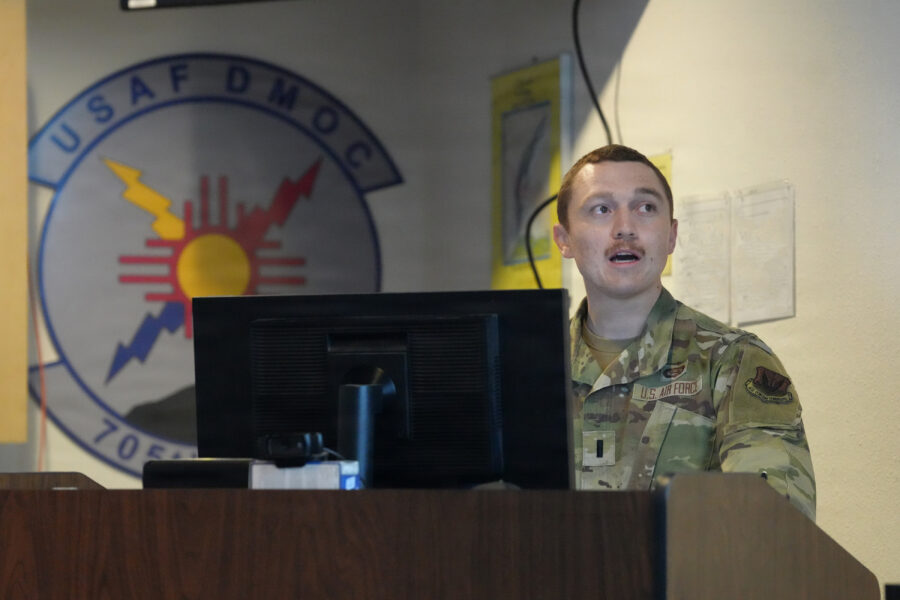
Between Aug. 3-7, the 705th Combat Training Squadron at Kirtland Air Force Base, N.M., hosted and served as the physical and operational hub for Virtual Flag 26-4, which included more than 267 participants from 28 units around the world, including from the Air Force, Space Force, Army, Marine Corps, United Kingdom, and Australia.
“The foundation of joint warfighting is built in exercises like Virtual Flag,” Col. James Fields II, commander of the 505th Command and Control Wing, Hurlburt Field, Fla., said in a release. “This event is where we prove that we are the Air Force’s premier organization for operational command and control.”
The 505th Combat Training Squadron replicated an Air Operations Center and worked with units scattered across the country as participants trained in a distributed, contested environment using joint and coalition C2.
The exercise focused on creating “realistic friction” between the tactical and operational levels of C2, according to the release.
Another focus for the exercise was delivering a complete intelligence picture for commanders. Marine Air Support Squadron 1 and Marine Air Control Squadron 2, both out of Marine Corps Air Station Cherry Point, N.C., tied together all the intel streams to provide a common tactical picture for all commanders, serving as a multifunction air operations center.
“They provided the critical expertise needed to ensure every single participant, from our pilots in the virtual simulators to our commanders in the [Air Operations Center], was looking at the exact same, accurate common tactical picture,” Maj. James McCarthy, director of operations for the 705th, said. “That shared view of the battlespace is the absolute foundation of joint C2.”
Realistic Training
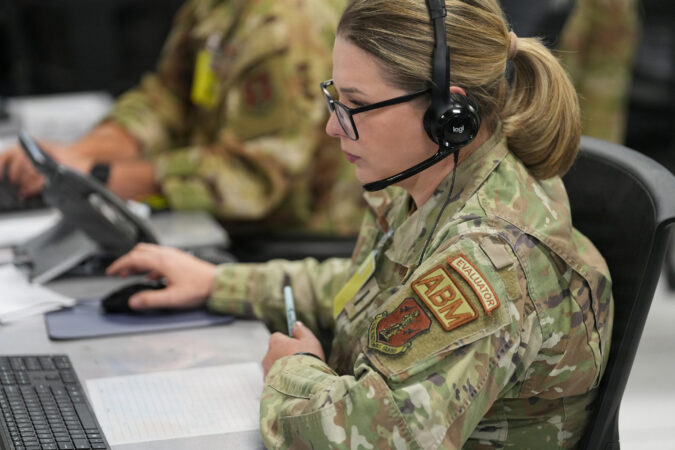
VF 26-4 saw crews for MQ-9 Reaper drones and RC-135 Rivet Joints participate and, rather than relying on traditional “white carding” of their capabilities, crew members worked their roles into the various exercise scenarios. The exercise also saw E-3 Sentry and E-7 Wedgetail crews simulate the platforms.
“In a peer conflict, identifying tracks and targets is going to require a robust [Intelligence, Surveillance and Reconnaissance] enterprise,” McCarthy said. “This is extremely valuable because it helps our C2 community understand what the ISR enterprise can and cannot provide in a high-tempo fight.”
The exercise simulated operations between Kirtland’s Distributed Mission Operations Center and the Royal Air Battlespace Training Center at RAF Waddington, England, more than 4,000 miles away, and saw crews flying simulators in the virtual exercise from the Royal Australian Air Force Control and Reporting Center, which is more than 8,000 miles away from Kirtland.
Select U.S. joint personnel from each service, the RAF and RAAF, physically traveled to Kirtland’s DMOC to run the AOC replication cells, tactical C2 and ISR crews, and space and network integration for the exercise.
During the exercise, RAF Typhoon fighter/attack aircraft and Voyager tanker/transport aircraft crews flew in tactical simulators, acting as the White Force at Waddington, while RAAF battle managers operated from Australia, running E-7 simulators, also as the White Force.
The AOC replicated at Hurlburt with the 505th CTS let core joint leadership plan and execute “side-by-side” on the operations floor back at Kirtland while connected to operators in the U.K. more than 4,000 miles away.
“That connectivity is important because it enables operational command and control training across geographically separated teams, helping warfighters practice the coordination, communication and decision-making required in real-world joint and coalition operations,” Lt. Col. Sajjad Abdullateef, 705th Combat Training Squadron commander, told Air & Space Forces Magazine in a written statement.
The inclusion of Australian and British forces was important, retired USAF Col. George Dougherty told Air & Space Forces Magazine; most allied partners have historically let the United States take the lead in developing network architecture, tech, and standards for C2 systems.
“The U.S. was way ahead in terms of real-time battle management C2,” said Dougherty, who served as assistant to the Air Force’s program acquisition executive for command, control, communications, and battle management. “Europe/NATO was, for instance, more focused on strategic and collective ministerial-level C2, which is a bigger challenge for their collective multinational decision-making and planning.”
A Balancing Act
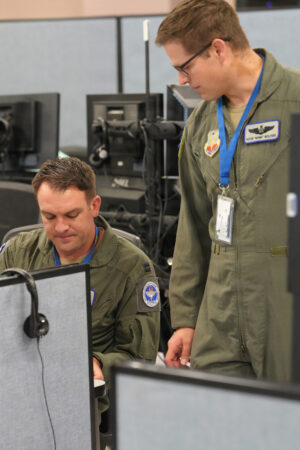
As commanders worked through their AOCs receiving simulated strikes, launching aircraft for reconnaissance and personnel recovery, they had to move units and platforms around the virtual battlespace, which affects sortie generation, sustainment, and mission planning, Abdullateef wrote.
“Commanders were required to balance survivability against mission effectiveness,” Abdullateef wrote. “They had to determine how and where to disperse forces, how to continue supporting the daily Air Tasking Order despite personnel and resource losses, and how to preserve combat power for follow-on operations.”
Operational C2 requires commanders and their staffs to translate shared understanding into timely decisions, synchronized actions, and combat effects across distributed forces, Abdullateef wrote.
“Stepping into a Wing Operations Center to manage six mission generation force elements across three simulated bases is a massive departure from our Airmen’s daily tactical routines, and Virtual Flag 26-4 provided the proving ground,” said an Air Force major serving as the exercise deputy offensive director.
“What started as an uncomfortable learning curve quickly turned into operational confidence as our team synchronized our offensive and defensive sections from home station,” the major said. “They streamlined our internal reporting, integrated real-time logistics and base defense with sortie generation, and proved our forces are ready to execute distributed command and control under contested conditions.”
Virtual Yet Real Enough
Though the virtual exercise didn’t provide live-fire experience, the simulated nature of the event gave participants experience they could not have gained in a standard, smaller-scale live-fire event.
“The virtual environment allows us to provide high-quality, high-repetition training in a fiscally responsible manner,” said Wing Commander Richard Kinniburgh, a Royal Air Force exchange officer with the 505th Test and Training Group. “More importantly, it allows us to present our warfighters with a scale of conflict that would be impossible to replicate in a live-fly exercise. We also remove many of the real-world friction points that can cancel live-fly training, ensuring our warfighters get the maximum training value out of every event.”
As this edition of Virtual Flag wrapped, planners and operators pull in the lessons learned for future iterations of the exercise and to better inform the Air Force-wide C2 community.
“That matters because the value of Virtual Flag is not just executing the event,” Abdullateef wrote. “It is learning how decisions affected the broader force, identifying what worked and what required adjustment, and using that feedback to strengthen future operational C2 training.”