
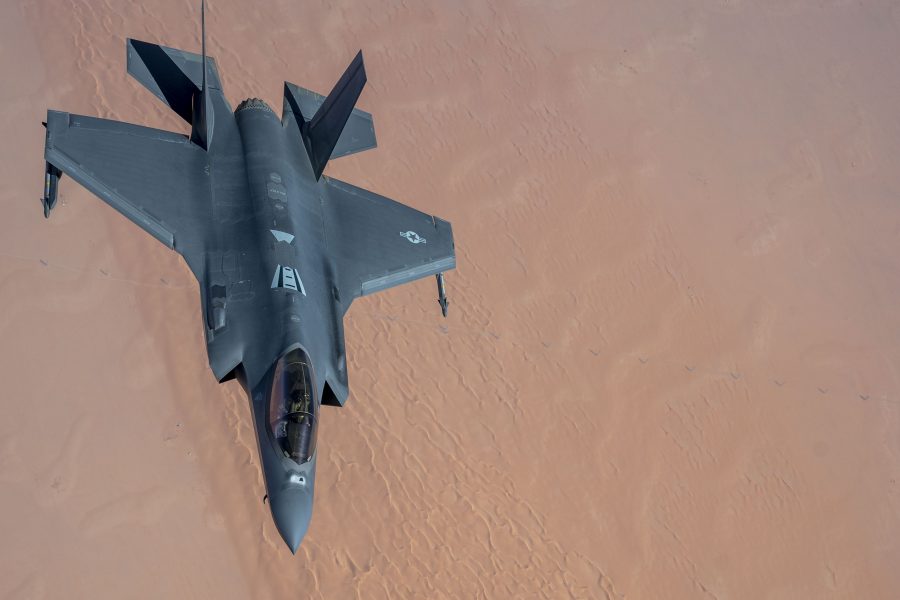
The U.S. continued to move a significant amount of airpower toward the Middle East in recent days as talks to forge a nuclear deal with Iran hung in the balance. Flight tracking data indicate there was unusually heavy movement of dozens of fighter jets and other assets that might be used in a strike against Iran.
The aircraft have been moved to bases in Europe and the Middle East. Some of them include the same types of aircraft that were involved in last June’s Operation Midnight Hammer strike on Iranian nuclear facilities, people familiar with the matter told Air & Space Forces Magazine.
U.S. Central Command, which oversees forces in the Middle East, declined to comment.
F-16 Fighting Falcons from Spangdahlem Air Base, Germany; Aviano Air Base, Italy; and McEntire Joint National Guard Base, S.C., were on the move from their home bases, according to air traffic control communications and flight-tracking data. More F-15E Strike Eagles from RAF Lakenheath, U.K., were also dispatched towards the Middle East.
F-22s from Joint Base Langley-Eustis, Va., arrived at Lakenheath on Feb. 17, imagery from local spotters, air traffic control communications, and flight tracking data show. Those aircraft took off earlier in the day and crossed the Atlantic using “TREND” callsigns, which are typically associated with deployments. Six aircraft crossed the Atlantic on Feb. 17, with more F-22s likely on their way in the coming days.
Lakenheath is a typical stopover point on the way to the Middle East for F-22s coming from the United States, in addition to housing its own aircraft. If they continued their onward journey to the Middle East, the F-22s would join a vast array of airpower already assembled in the region.
The U.S. has multiple squadrons of fifth-generation F-35 fighter jets in the region, in addition to F-15Es, A-10 Thunderbolt II attack aircraft, and other F-16s that were already in the Middle East.
Support aircraft, including intelligence and surveillance aircraft, have also been operating in the region. An RC-135 Rivet Joint signals intelligence aircraft, which has been flying missions from Al Udeid Air Base, Qatar, has relocated to the Greek island of Crete in the Mediterranean, a less vulnerable location. Another RC-135 is on its way to the island from Florida.
Multiple P-8 Poseidon maritime patrol aircraft have been flying missions in the Middle East, including one that was patrolling the Strait of Hormuz on Feb. 17, flight tracking data shows.
The deployments come as the Trump administration has demanded that Iran agree to a new nuclear accord that would prohibit uranium enrichment. Though Iran’s foreign minister said Feb. 17 that the “path for a deal has started,” no deal yet appears to be in the offing.
The deployments also come just a day after additional firepower headed toward the Middle East.
On Feb. 16, 18 F-35s from the 48th Fighter Wing from RAF Lakenheath, U.K., departed towards the region, accompanied by aerial refueling tankers. They would be joining 12 F-35As from the Vermont Air National Guard’s 158th Fighter Wing that deployed to the Middle East last week.
The F-22s that landed at Lakenheath from Langley come from the same unit that participated in the U.S. operation to seize Venezuelan President Nicolás Maduro last month as part of Operation Absolute Resolve—12 of the fighters deployed briefly to Puerto Rico after that mission before returning home to Virginia.
The last time F-22s from Langley were spotted arriving at RAF Lakenheath was in the lead-up to Operation Midnight Hammer in June 2025, in which seven B-2 Spirit bombers struck two Iranian nuclear sites at Fordow and Natanz, while an additional site at Isfahan was struck with Tomahawk cruise missiles.
The F-22 is America’s premier air-to-air fighter jet. While Iran has little air-to-air capability, F-22s have often been employed in the Middle East to lead strike aircraft that go in harm’s way. The F-22s protected strike aircraft during Operation Midnight Hammer, Chairman of Joint Chiefs of Staff Gen. Dan Caine told reporters after the mission.
F-22s have also led strike packages in Syria during the height of America’s air campaign against the Islamic State group to help protect the other aircraft and serve as a deterrent to Russian or Syrian aircraft when the regime of Bashar al-Assad was in power. Raptors have previously been dispatched to the region in recent years to combat the threat of Iranian drone and missile attacks on the U.S. forces and American partners in the region.
The F-35s from Vermont and the F-16s from Spangdahlem and the South Carolina Air National Guard are Wild Weasel units, which specialize in destroying enemy air defenses and acting as a decoy for strike aircraft, a role those aircraft types played in last year’s attacks on Iran. The 12 F-16s from the South Carolina ANG—the “Swamp Foxes”—landed at Lajes Field in the Azores, a Portuguese territory, on Feb. 17, imagery from local aircraft spotters shows.
The U.S. has also recently sent two E-3 Sentry AWACS airborne command and control aircraft to Europe, which landed at RAF Mildenhall on Feb. 17, imagery and flight tracking data show, with more E-3s on their way to Europe. Additional E-11 BACN airborne communications relay aircraft have deployed to the Middle East and to Europe, and over a dozen refueling aircraft were on their way to Europe on Feb. 17 and Feb. 18.
In addition to USAF aircraft, the USS Abraham Lincoln aircraft carrier and its strike group are in the Arabian Sea, with an embarked carrier air wing of F-35Cs, E/A-18 Super Hornet fighters, and EA-18 electronic attack aircraft.
It is set to be joined by USS Gerald R. Ford aircraft carrier, which supported U.S. operations against drug smuggling boats and the mission to capture Maduro, but has now been redirected from the Caribbean toward the Eastern Mediterranean. The Ford has now left U.S. Southern Command’s area of responsibility and is in the Atlantic, U.S. officials said Feb. 17. The Ford has embarked F/A-18s and EA-18s. Both carriers are accompanied by warships that can defend against ballistic missiles and carry Tomahawk cruise missiles.