
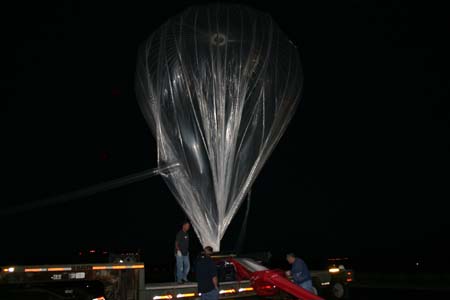
 Operational since the 1940s, the Air Force’s high-altitude balloon program still plays an important role in evaluating scientific experiments. “We’re able to fly payloads for several hours to a few days in the stratosphere to test them in an environment similar to space,” said Maj. Kenyon Orme, the program’s manager in the Air Force Research Lab’s space vehicles directorate at Kirtland AFB, N.M. He added, “We can do it for less money than a space launch would cost and we have the added advantage of returning the hardware to the customer.” In the past two years, there have been more than 10 missions from municipal airports in Holbrook, Ariz., and Belen and Santa Rosa, N.M. In late September, for example, program officials staged two test flights of FAA’s Automatic Dependent Surveillance-Broadcast payload. The next flights are tentatively scheduled for 2011. (Kirtland report by Michael P. Kleiman)
A combined Navy and Air Force program is seeking to build a smaller version of a ubiquitous air-to-air missile that could give advanced aircraft, such as the Collaborative Combat Aircraft, greater magazine depth in a high-end fight.