


The 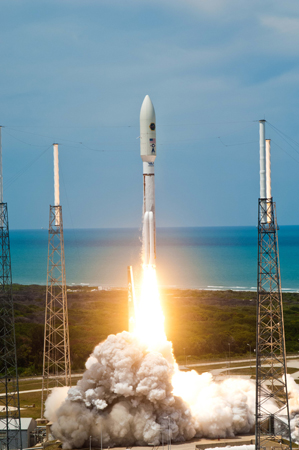 Air Force and its industry partners successfully launched the second Advanced Extremely High Frequency satellite into orbit from Cape Canaveral AFS, Fla. A United Launch Alliance Atlas V rocket carried the sophisticated, Lockheed Martin-built military communications satellite into space on May 4. “We applaud the teamwork between our wing and all our mission partners involved in making this mission a success,” said Brig. Gen. Anthony Cotton, 45th SW commander at Patrick AFB, Fla., who served as the launch decision authority. The satellite, which joins AEHF-1 on orbit, will undergo approximately 110 days of orbit-raising operations followed by approximately 120 days of on-orbit testing, stated officials with the Space and Missile Systems Center at Los Angeles AFB, Calif., in a release. “Each AEHF spacecraft will provide warfighters much improved protected communications capabilities,” said Col. Michael Sarchet, AEHF program manager. The satellite will improve user data rates “five-fold,” permitting transmission of tactical communications including real-time video, battlefield maps, and targeting data, said Lockheed Martin in a release. “AEHF is integral to our national security architecture,” said Kevin Bilger, general manager of the company’s Global Communications Systems. (Includes Cape Canaveral report by Chris Calkins)
The top Air Force commander on on the Japanese island of Okinawa has clamped down alcohol and issued a curfew for junior enlisted Airmen and Guardians at Kadena Air Base for the next month. The order came roughly two weeks after a U.S. Marine was arrested for allegedly robbing and…