
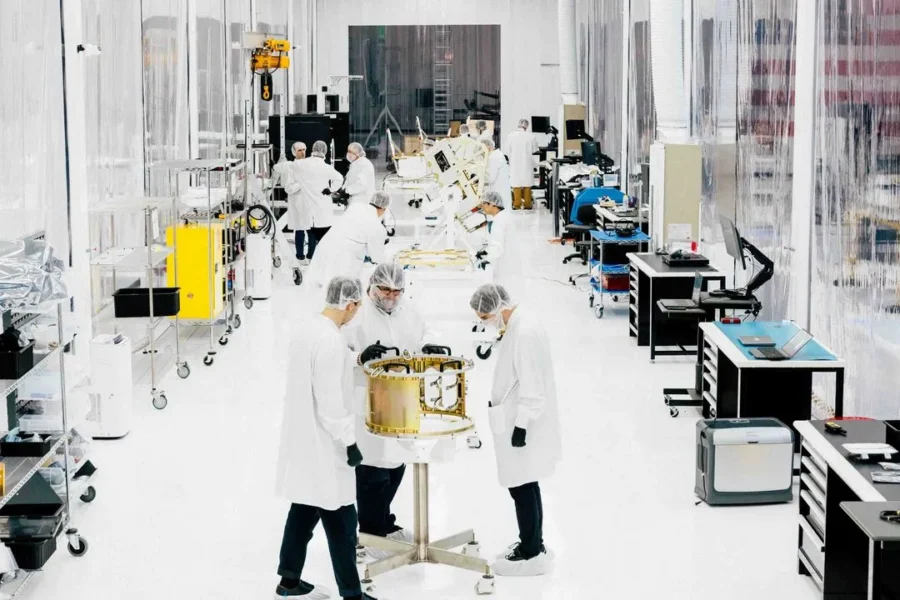
The Pentagon is moving forward with plans to invest in manufacturing capacity for the space industrial base, awarding multiple contracts in recent weeks to companies who supply key space components and subsystems as well as firms with innovative manufacturing technology that’s ready to scale.
The Defense Innovation Unit, a Pentagon technology hub designed to help funnel promising commercial capabilities to the military at scale, awarded other transaction agreements in July and August to two companies through its Adaptive Space Manufacturing and Integration Scale project. The effort aims to leverage commercially available tools and adaptive manufacturing processes to kick-start higher production rates across the space industrial base.
ALL.SPACE, a firm owned by York Space Systems, was one of those recipients. The company said in an Aug. 31 statement that it will demonstrate on-demand production of its Hydra satellite communications terminal with the goal of producing hundreds of units per month and potentially thousands per year.
“This award reflects a fundamental shift in how defense capabilities are being fielded,” ALL.SPACE Chief Operating Officer Rod McCurdy said in a statement. “Hydra was designed to deliver resilient connectivity across multiple networks and orbits, and this effort provides an opportunity to demonstrate how those capabilities can be delivered at the pace required by next-generation space and defense architectures.”
A second company, Freeform Future Corp., received a contract in July to scale its production of key propulsion and structural hardware. Earlier this year, the company unveiled a laser-based additive manufacturing platform called Skyfall, which it says will significantly expand its production.
Separate from the DIU awards, the Pentagon announced Sept. 1 it would invest $11.4 million in Stellant Systems, a company that makes vacuum tubes that can amplify certain radio frequency signals. In a statement, the Pentagon said it would use Defense Production Act funds to support qualification of the company’s space-based amplifier and to boost production rates, which it says “will greatly reduce schedule, cost, and performance risks to U.S. government satellite programs.”
The Space Force is preparing for a sizable increase in the number of satellites it operates. Deputy Chief of Space Operations for strategy, plans, programs, and requirements Gen. David N. Miller Jr. said in May that the service’s five-year budget projection includes “thousands” of satellites. Those will fall across a number of mission areas, including space-based moving target indication, data transport, missile warning, and space domain awareness.
In May, the Space Force awarded more than $4 billion to SpaceX to build out a new Space-Based Air Moving Target Indicator constellation and another $2.3 billion contract to field satellites as part of its Space Data Network program. It’s also planning to launch new fleets of surveillance and reconnaissance satellites starting in 2029. The service hasn’t said how many spacecraft these constellations will include, but officials have said hitting these numbers will require significant expansion of current production capacity.
“If a company is nominally making 10, we want you to be prepared to make 40,” Space Systems Command Commander Lt. Gen. Philip Garrant said in April. “We want industry to make the investments in capitalization and facilitization, and in return you’re going to get these large production contracts.”
Air Force Secretary Troy Meink has said he’s interested in awarding multiyear procurement contracts for both aircraft and satellites. He told Air & Space Forces Magazine in July the goal is to give industry the demand signal it needs to make investments in its manufacturing capacity.
“When the future is uncertain, it’s hard for industry to make those investments to either modernize their facilities or do what they need to do to get to the production capacity we need,” Meink said. “So those long-term deals are a huge part of that.”
