
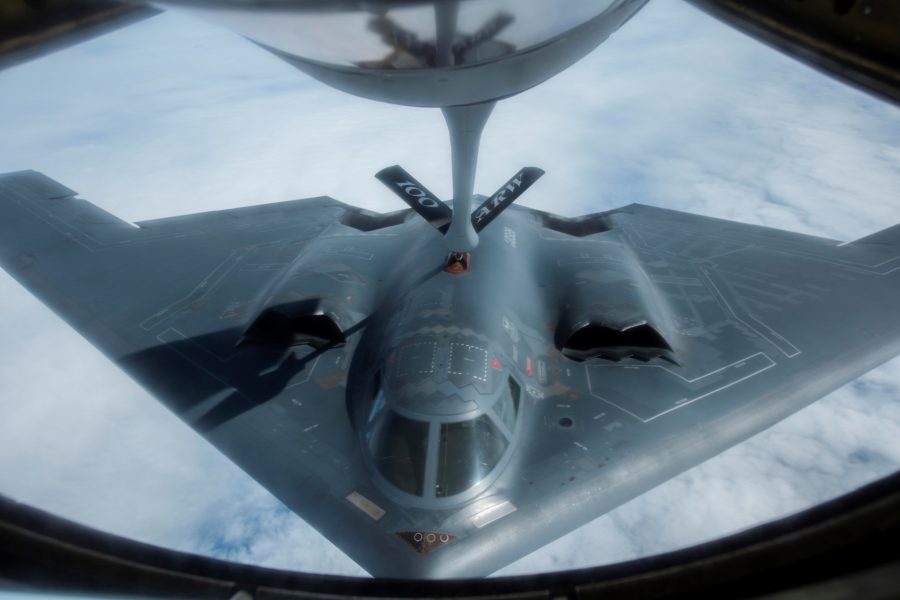
Air Force leaders hail recent strike missions like Midnight Hammer as a shining example of operational readiness, but that success also highlights the challenges ahead should USAF need to mount an extended long-range strike campaign.
Midnight Hammer employed 125 aircraft, including B-2 Spirit bombers, numerous refueling tankers as well as F-35 Lighting IIs, F-22 Raptors, F-15s, and F-16 Fighting Falcons. Just six months later, Air Force B-1B Lancer bombers, F-35s, F-22s, tankers, and other aircraft joined Operation Absolute Resolve, the successful capture of Venezuela’s former president, Nicolás Maduro and his wife.
“Operation Midnight Hammer, Absolute Resolve—that is a definition of readiness,” said Director of Staff Lt. Gen. Scott L. Pleus Jan. 29 at the Airpower Forum, hosted by AFA’s Mitchell Institute for Aerospace Studies. “We do things in the United States Air Force that no other country can do.”
The lessons of those operations will inform investment, training, and planning decisions for years to come, affecting aircraft and munitions requirements, fleet size decisions, and more. The Air Force once planned to buy 100 B-2s and perhaps 400 B-1s. But when the Cold War ended, those plans were seriously truncated.
Lt. Gen. Jason R. Armagost, deputy commander of Air Force Global Strike Command and Air Forces Strategic-Air at U.S. Strategic Command, said those requirements go beyond how many B-21 Raiders buys, a figure currently set at 100 Raiders but which some have called to increase to as many as double. The Air Force tanker fleet, he said, is no less critical to pulling off sustained bombing campaigns.
“The first thing I worry about when something like a Midnight Hammer starts to take shape is what does the tanker force looking like, what’s the position of it, and how do we posture in the world to actually do this,” Armagost said. “It’s not an easy thing.”
Midnight Hammer’s 36-hour, roundtrip bomber route took seven B-2s from Whiteman Air Force Base, Mo., to Iran and back, a trip in excess of 12,000 nautical miles. That required a massive tanker bridge, with aircraft positioned at key points all the way to refuel bombers en route to the target and back. Today’s tanker fleet numbers about 500, of which about 375 are KC-135 Stratotankers that average over 63 years old.
Maj. Claire Randolph, chief of Weapons and Tactics at Air Forces Central and one of the planners for the operations, said that’s a major concern for planners like her.
“I worry a lot about the tankers,” she said. “I think—because it’s not sexy, it’s not a weapon, and it’s not a fighter and it’s not a bomber—the tankers are often really left out in this conversation.”
That’s got Randolph “very concerned” over a serious limiting factor for operations. “If I were writing our request list for procuring things,” she said, “probably the first 100 things on the list would be tankers.”
The Air Force continues to buy KC-46 tankers and decided last July that it would forgo a competition for a so-called bridge tanker between the Pegasus and a future tanker and buy more of KC-46s instead. The service is also looking ahead to an entirely new capability, seeking industry ideas for the Next-Generation Air Refueling System, which potentially could be uncrewed.
Boeing’s MQ-25 Stingray, an uncrewed tanker developed for the Navy, is undergoing taxi tests and could pave the way for a future Air Force capability. But the size, capacity, range, and speed of the MQ-25 falls far short of what Air Force requirements would be, and would have to be scaled up extensively to match USAF requirements.
Munitions Flexibility
Munitions present another challenge highlighted by operations like Midnight Hammer. Randolph said future operations will likely need munitions that can penetrate deeper to destroy facilities buried even further underground.
For Midnight Hammer, seven B-2s dropped 14 GBU-57 Massive Ordnance Penetrators, the world’s largest air-delivered bomb. The “MOP” includes 5,740-pound warhead encased in steel and fused to blow up an estimated 200 feet underground. The weapon was purpose-built and designed for that application, but North Korea and other potential adversaries have long been known to bury facilities deep underground as a means of protection. While the exact number purchased was never divulged, public records suggest as few as 20 were purchased.
Munitions for “hard, deeply buried targets are critical,” Randolph said. “If our adversaries are learning anything from our operations, they’re starting to put more things underground, and the Earth is a pretty difficult thing to penetrate.”
More options for stand-off weapons to destroy both mobile and stationary targets on the Earth’s surface are also needed. The B-2 was configured in the early to carry up to 80 500-pound Joint Direct Attack Munition, or JDAMS; at the time, no one saw the utility in enabling it to carry up to 240 GBU-39 Small Diameter Bombs I, or SDBs, even though those weapons reached initial operating capability in 2006, Armagost said.
“I don’t think anybody at the time was envisioning why you would ever need to carry more of something [than] for 80 targets,” he said. “But now, if you can take that a step further and think about what you could do with 240 SDBs—they are starting to talk about what we’re actually designing into future systems, which is smaller, modular capabilities that are form-fit to actually have a range and capability from a platform host. Because you can do different things with penetrating platforms and general purpose weapons or smaller weapons that you can’t do just based on the physics of fly out for standoff runs.”
Engaging moving surface targets using standoff munitions is more challenging, because those weapons need to be able to travel greater distances on their own power. There are limited options between a JDAMs and an AGM-158 Joint Air-to-Surface Standoff Missile, Randolph said. The maximum travel range for a JDAM is about 40 miles and the SDB II—the newer, GBU-53 StormBreaker developed for striking moving targets— has a range of 46 miles. By contrast, the JASSM can attack targets from more than 500 miles away.
“We don’t have a lot of things that fit in well there, which is a huge problem,” Randolph said.
“Surface mobile targets are really difficult, because you can’t just use 240 SDBs to go kill a bunch of [surface-to-air missiles] if you don’t know where they are or if that weapon is slow and easily detected and shut down by adversaries.”
Armagost said possessing a range of standoff and penetrating munitions would increase the Air Force’s deterrent capability.
“You have to have proof you can gain access to hold any target at risk, keep it at risk, and then carry out orders that provide options that can happen from standoff and can happen from penetrating,” Armogost said. “But in combination, those things are incredibly powerful.”